

Early Afternoon, Sunday, February 16, 2025, Miami, Florida
It’s early afternoon here in sunny South Florida, and I’m sitting at my desk, pondering how I will spend this lovely Sunday. The weather feels like early summer rather than late winter with the temperature already at 83°F (29°C) under mostly sunny skies. The “feels-like” temperature is even higher at 85°F (29°C), and according to the forecast, it’s expected to reach a toasty 85°F by midafternoon.

Meanwhile, up in Madison’s Eidelweiss District, New Hampshire, where I spent nearly a year from mid-December 2023 to mid-October 2024, it’s a completely different story. As I lounge here in the warmth, it’s currently snowing up there. I haven’t checked the radar to see if it’s just a light dusting or a full-blown snowstorm, but one thing’s for sure – it’s cold! The thermometer reads a frigid 20°F (-9°C). Talk about a contrast!
A Saturday of Leisure

Though I have a strong urge to wrap up Reunion: Coda sooner rather than later, I know weekends are meant for a bit of R&R—to recharge the creative batteries. Stephen King’s advice on time management is something I try to follow to the letter, especially when balancing work, family, and self-care. In his book On Writing: A Memoir of the Craft, King mentions he writes for about four hours a day, five days a week, aiming for a 2,000-word daily goal. Once he hits his mark, he steps out of his writing cave and dives into day-to-day life—spending time with family, tackling everyday chores, and just being a regular person. As King himself puts it, “Life isn’t a support system for art. It’s the other way around.”
So, even though my novel is never far from my mind, I didn’t work on it yesterday. Instead, I spent most of my Saturday watching YouTube videos, reading Jim Rasenberger’s The Brilliant Disaster: JFK, Castro, and America’s Doomed Invasion of Cuba’s Bay of Pigs, and trying out a few scenarios in Sea Power: Naval Combat in the Missile Age.
Missiles, Bombs, and Wayward Warships
I say “trying” because I bought Sea Power in November when Triassic Games and MicroProse released the much-anticipated naval wargame in Early Access. Instead of waiting a few months for the developers to reduce bugs, add a dynamic campaign, and include more classes of ships, aircraft, and weapons systems from the Cold War era (1961-1990), I bought it on Day One of its release. The game is fascinating, but it’s clear that it’s still a work in progress.
First, I tried to play the scenario Hormuz, which is loosely based on Operation Earnest Will, a U.S. military operation from July 24, 1987, to September 26, 1988, to protect Kuwaiti-owned tankers in the Persian Gulf during the height of the Iran-Iraq War.
In this scenario, players command a three-ship surface action group (SAG) composed of the Belknap-class cruiser USS Fox (CG-33), the Kidd-class destroyer USS Kidd (DDG-993), and the Oliver Hazard Perry-class frigate USS Crommelin (FFG-37), along with two civilian tankers, MV Bridgeton and MV Gas Prince. According to the mission briefing, the Iranians have closed the Straits of Hormuz, and this small convoy must make the transit from the Gulf of Aden to the Persian Gulf, even if Iranian warships, aircraft, and shore-based missile batteries use force to prevent its safe passage.
I’ve played through this scenario a few times. It has a difficulty rating of two out of five stars, so it is not the hardest mission in Sea Power (two Hormuz variants are much harder). It presents armchair captains with potential attacks by regular Iranian Navy warships, Revolutionary Guard Boghammar fast boats, and air attacks by fixed-wing jets and missile-armed helicopters. The only threats missing from Hormuz are submarines, and that’s because Iran didn’t have any subs in service at the time.


Because the scenario doesn’t require the convoy to travel from the Gulf of Aden to the oil terminals near Basra in pre-Desert Storm Iraq, Hormuz is one of the shorter and less challenging scenarios in Sea Power, ideal for players new to the game or naval war games in general. The convoy’s course is pre-set at the start of the mission, and the safe zone that the player’s ships must reach for a total victory is relatively close to the starting point in the Gulf of Aden. Thus, I’ve successfully completed the Hormuz scenario three times since purchasing Sea Power in November.
However, yesterday was not one of those times.
During several playthroughs of this mission, I’ve noticed that ever since Triassic Games rolled out some patches between December 24, 2024, and January 22, my SAG’s warships, especially Kidd and Crommelin, don’t stay in formation or maintain the convoy’s speed limit of 15 knots once the player detects the Iranians and hostilities begin. It doesn’t matter which side fires first, but whenever missiles are detected and the radio call “Vampire! Vampire! Vampire!” goes out over the airwaves, those two ships leave the formation and increase speed without the SAG commander’s permission. For context, “Vampire” is the NATO brevity code for an inbound anti-ship missile, signifying an immediate and severe threat to naval vessels.

I’m not sure if it’s a bug in the game or if it’s my seamanship, but once the convoy’s positional scheme is disrupted, it’s almost impossible to get the ships to rejoin the formation and stay in their assigned stations. The game designers did include a collision avoidance protocol to the ships’ navigational AI, but I lost Kidd in one playthrough of Hormuz when the “Ayatollah-class” destroyer collided with MV Bridgeton while making the transit from the Gulf of Aden into the Strait of Hormuz during an Iranian Harpoon missile attack. The resulting embarrassment of losing a multi-million-dollar warship was palpable.
(The Kidd-class destroyers, sometimes referred to as the “Ayatollah class,” were originally ordered by the Shah of Iran before the 1979 Iranian Revolution. After the revolution, the order was canceled, and the vessels were acquired by the U.S. Navy. They earned the nickname “Dead Admirals class” because they were named after U.S. Navy admirals who had died in combat or as a result of heroic actions. This unique history and their superior combat capabilities set them apart from other destroyers in the fleet.)
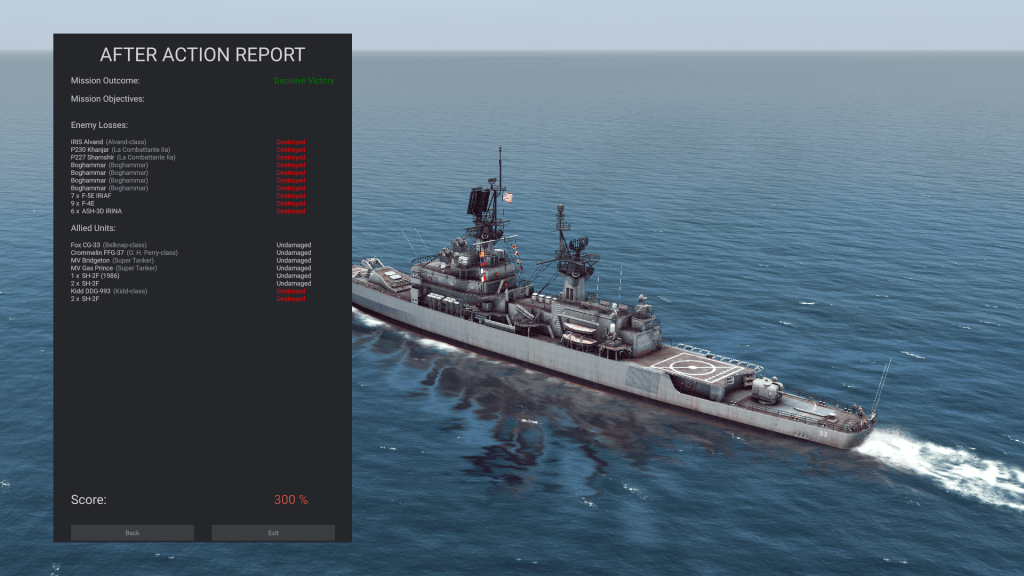
I’ve successfully completed the Hormuz scenario without losing any ships, either to enemy attacks or unpredictable maneuvers by American warships, a few times. However, ever since the January 22 patch, it has become trickier to keep the convoy together. While there haven’t been any more ship-to-ship collisions, it appears that whenever Kidd or Crommelin maneuver to unmask their guns or missile launchers during combat, they speed up and veer off course like rebellious teenagers. No amount of clicking on the Join Formation command seems to persuade them back into position.

So, even though I attempted to navigate this scenario twice yesterday afternoon, I eventually threw in the towel. Trying to corral my wandering warships through the Strait of Hormuz felt like herding cats. Instead, I decided to dive into a good read about the Bay of Pigs fiasco.
Because herding wayward warships through the Strait of Hormuz was frustrating, Sea Power didn’t end up being my Saturday’s leisure activity. Thankfully, I was a reader before I was a gamer. Today, I think I’ll take a break from gaming. After all, navigating unpredictable ships can be as mentally taxing as laboring over the chapters of a novel. Instead, I decided to try other leisure activities to unwind and recharge.
 A Certain Point of View, Too
Comments
One response to “A Writer’s Warm Sunday in Miami”
I don’t play games but I remember the Strait of Hormuz. It was when I came over to the US as a University level exchange student. That was August of 1987. A nice Sunday is a good day to relax.
LikeLiked by 1 person