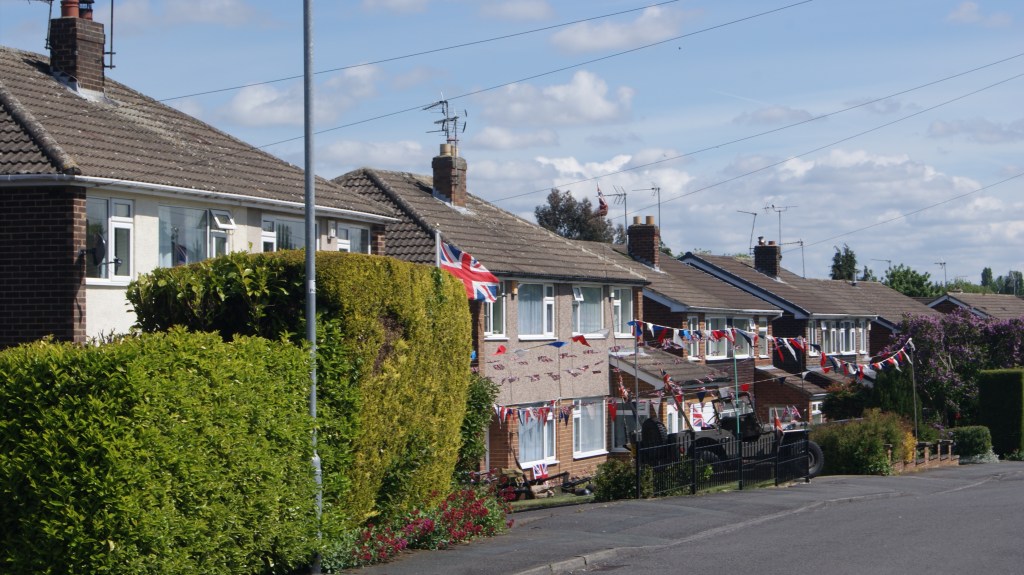

Late Morning, Thursday, May 8, 2025, Miami, Florida
The German High Command will at once issue orders to all German military, naval and air authorities and to all forces under German control to cease active operations at 23.01 hours Central European time on 8 May 1945… – German Instrument of Surrender, Article 2
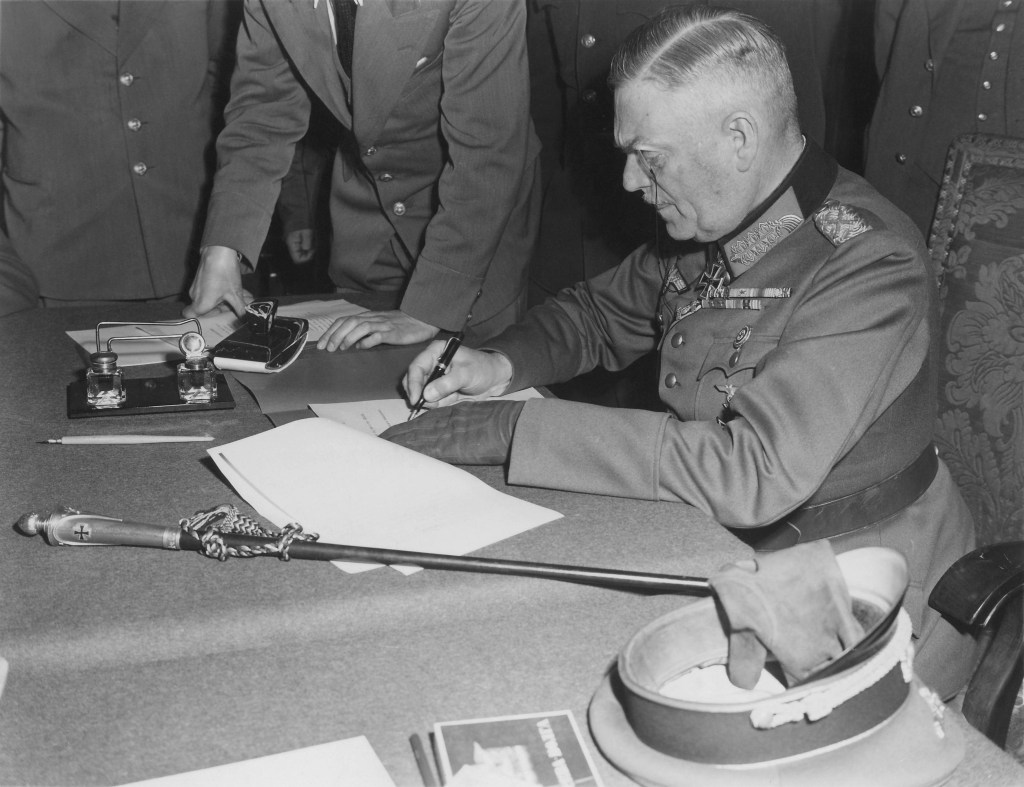
Eighty years ago today, in a Berlin suburb called Karlshorst, the senior leadership of the German High Command signed documents that marked their unconditional surrender to the Allied powers—France, Great Britain, the Union of Soviet Socialist Republics, and the United States—thus ending the European phase of World War II.
By then, Adolf Hitler was dead, having committed suicide along with his wife of one day, Eva Braun, in an underground bunker at the Reich Chancellery on April 30. In a grim final Nazi ritual, their bodies were cremated even as Soviet artillery shells landed nearby. Many of Hitler’s top associates, like Propaganda Minister Joseph Goebbels and SS Reichsführer Heinrich Himmler, had also taken their own lives. Others, like the disgraced former leader of the Luftwaffe, Reichsmarschall Hermann Göring, were either under arrest by the Western Allies or, in the case of Admiral Karl Dönitz—Hitler’s chosen successor, cloistered in Flensburg, the capital of a rapidly disintegrating rump state that had less than a month left before the Allies ordered its dissolution.

The surrender ceremony in Karlshorst on May 8, 1945, is the one that many countries, including the United States, commemorate as Victory in Europe (VE) Day. This wasn’t the first surrender signing; there had been an earlier one at General Dwight D. Eisenhower’s Supreme Headquarters, Allied Expeditionary Force (SHAEF) in Reims, France, on the morning of May 7. However, Soviet dictator Joseph Stalin protested that the Russian liaison to SHAEF, General Ivan Susloparov, had not been authorized by Moscow to sign the surrender document, demanding that the “official” surrender occur in Berlin, the former “lair of the fascist beast.”
Stalin could have accepted the Reims ceremony, but he understood the propaganda value of having the German High Command sign the German Instrument of Surrender in the ruins of Berlin. It was a powerful symbol to show the world, and especially the defeated German people, that the Nazi dream of dominating Europe and creating a “thousand-year Reich” built on racial superiority had ended in total, undeniable disaster.
The Western Allies, led by President Harry S. Truman and Prime Minister Winston S. Churchill, recognized the importance of this act as well. They knew one of Nazi Germany’s “creation myths” was that the German Empire had not lost World War I on the battlefield but had been “stabbed in the back” by politicians, Communists, and Jews at home. In reality, Germany had been beaten on the Western Front in 1918, and if the conflict had continued into 1919, the Allies would have advanced into German territory—a sign of total defeat that no rational German citizen could deny.
However, because the Allies allowed the German Army to leave France and Belgium in “good order” and return home, nationalists, monarchists, and far-right factions could push the “stab in the back” myth—a myth Adolf Hitler used to gain power by promising to make Germany great again.
Despite the Alliance against Nazi Germany fraying and early signs of the Cold War emerging, Truman and Churchill did not protest Stalin’s demand for a second surrender ceremony in Berlin. The Red Army had borne the brunt of the war against the Nazis from June 1941 to May 1945, with an estimated three-fourths of German personnel killed in action falling on the Eastern Front. Moreover, the Soviet Union lost over 25 million citizens in the war—a loss of population that continues to affect post-Soviet Russia.
In many European countries that were combatants in World War II, Victory in Europe (VE) Day is still officially observed on May 8. In Russia, the successor state to the one that insisted on a second surrender ceremony rather than accepting the Reims agreement, the official celebration is held on May 9 as Victory Day.


Comments
12 responses to “VE Day 1945 Plus 80 Years”
Always enjoy reading history related posts although a little saddened that not too much has changed since then and fascism is still very much a threat.
LikeLiked by 1 person
Unfortunately, the world we live in today (2025) is still feeling the effects of World War I (the other global cataclysm of the 20th Century. That war unleashed most of the nastiness that led to WWII, which segued into the Cold War rather quickly. Nationalism, tribal rivalries, the climate crisis, and the perennial struggle between those who seek progress and those who fear it…it’s a never-ending cycle, I fear.
Man, I sound like Jim Garraty now, don’t I? 😉
LikeLiked by 1 person
You do but that’s not a bad thing 😅
LikeLiked by 1 person
That, Pooj, is a reassuring comment. It means you like Jim Garraty as a character. 🙂
LikeLiked by 1 person
Haha yes I do, he’s relatable for me at least.
LikeLiked by 1 person
As a first-time novelist, I’m glad to know you can relate to Jim!
(It really does make me feel better about the novel. I know not everyone will like it; especially those readers unlucky enough to get the print version with the typos and errors.)
LikeLiked by 1 person
That’s fair but not everyone will like the book regardless, even if it was perfect. You just have to appreciate those that do and move on with the rest.
LikeLiked by 1 person
Oh, I know that I’m going to get lukewarm ratings and reviews that will point out flaws of omission or commission. I had a few of those with Book 1; no doubt I’ll get them with Reunion: Coda.
I’m still proud of my novel, and I hope you enjoy it as much as you did the first book in the duology.
LikeLiked by 1 person
So far, I’m really enjoying it.
LikeLiked by 1 person
I’m happy to know this!
LikeLiked by 1 person
It was very interesting reading. My wife and I just had a French class and our French teacher talked about VE Day. It is also our daughter’s birthday. I should have read your article before French class so I’ve had known more about it.
LikeLiked by 1 person
Thanks, Thomas. It’s nice to know that readers get something out of my rare posts about history.
LikeLike