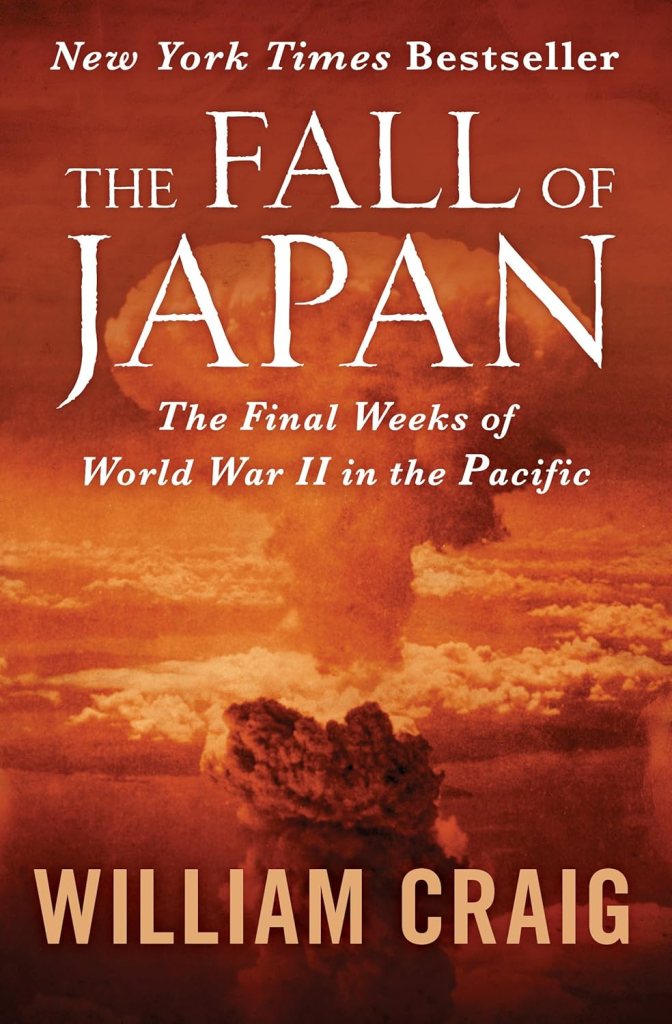
The Fall of Japan: The Final Weeks of World War II in the Pacific
Kindle Edition
By: William Craig
Publisher (Original): The Dial Press
Publisher (Kindle Edition): Open Road Media
Year of Publication: Original (1967); Kindle Edition (2015)
Amazon’s Publisher’s Description
New York Times Bestseller: A “virtually faultless” account of the last weeks of WWII in the Pacific from both Japanese and American perspectives (The New York Times Book Review).
By midsummer 1945, Japan had long since lost the war in the Pacific. The people were not told the truth—and neither was the emperor. Japanese generals, admirals, and statesmen knew, but only a handful were willing to accept defeat. Most were bent on fighting the Allies until the last Japanese soldier died and the last city burned to the ground.
Exhaustively researched and vividly told, The Fall of Japan masterfully chronicles the dramatic events that ended the Pacific War and forced a once-mighty military nation to surrender unconditionally.
From the ferocious fighting on Okinawa to the all-but-impossible mission to drop the second atomic bomb, and from Franklin D. Roosevelt’s White House to the Tokyo bunker where tearful leaders first revealed the truth to the emperor, William Craig captures the pivotal events of the war with spellbinding authority.
The book vividly portrays both celebrated and lesser-known figures, including Admiral Takijiro Onishi—the brash commander who devised the Yamamoto plan for Pearl Harbor and inspired the kamikaze death cult. This astonishing account ranks alongside Cornelius Ryan’s The Longest Day and John Toland’s The Rising Sun as a masterpiece of World War II history.
My Take
I’ve been passionate about World War II for most of my life. My interest began in 1969, when I was just six years old. Despite my limited understanding of the war’s complex social and political dimensions, I was an advanced reader for my age. My introduction to D-Day (June 6, 1944) came from a condensed version of Cornelius Ryan’s The Longest Day in an old Reader’s Digest at my grandparents’ home in Bogotá, Colombia. That pivotal moment shaped not only the lives of those who lived through it but the world we inhabit today.
Since then, I’ve read hundreds of books exploring a wide range of topics—from Hitler’s rise and the Greater German Reich to the Allied victories in Europe and the Pacific, as well as the strategic schism between Western Allies and the Soviet Union that led to the Cold War.
Like many WWII buffs, I’m more familiar with the war in North Africa, the Mediterranean, and Northwest Europe than the Asia-Pacific theater. The war against Hitler tends to dominate mass media—whether in nonfiction publishing or Hollywood’s dramatizations of Allied heroics against the Nazis.
That said, I don’t neglect the Pacific Theater. I own several books on Pearl Harbor, Midway, and Guadalcanal, as well as Ian Toll’s excellent trilogy. While living in Madison, New Hampshire, I often discussed this aspect of the war with a fellow tenant named Stuart, whose father served on Okinawa as an Army Air Force enlisted man.
My deepest fascination lies with the final phase of the Asia-Pacific War in summer 1945. Unlike the contentious Allied “race for Berlin,” there was no parallel competition for Tokyo. Instead, the closing days of the war were shaped by Truman’s controversial decision to deploy atomic bombs on Hiroshima and Nagasaki.
William Craig’s The Fall of Japan is one of the earliest attempts to chronicle the final weeks of the Pacific War. Published in 1967, it covers the aftermath of Okinawa, General Curtis E. LeMay’s relentless B-29 firebombing campaign, and the sharp divide among Japanese leaders over surrender.
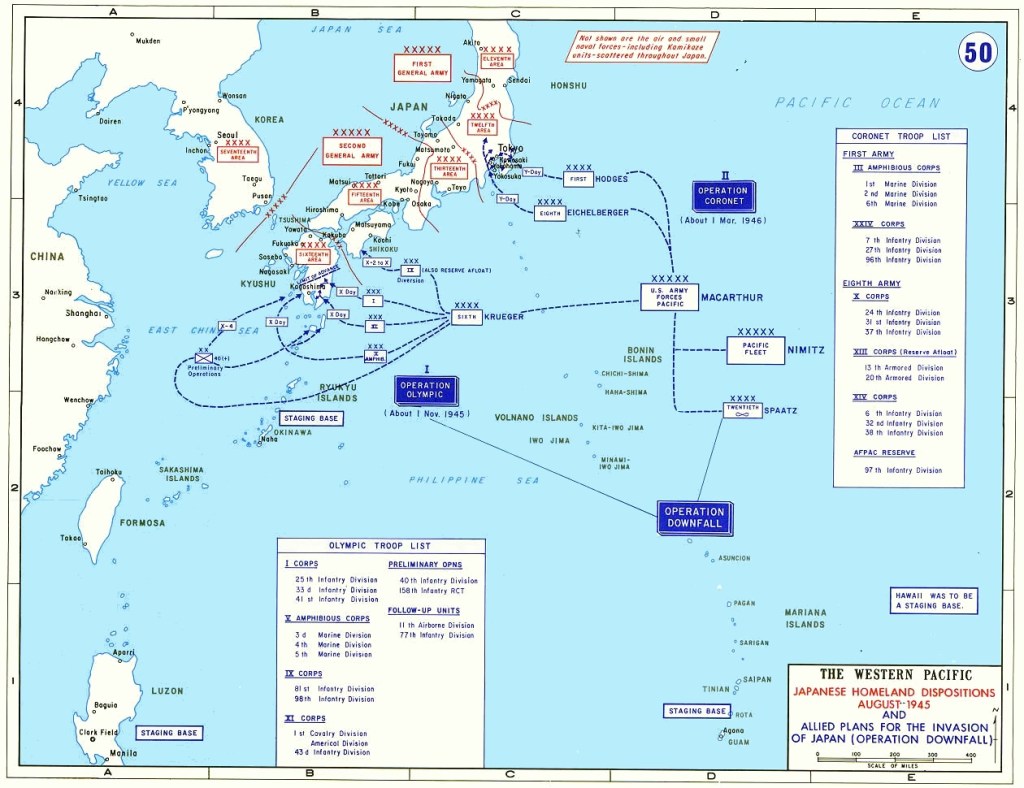
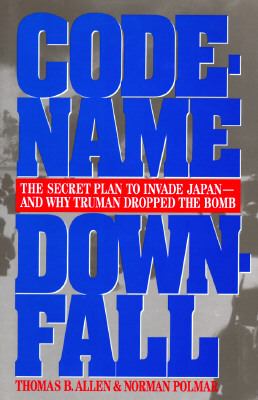
Although I’ve read speculative fiction and historical analyses of Operation Downfall—the proposed two-phase invasion of Japan—Craig’s book offers a foundational look at why Japan ultimately accepted the Potsdam Declaration in mid-August 1945. Reading it with the understanding that it predates the 1974 declassification of the Ultra secret adds valuable context.
Craig opens with a sweeping summary of the Pacific conflict—from Pearl Harbor through the liberation of the Philippines in late 1944 and early 1945. He devotes limited space to Operation Downfall’s Olympic and Coronet phases, referencing them mostly in the context of Truman’s atomic bomb decisions and the Trinity test.
One noteworthy post-Hiroshima exchange between Emperor Hirohito and War Minister General Anami touches on Japan’s defensive unpreparedness—plans expected by June 1945 wouldn’t be ready until September. The book also mentions the sinking of the USS Indianapolis, though somewhat incidentally, as part of a broader effort to persuade Japan to surrender amid mixed signals concerning Hirohito’s postwar status.
Craig emphasizes the deep split within Japan’s leadership. The Supreme War Ruling Council, or “The Big Six,” was evenly divided between surrender advocates and hardline “bitter enders.” He devotes considerable attention to their motivations, dismantling the myth that Japan would have capitulated without invasion or nuclear intervention.
While The Fall of Japan is an admirable debut, it has flaws. Some are tied to its era, like the absence of Ultra intelligence revelations, which later works could incorporate. Craig couldn’t access Allied signals intelligence, so readers don’t learn how Washington, London, or Moscow accurately gauged Tokyo’s intentions after the Potsdam Declaration.
The book also glosses over Japan’s preparations for an American invasion of Kyushu, and it doesn’t explore General MacArthur’s push for Soviet involvement in Manchuria to prevent reinforcements from reaching the Japanese home islands.
And then there’s the curious matter of Curtis LeMay’s name. In the Kindle edition, he’s repeatedly referred to as “Curtis Lemay”—a distracting typographical error. At first, I assumed it was a one-off mistake, but it recurs consistently. Since I haven’t read the original 1967 edition, I wonder: Did Craig himself misspell LeMay’s name, or did Open Road Media’s 2015 reissue suffer from lax editorial standards?
While The Fall of Japan is a compelling and accessible primer on the final days of the Pacific War, readers should keep in mind that it reflects the historical limitations of its time. I recommend it to anyone seeking a well-paced narrative written before the declassification of crucial wartime intelligence. That said, there are more comprehensive and nuanced accounts available today, such as Richard B. Frank’s Downfall: The End of the Imperial Japanese Empire and Ian W. Toll’s Twilight of the Gods. These newer works benefit from decades of additional scholarship and offer deeper insight into the strategic, political, and human dimensions of Japan’s surrender.
 A Certain Point of View, Too
Comments
2 responses to “Book Review: ‘The Fall of Japan: The Final Weeks of World War II in the Pacific”
I confess to having had this book for about 20 years, and I’ve never opened it (admittedly, I’m one of those people who’s book acquisition rate far outpaces my available time to read). This review is a pretty good argument to get it on the to-do list.
–Scott
LikeLiked by 1 person
As a reader, writer, and copy editor, I hope that your edition doesn’t have the editorial flaws that, minor as they might seem, exist in the Open Road Media reissue. If you purchased your copy circa 2005 in print format, there’s a chance that the “Lemay” thing might not be there. (The pre-1974 era limitations about Allied codebreaking will, unfortunately, still be there.)
Overall, Craig’s book is decent, but later books about the end of the war in the Asia-Pacific theater are better.
LikeLike