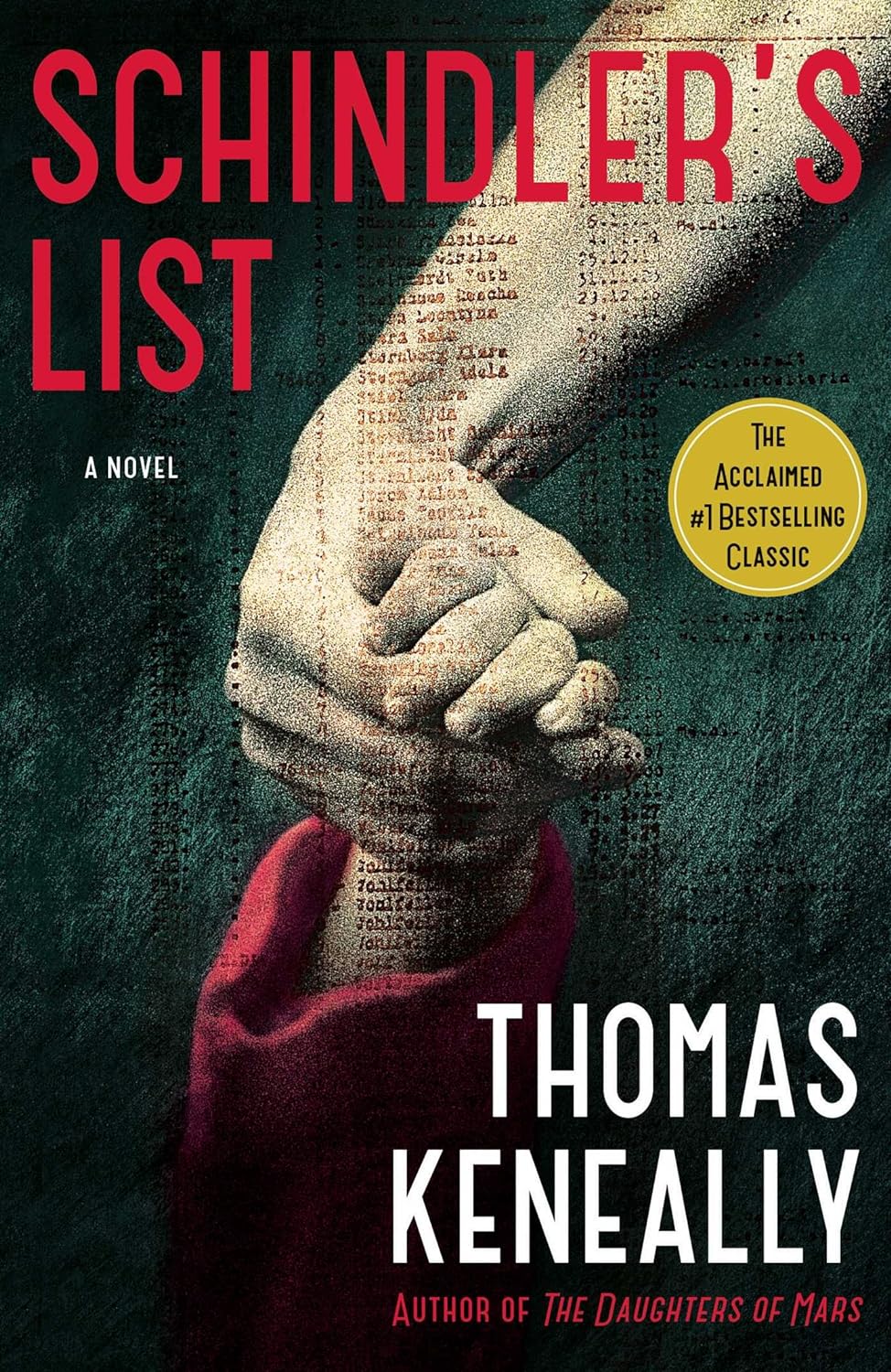
Schindler’s List (1993 Reissue)
Author: Thomas Kenneally
Publisher: Atria Books
Year of Publication: 1982 (First Edition); 1993 (Movie Tie-In Reissue)
Schindler’s List: Thomas Keneally’s haunting and unforgettable account of one man’s moral awakening amidst the unfathomable cruelty of the Holocaust remains one of the most compelling historical narratives of the 20th century.
Published in 1982, Keneally’s “non-fiction novel” follows the arc of Oskar Schindler—a Sudeten German war profiteer whose early pursuit of wealth and indulgence in Nazi-occupied Poland evolved into a courageous mission to save lives. Through charm, cunning, and considerable personal fortune, Schindler defied the machinery of genocide, ultimately rescuing around 1,200 Jews from extermination.

Keneally, known for his mastery of fictional technique, consciously weaves factual storytelling with a novelist’s sensibility. As he explains in his Author’s Note, this blend feels necessary to capture the ambiguity and complexity of Schindler’s character. The result is both cinematic and grounded, offering a layered portrait of a flawed man whose humanity prevailed.
Much like the 1993 Spielberg adaptation it later inspired, Schindler’s List documents the shifting tides of Schindler’s conscience as he witnesses firsthand the crimes committed in the name of the “Final Solution.” From acquiring a factory once owned by Jewish investors to bribing SS officials to protect his Jewish workforce, Schindler’s evolution is presented not as myth or melodrama, but as a testament to moral courage.
What sets the book apart from the film is its broader scope—detailing Schindler’s early business ventures, postwar struggles, and the persistence of Leopold Pfefferberg, one of the Schindlerjuden, whose determination helped bring the story to light.
In the end, Keneally gives us a study in contradictions: a man at once opportunist and savior, self-serving and self-sacrificing, flawed and deeply admirable. Through Schindler’s story, we’re reminded that righteousness doesn’t always arrive in ideal packages—but when it does arrive, it can change the course of history.
 A Certain Point of View, Too
Comments
7 responses to “Book Review: ‘Schindler’s List’ by Thomas Keneally”
I haven’t read the book but watched the movie. It was so emotional.
LikeLiked by 1 person
I saw Spielberg’s movie in a theater first, then read the book.
I also bought the soundtrack album (two versions of it), as well as home video releases in VHS, DVD, Blu-ray, 4K UHD Blu-ray, and digital.
LikeLiked by 1 person
Thanks for sharing your review. Books are usually so much better than the movies.
LikeLiked by 1 person
As a screenwriter, I have a different take on the “books vs. movies” argument. It’s really not fair to compare the two formats, because they must work differently.
Basically, most folks who say “Oh, the book is always better than the movie” forget that a movie has a finite amount of time to tell a story, so a complicated novel (like Jaws or Schindler’s List) must be pared down to their main beats instead of a 100% book-accurate depiction. Otherwise, we screenwriters would have to write 20-hour films. Theater owners and moviegoers would not like 20-hour-long movies.
Books are books. Movies are movies. Each format works differently.
LikeLiked by 1 person
Thank you for that perspective. I really hadn’t thought about it like that. Looking at them as 2 separate works with characteristics unique to each.
LikeLiked by 1 person
Film is an audio-visual medium, which restricts us scribes from delving into the characters’ inner worlds. It’s also quite restrictive because of such constraints as budgets and running time. Screenwriters usually don’t have to worry about budgets, but the producers and studios do, because everything you see on screen costs money.
Also, there’s another practical reason why screen adaptations get a bad rap from readers: they need to be true to the idea of the literary source, but they also need to diverge from it. Otherwise, there’s no novelty, no exciting revelation to attract viewers. If you are already aware of how a story ends, why bother seeing a movie version of it? Spielberg’s Jaws, for instance, has a different ending from Peter Benchley’s novel (which was OK with Benchley cos he co-wrote the script with Carl Gottlieb and a few others).
Books, on the other hand, do not have that kind of limitation. There’s no studio exec or producer reminding you that everything you write in a screenplay will cost money to create visually, or complain that the lead actors won’t do a love scene in your script because they despise each other or don’t do spicy material. In my novel Reunion: Coda, for instance, I tell a story that takes place in two timelines, is set in three cities, and has a relatively large cast of main and supporting characters. I’ve been asked if I’d ever adapt any of my Jim Garraty stories into a movie, and I balk, because I know I’d have to cherrypick the best beats and leave out lots of others.
LikeLiked by 1 person
Thanks for all the great insights.
Yes, that does seem to be the next evolution, turning a book into a movie or t.v. series.
As I have gotten older, I find myself say that very thing. Amazon (I think) came out with House of David based on King David from the Bible. I find myself not much interested in finishing it because I know the story from the Bible.
LikeLike