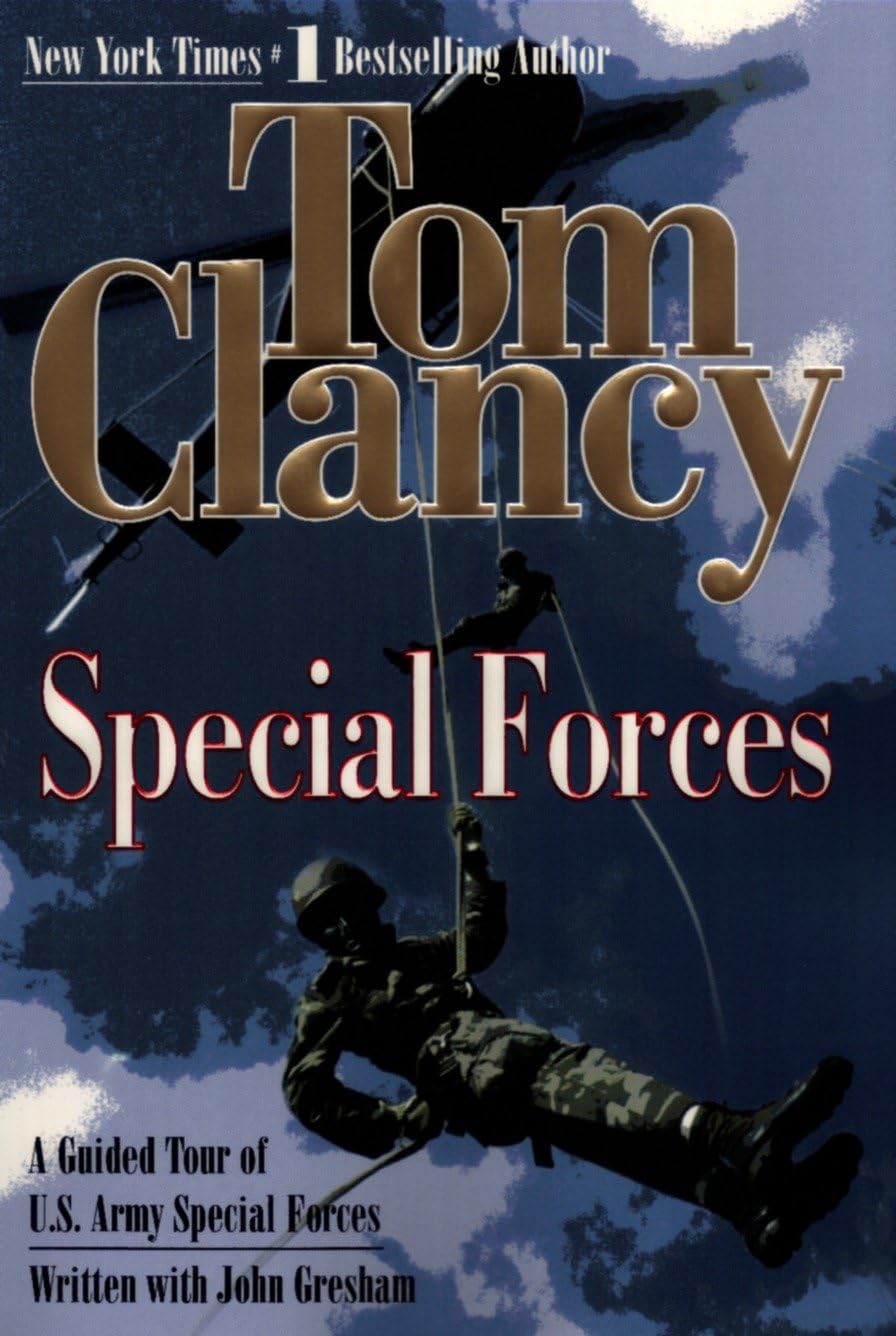

📚 Review: Special Forces – A Guided Tour of U.S. Army Special Forces
By John D. Gresham (with Tom Clancy)
Berkley Books, 2001 | 366 pages | ISBN: 9780425172681
Status: Out of print, but available via Internet Archive and select used book retailers.
Publisher’s Blurb:
They are sent to the world’s hot spots-on covert missions fraught with danger. They are called on to perform at the peak of their physical and mental capabilities, primed for combat and surveillance, yet ready to pitch in with disaster relief operations. They are the Army’s Special Forces Groups. Now follow Tom Clancy as he delves into the training and tools, missions and mindset of these elite operatives.
Special Forces includes:
- The making of Special Forces personnel: recruitment and training
- A rare look at actual Special Forces Group deployment Exercises
- Tools of the trade: weapons, communications and sensor equipment, survival gear
- Roles and missions: a mini-novel illustrates a probable scenario of Special Forces intervention
- Exclusive photographs, illustrations and diagrams
Plus: an interview with General Hugh Shelton, USA, Chairman of the Joint Chiefs of Staff (and the former Commander-in-Chief of the U.S. Special Operations Command-USSOCOM)
Inside the Book
In Special Forces, the final volume of the Guided Tour series, Tom Clancy’s name may headline the cover, but the narrative voice and granular expertise suggest that John D. Gresham—Clancy’s longtime collaborator—was the principal architect of this detailed and surprisingly nuanced portrait of America’s Army Special Forces.
Gresham’s approach is less bombastic than Clancy’s fictional thrillers, offering instead a sober, well-researched account of the “quiet professionals” whose missions often unfold far from the public eye. The book dismantles popular myths shaped by films like The Green Berets and Rambo, revealing a cadre of soldiers whose skill sets extend beyond combat into diplomacy, cultural engagement, and nation-building.
One of the most compelling sections explores the role of Special Forces in El Salvador during its civil war. Gresham outlines how SF advisers, operating under the constraints of Cold War geopolitics and domestic skepticism, helped reshape the Salvadoran military’s approach to counterinsurgency. Rather than brute force, they introduced principles of human rights and civic responsibility—an effort that, while not solely responsible for peace, contributed meaningfully to the country’s eventual stabilization.

This case study exemplifies the book’s broader thesis: that Special Forces are not simply warriors, but agents of transformation. Their work in Afghanistan, Iraq, and other global hotspots reflects a blend of tactical precision and cultural sensitivity that defies the “shoot-first” stereotype.
The volume also includes an interview with Gen. Henry H. Shelton, former Chairman of the Joint Chiefs of Staff, and a fictional vignette that imagines SF operatives in action. While the latter may feel like a nod to Clancy’s narrative flair, it’s the real-world insights—training regimens, organizational structures, and mission profiles—that give the book its weight.
There’s even a moment of levity: a soldier’s insistence that “We are NOT hats,” a gentle rebuke to the “Green Beret” label that oversimplifies their identity.
🧭 Final Thoughts
Though out of print, Special Forces remains a valuable resource for readers interested in the intersection of military strategy, ethics, and global engagement. Gresham’s voice—clear, informed, and quietly passionate—deserves recognition. This isn’t just a guided tour; it’s a reframing of what it means to serve, advise, and protect in a world where the lines between war and peace are rarely clear.
 A Certain Point of View, Too
You must be logged in to post a comment.