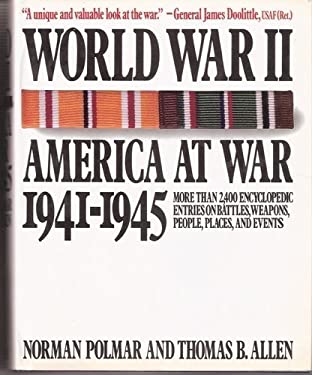
- World War II: America at War 1941-1945
- Thomas B. Allen and Norman Polmar
- Publisher : Random House
- Publication date : October 12, 1991
World War II: America at War 1941–1945 — A Richly Layered Reference to a Defining Global Conflict
The Second World War was not merely a chapter in history—it was the seismic event that reshaped the 20th century. Every major power was drawn into its vortex: some aligned with the Axis, most with the Allies, and a few shifted allegiances as the tide of war ebbed and flowed. The human cost was staggering—over 50 million lives lost, the majority civilians. Millions more were wounded, displaced, or imprisoned. Europe became a battlefield from end to end, joined by North Africa, China, India, Southeast Asia, and the vast oceans that connected them. The war’s aftermath—Germany, Italy, and Japan defeated; Britain and France diminished; the United States and Soviet Union ascendant—set the stage for the Cold War and the uneasy peace that followed, echoing into the conflicts of our own century.

Among the many reference works chronicling this global upheaval, World War II: America at War 1941–1945 by Norman Polmar and Thomas B. Allen stands out as one of the most accessible and comprehensive. First published in 1991, this volume offers over 2,400 encyclopedic entries covering battles, weapons, key figures, strategic decisions, and pivotal events. It’s a treasure trove for historians, enthusiasts, and anyone seeking to understand the war’s complexity through an American lens.
The book is organized into four major sections:
🕰️ Prologue to War: 1919–1941
This opening essay sets the historical stage with clarity and nuance. It traces the aftermath of World War I, the rise of authoritarian regimes in Germany, Italy, Japan, and the Soviet Union, and the global forces—economic collapse, isolationism, pacifism—that paved the way to war. The essay charts the ascent of Hitler, Mussolini, Stalin, and Japan’s militarists, and outlines the crises that led to open conflict: the Spanish Civil War, Japan’s aggression in China, and Italy’s invasion of Ethiopia. It concludes with the attack on Pearl Harbor, marking America’s entry into the fray.
📆 War Chronology
Spanning 52 pages, this section offers a month-by-month overview of the war, with a focus on American involvement. While not exhaustive, it’s well-crafted and informative, providing a solid narrative arc for readers seeking context and continuity.
📚 War Guide A–Z
The heart of the book lies in its encyclopedic entries—from “A: Japanese code name for the capture of Rabaul” to “Zyklon-B: Chemical used in Nazi death camps.” These entries range from brief summaries to multi-page explorations, often accompanied by maps and photographs. Though the emphasis is on America’s role, the guide covers all theaters of war, offering insights into lesser-known contributions such as Brazil’s Expeditionary Force in Italy and Mexico’s P-47 Thunderbolt squadron in the Pacific.
Despite its scope, a few errors slip through—most notably the mislabeling of the America First Committee as “American First.” Still, the guide is impressively researched and compulsively readable. Cross-referenced entries invite exploration, making it easy to lose oneself in the details of aircraft specs, battlefield strategies, and the biographies of commanders and politicians.
🕊️ Epilogue to War: 1946–1990
This final essay reflects on the war’s long shadow. Quoting President John F. Kennedy’s description of the postwar era as “a hard and bitter peace,” it examines the Cold War, the Arab-Israeli conflict, Vietnam, and the fall of the Berlin Wall. It’s a thoughtful meditation on the legacy of World War II, charting the rise and fall of the Soviet Union and the emergence of the United States as the world’s remaining superpower.
Though sadly out of print, America at War remains a vital reference—not only for scholars and history buffs, but for anyone seeking to understand the deeds and misdeeds that shaped our modern world. For those with personal ties to the “Greatest Generation,” this book offers both remembrance and recognition. It’s a testament to sacrifice, resilience, and the enduring need to remember.


Comments
3 responses to “Book Review: ‘World War II: America at War 1941-1945’”
That sounds like a very interesting book. Too bad it is out of print. I frequently see different numbers for the death toll. Google AI says 50 to 85 million deaths, so then 50 million would just be the low estimate. I wonder what you think about the numbers. Anyway, you wrote a great and very helpful review.
LikeLiked by 2 people
We’ll never know precisely the death toll from WWII. I’m sure 50 million is, indeed, the low estimate.
The edition I have of this book is, as I mention in the review, out of print, but Dover Publications reissued it under a different title.
LikeLike
Yes I think you are right. Thank you for the info.
LikeLike