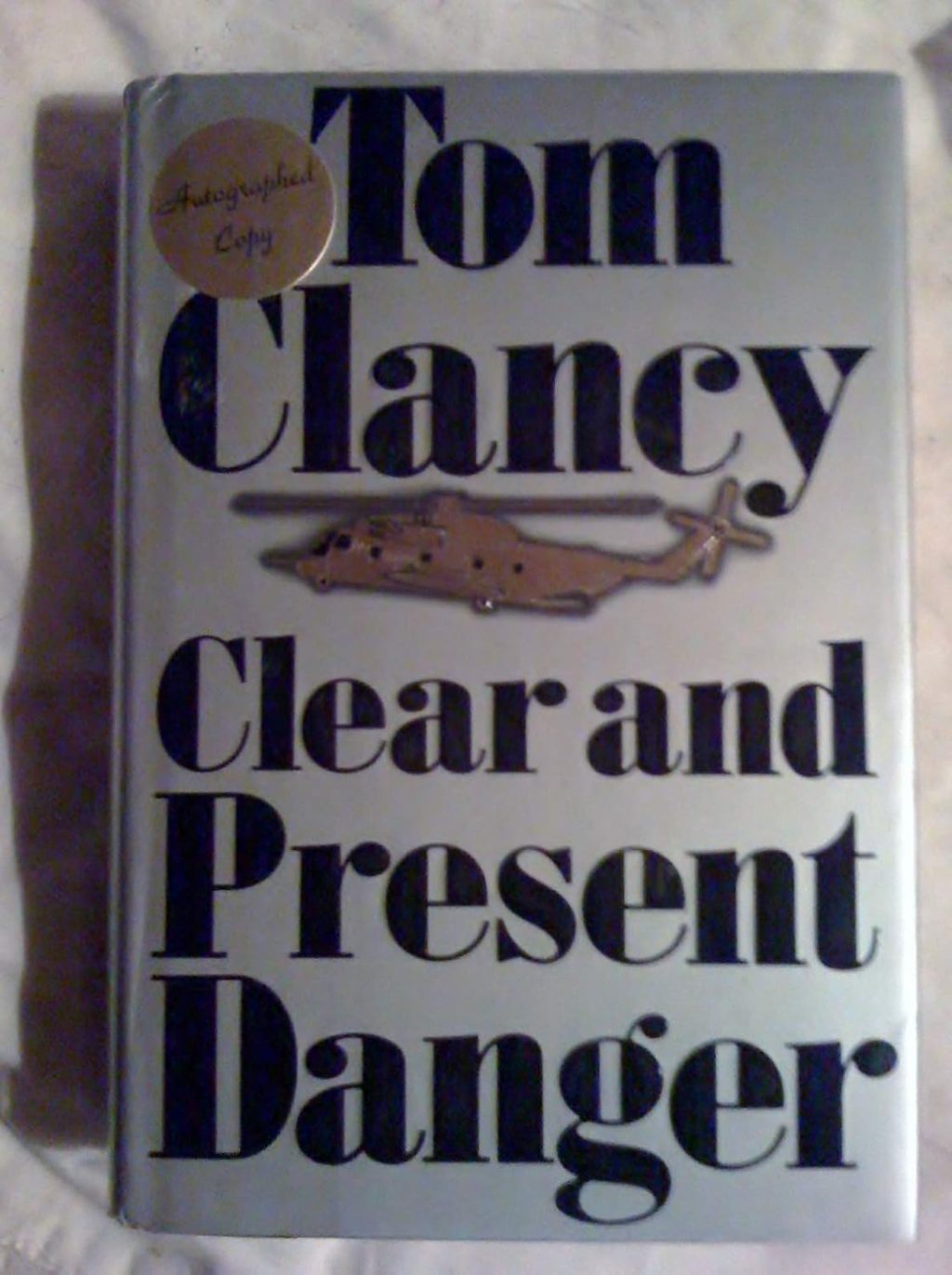

Clear and Present Danger
By: Tom Clancy
Publisher: G.P. Putnam’s Sons
Year of Publication: 1989
Clear and Present Danger: When the War Comes Home
Tom Clancy’s Clear and Present Danger marks a turning point in the Jack Ryan saga—and in Clancy’s own narrative ambitions. Gone are the Cold War chess matches and high-tech brinkmanship of earlier novels. In their place: a murkier, more morally ambiguous battlefield where the enemy isn’t a foreign power, but the erosion of accountability within our own institutions.
This fourth installment finds CIA analyst Jack Ryan climbing the ranks at Langley, stepping into the shoes of his mentor Admiral James Greer, who is quietly battling cancer. But Ryan’s promotion comes with a price. Unbeknownst to him, the President’s National Security Adviser, Admiral James Cutter, has orchestrated a covert war against the Medellín drug cartel—dragging CIA Director Arthur “Judge” Moore and paramilitary operative John Clark into a campaign that bypasses oversight, legality, and conscience.
What begins with the brutal murder of a family yacht’s owners by cartel sicarios quickly escalates into a geopolitical crisis. The assassination of three American officials in Bogotá prompts a Presidential response that’s equal parts vengeance and political theater. The result: a secret war waged in the jungles of Colombia, where American soldiers operate without acknowledgment, and where the rule of law is treated as an inconvenience.
Clancy uses this setup to explore themes that feel startlingly contemporary: the fragility of democratic norms, the weaponization of secrecy, and the moral cost of “plausible deniability.” Ryan, ever the moral compass of the series, is forced to confront not just the enemy abroad, but the rot within. His journey is less about espionage than about ethical reckoning. What does it mean to serve your country when your country’s leaders bend the law to suit their ends?
Clear and Present Danger is a complex, often unsettling novel. It asks hard questions about the nature of patriotism, the limits of executive power, and the quiet courage required to speak truth to authority. By the end, Ryan is no longer just an analyst—he’s a witness. And the scars of the “Colombian Affair” will follow him into every subsequent chapter of his life.
 A Certain Point of View, Too
Comments
4 responses to “Book Review: ‘Clear and Present Danger’”
This is a great and very helpful review. I haven’t read the book but I saw the movie with the same name, which I assume is based on this book.
LikeLike
The movie is, as with the other adaptations of Clancy’s novels, loosely based on the book. The basic main idea is there, yes? But it is not as interesting or intellectually deep as the 1989 book.
LikeLiked by 1 person
It is good that it is close to the book but I can imagine that it is not as interesting or intellectually deep as the book.
LikeLiked by 1 person
Thematically it’s close. But to fit the story of Clear and Present Danger into a feature film’s 2-hour runtime, it (by necessity) was trimmed and simplified. A bit too much, as you’ll see if you read Clancy’s novel.
LikeLiked by 1 person