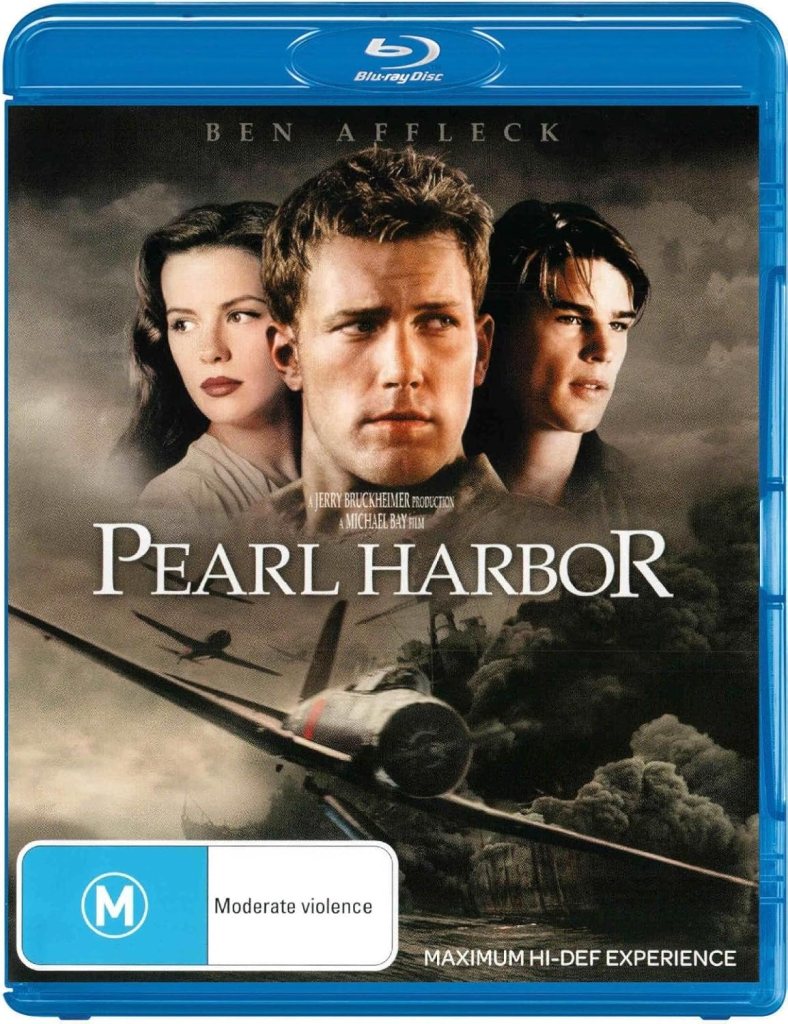
Pearl Harbor (2001): A Missed Tribute Wrapped in Spectacle
Pearl Harbor
Directed by: Michael Bay
Written by: Randall Wallace
Starring: Ben Affleck, Josh Hartnett, Kate Beckinsale, Jon Voight, Mako, Colm Feore, Tom Sizemore, Cuba Gooding Jr., Alec Baldwin
Produced by: Jerry Bruckheimer
Music by: Hans Zimmer
Studio(s): Touchstone Pictures, Jerry Bruckheimer Films, Buena Vista Motion Pictures Distribution
Producer Jerry Bruckheimer has long been associated with high-octane, visually arresting films—Black Hawk Down, helmed by Ridley Scott and featuring Josh Hartnett, stands as one of his most compelling achievements. With Pearl Harbor, released in 2001 to coincide with the 60th anniversary of the attack, Bruckheimer seemed poised to deliver another emotionally resonant war epic. But despite the pedigree—screenwriter Randall Wallace (Braveheart, We Were Soldiers) and director Michael Bay—the film falters, both as historical drama and romantic spectacle.
Bay, whose kinetic style thrives on explosions and adrenaline, lacks the narrative restraint and emotional fluency of Ridley or Tony Scott. Pearl Harbor aspires to be both a Titanic-style love story and a reverent tribute to the heroes of December 7, 1941. It succeeds at neither.
Wallace’s screenplay leans heavily on war film clichés, chief among them the “inseparable childhood friends torn apart by love” trope. Ben Affleck and Josh Hartnett’s characters vie for the affections of Kate Beckinsale, but their romantic arc feels contrived and emotionally hollow. Worse, the actual attack on Pearl Harbor—the historical centerpiece—is compressed into a mere 40 minutes, overshadowed by melodrama and a fictionalized account of the Doolittle Raid.
Framing fictional romance within real historical events isn’t inherently flawed. Titanic did so with grace, and From Here to Eternity remains a masterclass in emotional realism set against the backdrop of Oahu in 1941. But Pearl Harbor lacks the historical integrity and emotional depth to earn its place among such company.
The depiction of Admiral Yamamoto (played by Mako) and his staff borders on theatrical caricature. Scenes resemble minimalist Kabuki stages rather than authentic military settings. The absence of credible interiors—staff offices, wardrooms, strategic maps—undermines the gravity of Japan’s planning. Instead, we get outdoor vignettes with Rising Sun banners, reducing complex historical figures to stylized props.
Affleck and Hartnett’s characters, established as fighter pilots, inexplicably transition to flying twin-engine B-25 bombers during the Doolittle Raid. The leap in aircraft proficiency is never explained, leaving viewers to imagine a crash course in bomber training that defies logic and military protocol.
Talented actors like Jon Voight, Cuba Gooding Jr., and Colm Feore are relegated to glorified cameos. Alec Baldwin’s portrayal of James Doolittle, while central, lacks the charisma and gravitas the role demands. His performance feels muted, a shadow of his earlier work in Beetlejuice and The Hunt for Red October.
The attack sequence itself, though visually impressive, is historically flawed. CGI-rendered Japanese planes strike targets at random, with torpedo bombers arriving late in the raid. In reality, as documented by Walter Lord (Day of Infamy) and Gordon Prange (Dec. 7, 1941), torpedo planes led the assault. Bay’s version ignores tactical chronology, favoring chaos over accuracy.
Even the ships suffer from anachronism. While the battleships resemble their 1941 counterparts, the destroyers look suspiciously like 1990s Arleigh Burke-class vessels. Their presence breaks immersion—modern guided missile destroyers would have dramatically altered the outcome of the attack.
Perhaps most troubling is the film’s emotional manipulation. Scenes of dead nurses post-raid, while poignant, are fictional fabrications. The real tragedy of Pearl Harbor—2,403 American lives lost—deserves solemn remembrance, not embellishment. By adding invented sorrow, the film veers into dishonest territory, undermining its own commemorative intent.
In the end, Pearl Harbor is a film that confuses spectacle for substance, romance for resonance, and tribute for theatrics. It had the opportunity to honor history and deepen emotional understanding. Instead, it chose bombast over truth.
 A Certain Point of View, Too
Comments
4 responses to “Movie Review: ‘Pearl Harbor’ (2001)”
Wow, Alex.
This is intense. I’ve never watched any of this before. Thanks for sharing!
💔
LikeLiked by 1 person
Pearl Harbor is, subjectively, a bad movie. I saw it in theaters back in ’01 because a friend invited me; he knew I love history, and Kate Beckinsale is undeniably sexy, so…..
But, as my review points out, the film is a typical Michael Bay movie…full of sound and fury…signifying nothing.
LikeLike
I had the same problems with this film that I had with U-571. It’s meant to be a “patriotic” film but it ignores the actual history to do it.
LikeLiked by 1 person
I don’t like either film because they’re both jingoistic and inaccurate.
LikeLiked by 1 person