
Questions & Answers about Reunion: A Story
Since I self-published my novella Reunion: A Story five summers ago, I am sometimes asked by readers whether the story of Jim and Marty (and Mark!) is based on real events, who Marty really was based on, what inspired me to write Reunion, and whether there will be a sequel.
For many years, my answers to those questions were:
- Reunion is a work of fiction, but it has elements of truth in it
- Marty is based on every girl I ever loved or felt even a passing attraction to, but she, too, is a fictional character
- Reunion was inspired by several things, including my desire to write a short work of fiction, grief over the death of an acquaintance in a car accident back in 1998, and regret over not being able to attend the 15-year reunion of my high school class that same year
- When I wrote Reunion back in 1998, I did so as a “one-off” standalone story, with no plans to write a sequel. That was my stance until March of this year, which is when I began writing my first novel, Reunion: Coda
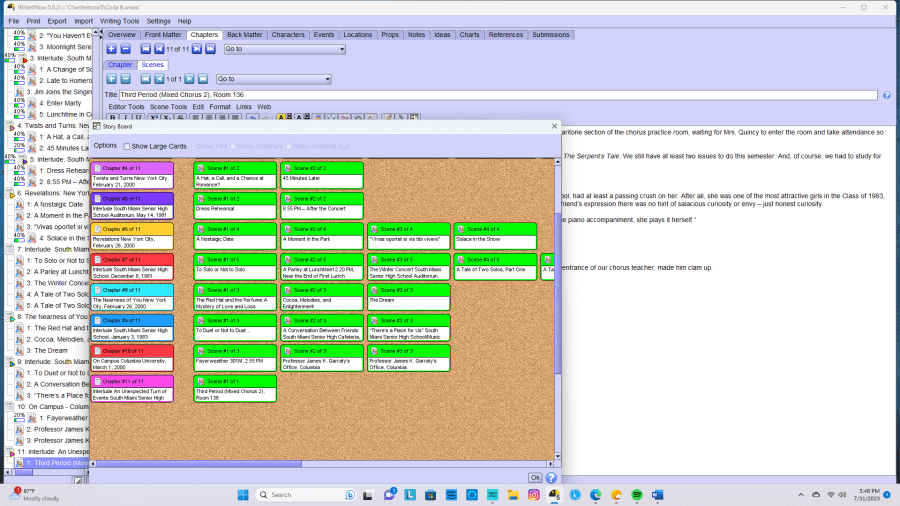
If you’re interested in how I came to choose the names of my characters and some of the musical influences that shaped the story, read on.
What’s in a Name?
Q.: How – or why – did you choose your characters’ names? Did you go through a phone book and choose names at random, or did you name Jim, Marty, and Mark after people you know?
A.: Jim Garraty – or as Stephen King would put it, my I-guy – was, in every iteration of the story (from a CRW-2001 assignment to the finished product), Jim Garraty. I’m not sure why I chose James/Jim/Jimmy as his first name; I just knew that I didn’t want to name the character after myself. I didn’t want anyone to think that the story was a roman à clef, which is a French term for a novel based on real people and real situations, with only the names changed to protect the identities of the people described in it. (Roman à clef, translated, means “novel with a key.”
I think – I’m not sure – that I chose “Jim” for my I-guy because I’m a Star Trek fan. James T. Kirk (or simply “Jim”) is my favorite Captain of the franchise, so that’s why I chose that name for the story’s protagonist.
As for his last name… Years ago, I bought and read The Bachman Books, an anthology of novels written by Stephen King using the pen name “Richard Bachman.” It contains The Long Walk, a dystopian story set in a fascist dictatorship set up in a near-future America. King/Bachman gave the protagonist the name “Garraty,” and even though The Long Walk is not one of my favorite reads, I liked the character’s last name. So, I pinched that from the Master of Horror himself.

As for Mark Prieto…I named Jim’s best friend and confidante after my own best friend of my “tweens.” We became friends in 1975 and hung out regularly for about two years till Mom got the notion – ill-conceived, I think – to sell our home in Westchester and buy a townhouse in the Fountainbleau area in the summer of 1977. After that, we talked on the phone or he would ride out to visit me on his bike until he, too, moved away from the old neighborhood. His divorced mother remarried, so she sold her house – which had been two houses away from our former residence – and moved to New England with her new hubby, Mark, and her younger daughter Leslie. Mark later moved back to Miami to be with his dad for a while, attended Coral Park Senior High for a year, then relocated once again to Michigan, where his mom, stepdad, and sister now lived. We exchanged a couple of letters during the 1981-82 school year, but for some reason he stopped writing. I have not seen or heard any news from him since.

Martina Elizabeth Reynaud (“Marty”) – I wanted to give my female lead a unique name and identity, so I named her after a famous tennis player, Martina Navratilova. “Elizabeth” I cribbed from my friend Betsy, whose formal name is…well, Elizabeth. The last name, “Reynaud,” I plucked out of thin air, although World War II buffs will say I was inspired by a certain French prime minister, who, per Wikipedia, “was Prime Minister during the German defeat of France in May and June 1940; he persistently refused to support an armistice with Germany and resigned on 16 June.” That’s an interesting theory, but it just isn’t so. I could have given Marty one of those stuffy-sounding compound names that some British families use, something like “Martina Stafford-Mills,” but I thought that was too stereotypical, so I went for a more exotic Anglo-French vibe instead.
Musical Influences and Inspirations
Where time’s winds blow
ALEX DIAZ-GRANADOS, Reunion: A Story: A Novella (The Reunion Duology Book 1) (p. 33). Kindle Create/ADG Books. Kindle Edition.
That’s where you’ll be.
Where love’s fires glow
Your smile I’ll see.
Across the stars
Across the sea
Where time’s winds blow
Our hearts will be.
Q.: You already told us how and why Billy Joel’s Scenes from an Italian Restaurant influenced Reunion: A Story‘s structure and emotional undertones. Was music always an integral part of the story, both within the characters’ world and your writing environment?
A.: I no longer have my original CRW-2001 “dream sequence,” so I can’t honestly say that music was always part of the story from the start. I don’t believe it was – the first iteration of the dream was a “forbidden fruit” sexual fantasy that Jim has while sleeping in the school library. But as far as later versions of Reunion go, music is like a fourth main character as well as the wellspring for creative inspiration.
For instance, when I conceived the idea of the dream sequence in which Jim and Marty dance together, I wanted to quote a few lines from the song by the band (which I suppose could have been the Four Tops or even The Platters) plays in the imaginary ballroom.

In my original draft, the song I chose was another Billy Joel song, This Night, from an album that came out around the time in which Reunion is set: An Innocent Man.
Now, I’ve always thought that This Night is perfect as the song to accompany Jim and Marty as they dance in that magical ballroom of the imagination. It fits the theme of the story…and I listened to it on my stereo as I wrote that part of Reunion.
Unfortunately, I was advised that if I ever wanted to publish the story in any format or venue – even as a free read on a website – I’d have to get permission from Billy’s music publishing company and pay for the rights to use several stanzas from This Night.
If I had had the means – then or even now – I would have gone that route. But…alas, I didn’t and still don’t. So, for legal reasons, I had to draft a poem that sorta, kinda fits the Michel Legrand melody. The resulting “song” is not the best bit of writing I’ve ever done, and it mars the dream sequence for me, personally. In my imagination, Jim and Marty will forever be dancing to This Night. But sometimes you just must work with what you have, and that’s what I did.
I also like to listen to music when I write. Quite often, I tend to think of my stories in cinematic terms, so I often try to imagine what the score would sound like if they were ever adapted into feature films. I did this when I wrote a 40-page “novel” for my ninth-grade English class back in 1980; I did it again when I worked on Reunion in the summer of 1998. I reluctantly went back to my original Word file and changed the song to something I made up while I listened to the Theme from Summer of ’42.
Where time’s winds blow
That’s where you’ll be.
Where love’s fires glow
Your smile I’ll see.
Across the stars
Across the sea
Where time’s winds blow
Our hearts will be.
Diaz-Granados, Alex. Reunion: A Story: A Novella (The Reunion Duology Book 1) (p. 33). Kindle Create/ADG Books. Kindle Edition.
When I wrote the passages describing Jim’s “reunion” in Miami as an adult and his journey through the halls of South Miami High on that last day of school, I listened to two then-current soundtracks as my “temp track” for the “score.” One was James Horner’s Titanic, and the other was John Williams’ Saving Private Ryan.
Specifically, I listened to two basic themes.
When I was crafting the 1998-set frame story, I mostly listened to Hymn to the Sea by James Horner.
I also listened to John Williams’ Omaha Beach cue from Saving Private Ryan.
Finally, when I was making some last-minute edits to the paperback and Kindle versions for publication five years ago, I again turned to Maestro Williams’ music for inspiration.
 A Certain Point of View, Too
Comments
2 responses to “On Writing & Storytelling: ‘Reunion: A Story’ – The Naming of Characters, and Musical Influences”
That’s an interesting background. I have to admit despite speaking French on an intermediate level, the term “roman à clef” was new to me.
LikeLiked by 1 person
Hi, Thomas! Thanks for commenting. Since I ran into a WordPress glitch, I was re-editing my post and adding music videos when you wrote your comment about speaking French! Would you like to re-read this with the music I added? Thanks in advance.
LikeLike