Regiments
Developed by: Bird’s Eye Studios
Published by: MicroProse Software
Release Date: August 16, 2022
Genre: Tactical Real-Time Tactics (RTT), Cold War-Turns-Hot (Alternative History), 1980s-Era Combined Arms Warfare

Regiments is a Real-Time Tactics game set in Germany 1989. The Cold War has gone hot, and the inferno is raging. Lead your Regiment through the fires of conflict and the fog of war. Break through the lines, call in artillery, maneuver, feign retreats, stage defenses, counter-attack. Do not relent. – Regiments promo blurb on Steam
It is June, 1989. Soviet leader Mikhail Gorbachev’s efforts to modernize the Soviet Union and liberalize the Communist Party through his glasnost (openness) and perestroika (restructuring) have eased tensions with the West and emboldened the restive populations of Eastern Europe to seek their own political paths and escape from the loosening grip of Russian domination.

As spring gives way to summer in this fateful first year of George H.W. Bush’s presidency, an East German motor-rifle (mechanized) division’s officers and men decide to speed up the process of “liberating” their homeland from the iron-fisted rule of the Sozialistische Einheitspartei Deutschlands (Socialist Unity Party of Germany), which has governed East Germany under the close supervision of the Soviet Union since 1946. On June 3, the 4th Motorisierte-Schützen-Division (MSD) mutinies and carves out an enclave near Eisenach, a city that lies near the Fulda Gap.

Alarmed by Gorbachev’s attempts to modernize the aging, repressive Communist system and its effects on the Soviet Union’ satellite nations, hardliners in Moscow and East Berlin decide to take drastic action. In a predawn coup, the reactionary wing of the Communist Party of the Soviet Union (CPSU) deposes Gorbachev, replacing him with a Provisional Council constituted by Defense Minister Dmitry Yazov, KGB director Vladimir Kryuchkov, Vice President of the Soviet Union Gennady Yanayev, Interior Minister Boris Pugo, and three other Gorbachev opponents.
Meanwhile, under orders from the new regime in Moscow, East German leader Erich Honecker declares a “state of national emergency” and orders the 7th Panzer Division to crush the nascent rebellion by erasing the 4th MSD’s pocket of resistance. Confident that loyalist forces will defeat the “traitors to the Socialist fatherland” and that the West will treat the incident as an internal matter of the German Democratic Republic, the leaders in East Berlin unleash their lavishly equipped armored division against their disillusioned and defiant countrymen…..
Regiments – Cold War Goes Hot! A 21st Century Spin on a Classic Late 1980s Wargame Scenario

On August 16, 2022, MicroProse, the revived version of the 1980s software company known for its classic simulations (Silent Service, F-15 Strike Eagle, and M1 Tank Platoon) and strategy games (NATO Commander, Crusade in Europe, and Sid Meier’s Civilization) published Regiments, a real-time tactical simulation of combined-arms warfare set in an alternate version of 1989 Germany in which the Cold War ends not with a peaceful fall of the Iron Curtain but in a hot war between the Soviet-led Warsaw Pact and the North Atlantic Treaty Organization (NATO), the Western alliance led by the United States and her closest allies in Europe, Great Britain and West Germany.
Regiments was designed and programmed by a small East European game studio, Bird’s Eye Games, led by Russian game designer Mikhail Shternnikov, but it was executive produced by MicroProse CEO David Lagettie. (I suppose one could say it’s a collaborative effort by Bird’s Eye Games and the better-known MicroProse.)
Regiments: The Basics

In Regiments, you are the commander of either a Warsaw Pact or NATO regiment or brigade-sized unit that was in service during the late Cold War period depicted in the game. Well, that’s not entirely true…you command a maximum of four task forces that comprise the rough equivalent of a battalion, depending on which army your regiment/brigade is a part of.
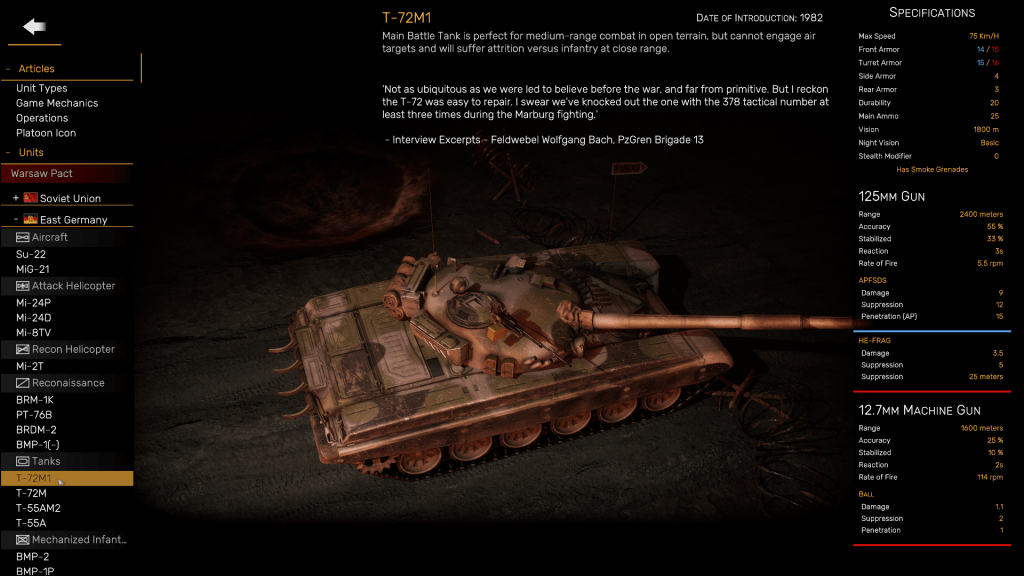
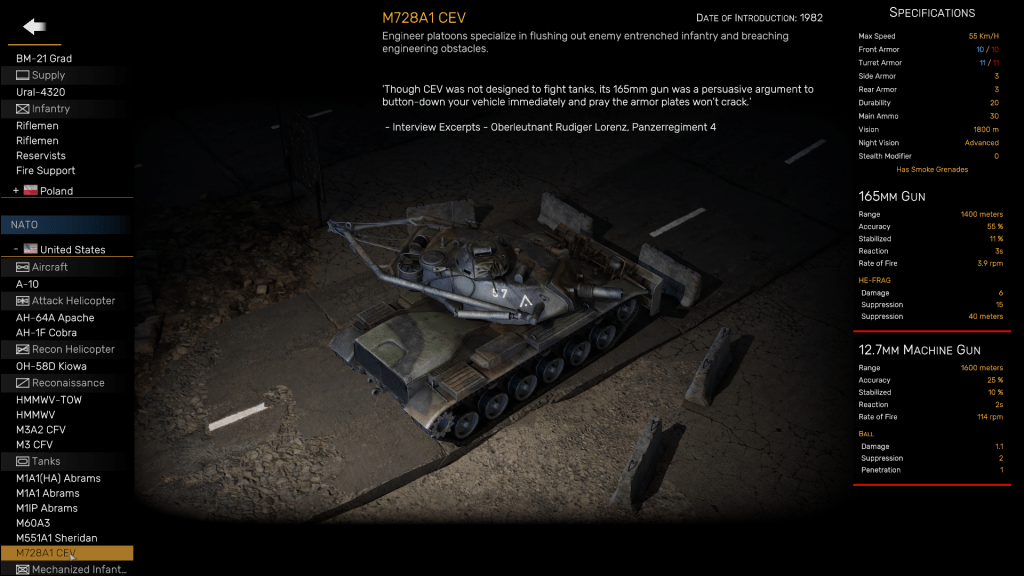
Each unit is organized and equipped to reflect the weapons, vehicles, and even uniforms used by both sides in the late 1980s. Thus, U.S. armored units will field several variants of the M1 Abrams that were deployed in what was West Germany at the time, including the M1, M1-1P, M1A1, and M1A1(HA). Other American tanks in the game include the M60A3 Patton, M551 Sheridan, and the M728A1 Combat Engineer Vehicle. (The most modern tank series fielded by the Soviets is the T-80 and its variants, so don’t expect to see T-90s and Armatas here.)

Note: The current iteration of Regiments, Iron Curtain, currently features American, Belgian, British, and West German units on the NATO order of battle, while the Warsaw Pact consists of East German, Polish, and Soviet units. The fourth version, which will be the game’s first for-pay upgrade – the first two were free download content (DLC) improvements – is titled Winds of Change and will add Canadian, Dutch, and French forces to the NATO side. The Warsaw Pact will be reinforced by Czechoslovakian forces.
Regiments: ‘Kinda Like M1 Tank Platoon, But Bigger…and Better’

Like its older “sibling” – but more modestly-scaled – M1 Tank Platoon, Regiments simulates ground warfare in the late Cold War era between NATO and Warsaw Pact armored and mechanized infantry units equipped with tanks, infantry fighting vehicles (IFVs), armored personnel carriers (APCs), attack helicopters, mobile surface-to-air missiles (SAMs) and anti-aircraft artillery (AAA or “triple-A”), based on the equipment that was in service in mid-1989.
Additionally, players have at their disposal several “off-screen” tactical aids controlled by higher echelons – usually by the Division HQ – such as several types of artillery support, air strikes by tactical aviation, and aerial reconnaissance (recce). Which TACAIDS the “commander gets is determined by which task forces he (or she) selects during a game session, and they come at a cost in “TACAID points” that are slowly accrued as the battle progresses.
As in the older M1 Tank Platoon duology from the 1980s and 1990s, Regiments has three modes of play: Training, the single battle Skirmish, and the campaign style Operations, which are a chain of Skirmishes connected by the game’s storyline, each one with special rules, game multipliers, specific mission objectives – such as Flush out the rebels of the 4. MSD from their nest near Eisenach – and strict limits on time, supplies, and reinforcement schedules.
Training missions are designed to – of course – teach commanders how to play the game, starting with the basics of issuing orders, using TACAIDs, and learning how to use terrain and different types of units in combat. Training missions increase in complexity as you go along, culminating in a Defense mission in which you command a West German mechanized force with tanks, infantry, artillery, helicopters, and TACAIDS to defend a position from a Warsaw Pact assault.

Skirmishes (single engagements) come in several flavors: Attack, Static Defense, Mobile Defense, and Meeting Engagement. Regiments features a wide array of settings based on different locations (such as Bischofroda, Lauterbach, Stembach, Runway (a mission to defend/capture/liberate a NATO forward airbase), Route “Sherwood,” or Five Hills.
(There are quite a few more Skirmishes, too many for the scope of this review. Trust me, though, there are enough variants in these single battles to keep players interested.)
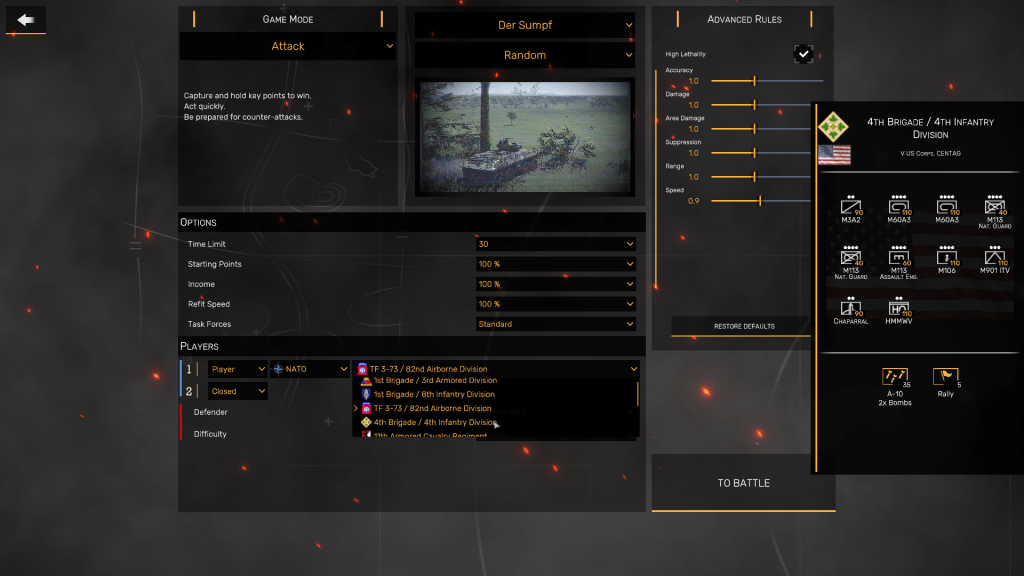
You can choose to set up each Skirmish with such variables as duration (from 20 minutes to an hour), weather conditions and time of day, difficulty level (from Easy to Master), and customize the amount of Deployment Points, the percentage of DPs you get when the game replenishes your “income,” repair time to damaged units you ordered to retreat, and how fast new task forces become available.
You can even choose to fight a Skirmish without an AI-controlled friendly unit (not recommended, but…) and go it alone against two enemy units (a main force and reserves). It’s not all that realistic, and it is reminiscent of 1980s games where you only have a few friendly units around to help you fend off waves of enemies, but it you like extra challenges, well….
The game is, in the tradition of classic MicroProse games, “easy to learn, difficult to master.” Issuing orders to units is easy – the user interface combines mouse-controlled point-and-click commands to units (usually platoon or section-sized) and a few keyboard commands (F for “advance forward,” R for “reverse,” and a double-tap of Q or QQ for “retreat,” X to change the mode of your mechanized infantry from mounted to dismounted, and Z for “stop here.”


You can also use the mouse to see the game from high above the battlefield or to zoom in on individual units so that you can see the details – such as camouflage, national/unit markings, vehicle serial numbers, and even individual soldiers’ uniforms, helmets, and personal weapons. All of the “cool stuff” you see in Regiments is painstakingly depicted to match the military vehicles, units, and “kit” used on both sides of the Iron Curtain in 1989, down to the styles of heraldry, camo paint, and vehicle ID numbers seen on turrets or tank/IFV hulls.

As I mentioned earlier, Regiments does not allow you to deploy your entire regiment/brigade all at once, especially in Skirmish mode. Instead, you start the battle with a core task force pre-selected for you with a mix of tanks, mech infantry, and support units (such as attack helicopters, AAA or SAM vehicles, and either one battery of self-propelled mortars or SP howitzers).
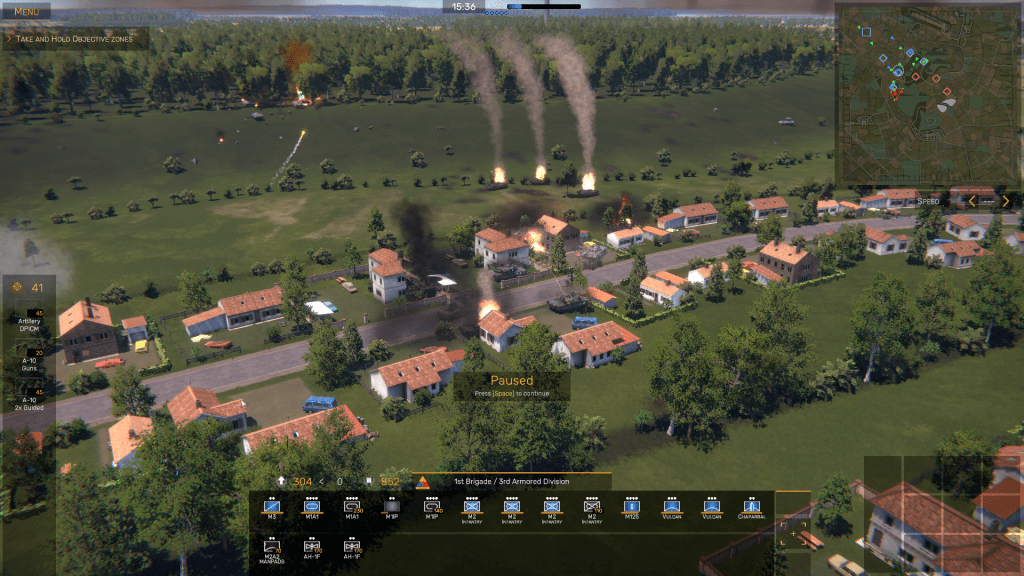
You also have a starting number of Deployment Points (you can choose from a menu of fixed choices when you set up a Skirmish) to “buy” platoons or sections for the initial stages of a battle. The game will slowly replenish Deployment Points over time so you can call in for reinforcements – each unit has a set “price” in DPs based on type and firepower. (For instance, an American M1A1 Abrams platoon of four tanks “costs” 230 DPs, while an earlier, less capable model, the M1-1P, costs only 140 DPs.)
My Take
I first heard of Regiments sometime in 2020 – I believe that You Tuber “The Historical Gamer” announced that MicroProse was publishing it in its first wave of new games since its rebirth as a company in 2017. I put it on my Steam wish list as soon as I could, and after an almost two-year-long wait, purchased the first iteration of Regiments on August 16, 2022, when I still lived in Florida.
Since then, Bird’s Eye Games and MicroProse have released two free DLC upgrades, Regiments: Second Wave and Regiments: Iron Curtain, and every so often, I see news on my Steam account that the developers have added little tweaks to add more details, hot fixes, or even fiddle with regiments’ tables of organization and equipment (TO&Es).
A third update, the aforementioned Winds of Change, will add three new countries to NATO and one to the Warsaw Pact, plus changes to the grand campaign Operations game.
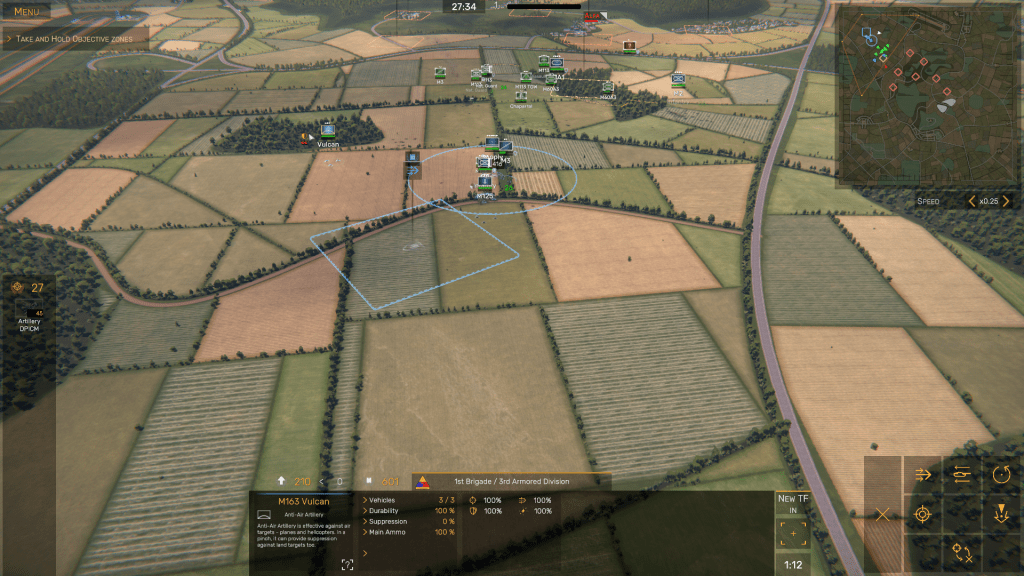

This third DLC will not be free, and because Bird’s Eye Game is a small studio, its project leader says that a release date for Winds of Change is still in the nebulous state of To Be Announced.
If you’re a regular reader of A Certain Point of View, Too, you know that Regiments is one of my favorite computer games, at least as far as 21st Century games are concerned. It doesn’t require four years of military education at either West Point or Fort Knox to learn how to play, the user interface is easy to learn and master – it’s mostly point-and-click with the mouse, really – and it boasts stunning visuals and sound effects that make playing Regiments an immersive and fun gaming experience, especially for folks who love Cold War-turned-hot games or spent countless hours in the late 1980s and early 1990s playing “original MicroProse’s” M1 Tank Platoon or its strategic level counterpart NATO Commander.
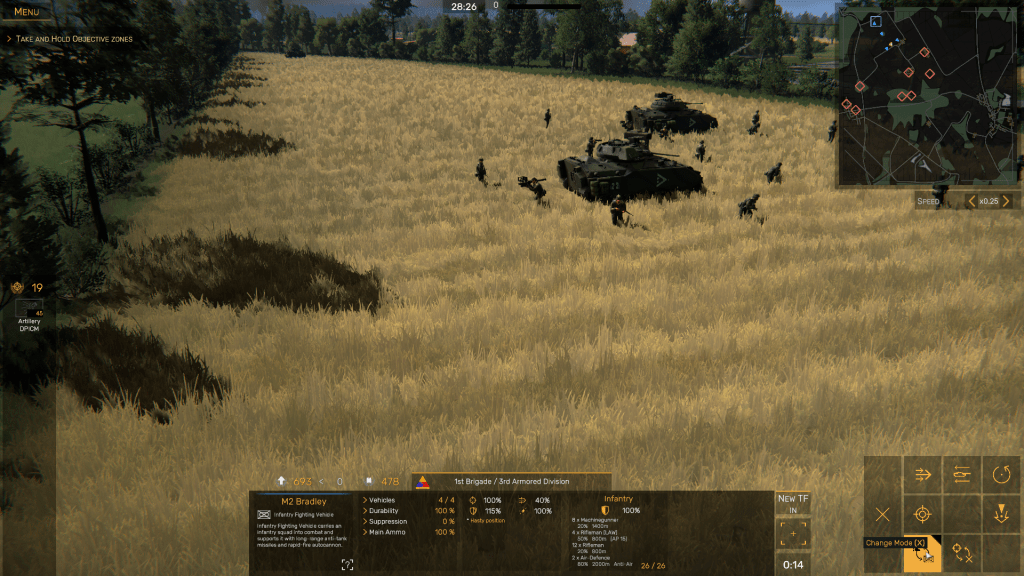
How stunning are the graphics and sound effects? Very. You’ll see the fiery plumes of anti-tank guided missiles being fired, accompanied by a loud and fearful “whoosh” as they streak toward their targets. You’ll hear the “railroad train” roar of heavy artillery shells as they zoom overhead in their deadly trajectories to strike a strong defensive position or put up a defensive curtain of high explosives on an advancing force. You’ll hear the “wop-wop-wop” of helicopter rotors as attack helos flit out from behind a screen of trees to rain destruction on a section of hull-down tanks or a squad of infantry dug in near an Objective Zone (OZ), as well as the “rat-a-tat-a-tat” of machine guns or excited radio calls advising you that “We’ve got a lot of casualties here!” or “Fire mission complete, over.”
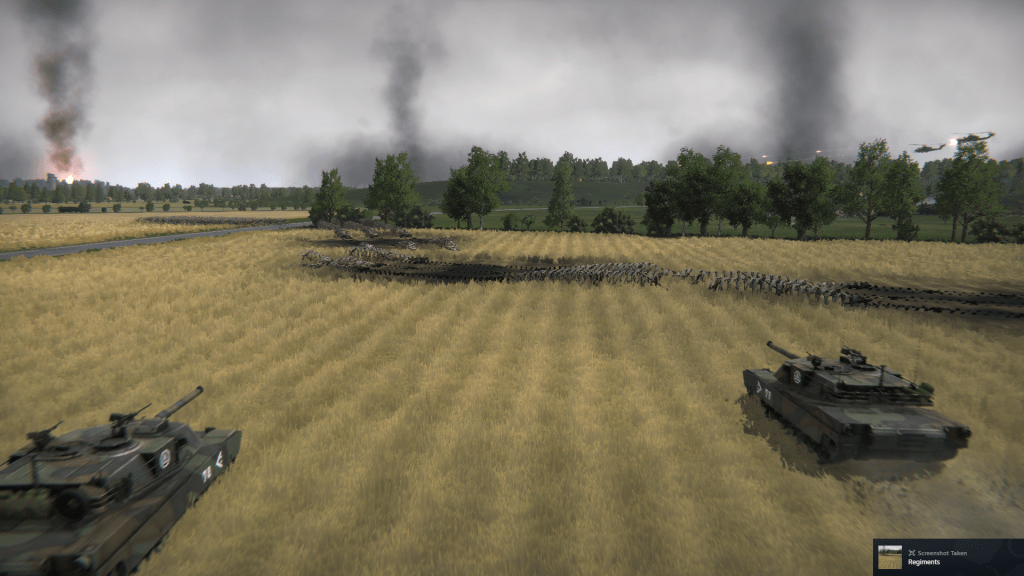
Pressing “I” during gameplay removes the user interface from the screen and allows players to see the action without the info and unit command panels. All game design elements in this collage and other screenshots in this review are (C) 2022 Bird’s Eye Games and MicroProse 


Pro Tip: If you want to see the action on your screen without the informational graphic interface (say, to get really cool screenshots), press the “I” key once to get rid of the User Interface you normally use to issue commands or see the status of your units and the amount of TACAID and Deployment Points you have. One tap clears the screen of all the symbology and info panels; two taps restore one layer of the UI, and a third tap restores all the map symbols and status report graphics. Do this sparingly, though, and never when you need to issue commands, especially in tight battlefield situations when you must make fast decisions.
My favorite visual effect is that of a Soviet-made main battle tank’s (MBT) turret flying up into the air on a red-yellow column of fire after being hit by an ATGM or 120mm tank round. It’s such a visceral experience, especially since I usually play NATO and I’m not currently a fan of Russia’s army or current leadership. Not after Russia’s invasion of Ukraine, anyhow.
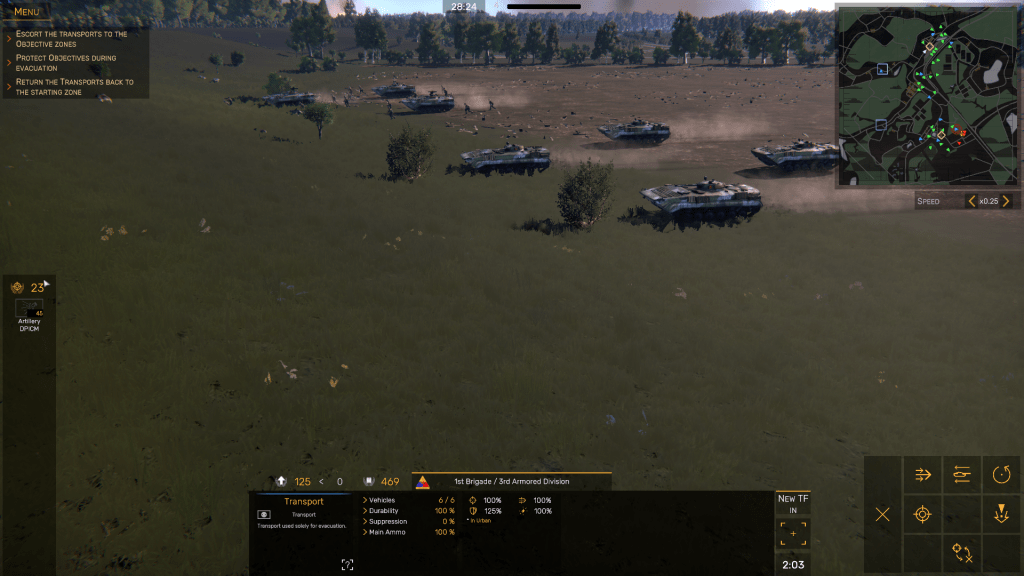
Of course, Regiments has to strike a balance between realism and playability, so players who remember M1 Platoon’s realistic portrayal of armored land combat at a lower command level might be disappointed that units don’t change tactical formations in this wargame. In M1 Tank Platoon and Matrix Games’ Armored Brigade, for instance, you can tell a tank platoon to move in line abreast, column march, vee formation, wedge formation, left echelon, right echelon, and inverted vee formation. Regiments doesn’t do this because It would require a lot more time and money to make the game closer to real life, plus the UI would need to be more complex and cluttered.
So, no. Regiments is not going to be so accurate a depiction of late Cold War-era armored land combat that you’ll earn a commission as a second lieutenant if you complete the grand campaign’s set of Operations.
My least favorite aspect of Regiments, incidentally, is the campaign. Instead of telling the story of World War III in two separate campaigns, one each for the Warsaw Pact and NATO, Regiments has a Rashomon vibe for the Operations.

The war starts, for instance, from the Warsaw Pact’s point of view in “Dissonance.” In this two-phase Operation, you are a unit commander in the East German army assigned to hunt down the “rebels” of the 4th Motorisierte-Schützen-Division and erase the “nest” of freedom-seeking mutineers and their civilian supporters in Eisenach.
In the next battle, “Reaction,” your point of view shifts from that of a People’s National Army (East German) officer’s to that of a Bundeswehr (West German) officer’s perspective as your superiors order you to investigate the strange and disturbing goings-on over on the other side of the Inter-German Border (IGB), the physical dividing line between Communist-ruled Eastern Europe and the democratic West.
I have not been able to complete “Reaction” without getting my West German force either trapped or annihilated outright. So, I can’t say for sure, but I believe that each Operation is “told” from a specific nation’s unit’s perspective. One battle will be a Soviet-centric engagement, while another will be an “All-American” battle royale.
It is, I suppose, a unique way to present a complicated conflict. It reminds me of the tagline for The Vietnam War: A Film by Ken Burns & Lynn Novick: “In war, there is no single truth.”
However, from a gamer’s point of view, it’s a confusing, almost schizophrenic approach to storytelling.
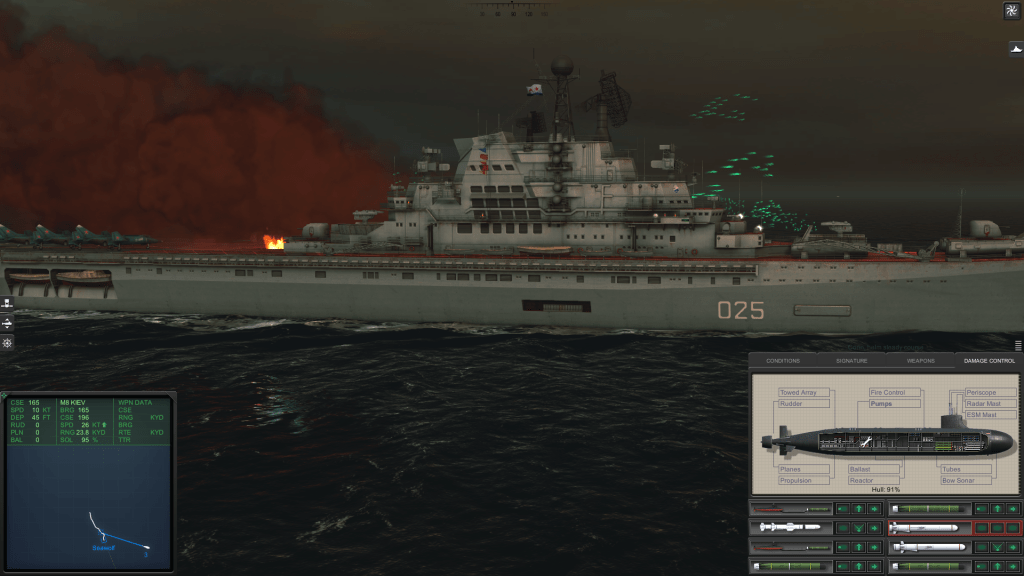
(C) 2017 Killerfish Games


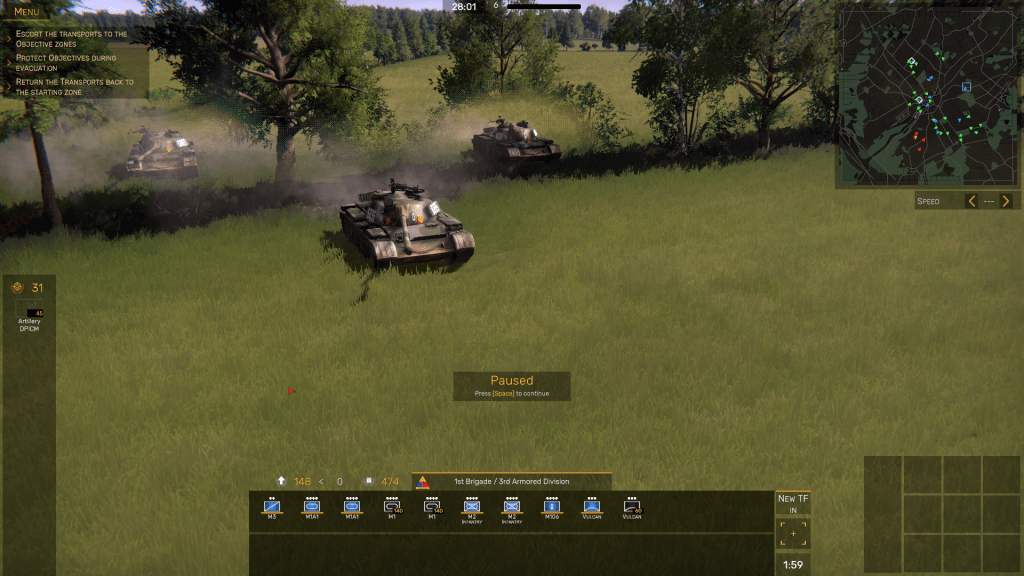

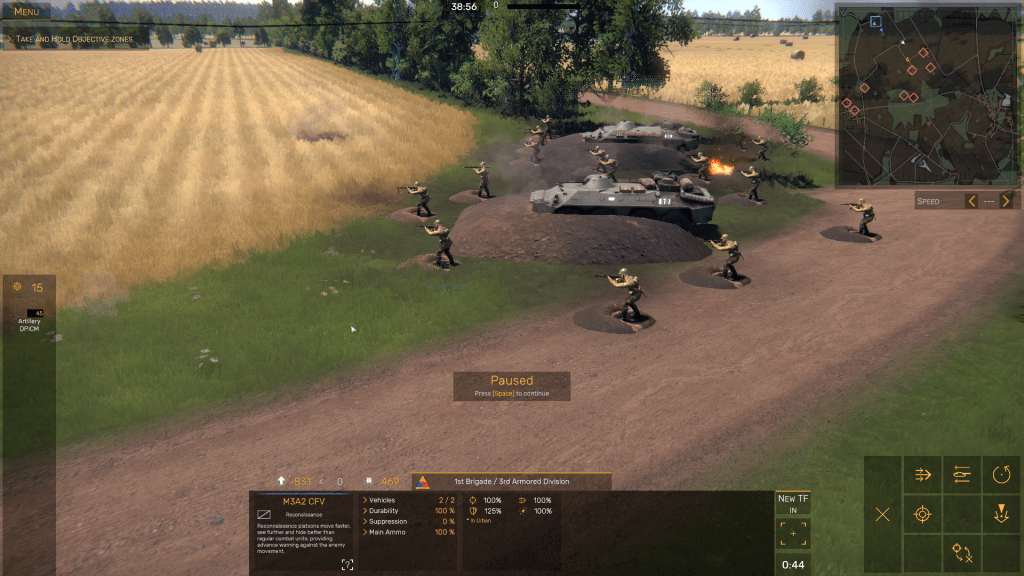

That said, aside from Cold Waters and my stash of adult graphic novel games – Acting Lessons or Leap of Faith included – I consider Regiments to be my favorite game of the ones I’ve bought since 2015. I play it at least once a week, usually on weekends cos even a Skirmish takes me over an hour to play through; I tend to hit the Space bar to pause Regiments so I can issue orders more efficiently and not hit the wrong command or send a platoon of Bradley IFVs without tank support toward an enemy held OZ. I do regret that the vehicles move in a preset formation and can’t be given specific formation commands to make the action more authentic, but I understand that game design involves compromises between 100% realism and playability/computing limitations.

And despite the baroque structure of the grand campaign’s Operations, Regiments is a worthy spiritual heir to both NATO Commander and M1 Tank Platoon. The game is action-packed, fast-paced (so much so that I play it at 25% game speed), and boasts adrenaline-inducing visuals and sound effects that put the player in the middle of World War III. Regiments is both fun and exciting, especially if you – like me – cut your wargaming teeth playing M1A1 Abrams, NATO Commander, F-15 Strike Eagle, or M1 Tank Platoon.

I heartily give Regiments my highest recommendation.
 A Certain Point of View, Too
You must be logged in to post a comment.