

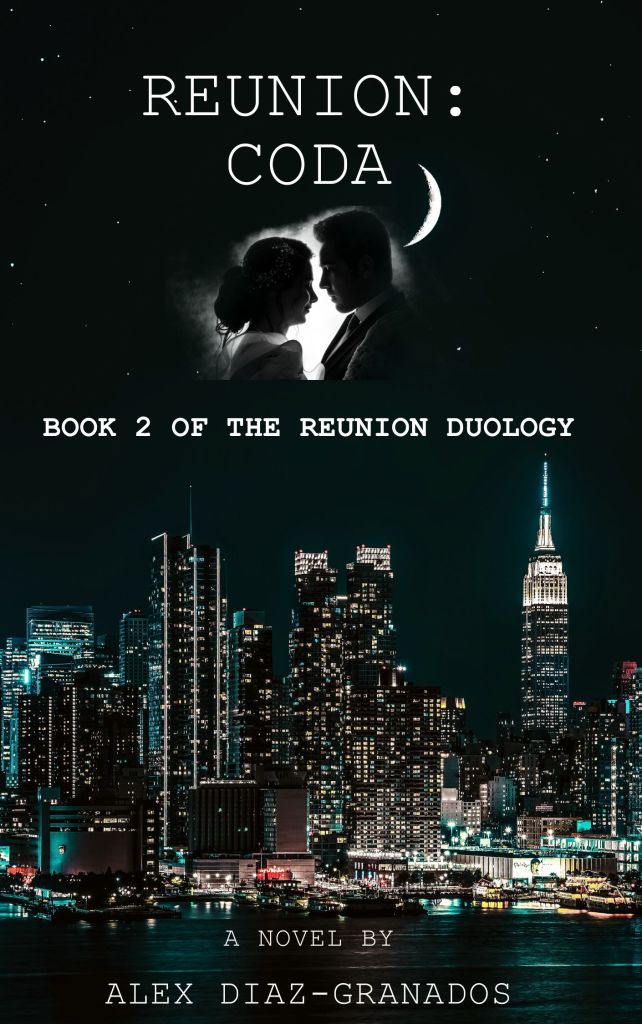
Writing Exercises for Reunion: Coda
Monday, April 1, 2024
What does your hero say the first time he sees the heroine naked?

“As a historian, I’ve always believed it’s the unseen details that hold the true essence of beauty. Now, standing before you, I realize some histories are felt rather than told.”
And this is how Maddie might reply:
“In the symphony of my life, you’ve been, as of late, the crescendo, Jim. And now, you’ve left me utterly breathless.”
Tuesday, April 2, 2024
Describe what your hero is wearing when your heroine first sees him.

Jim is a professor of history at Columbia University and an up-and-coming author of non-fiction books about military history (especially focusing on World War II). At the novel’s beginning, he’s at a new nightclub in Williamsburg (Brooklyn) called the Moonglow. It’s Friday night, and even though I don’t delve into it much in the book, we can safely assume that Jim went to his apartment in midtown Manhattan after work, showered, shaved, and chose a nice suit to fit in with the club’s 1940s theme.
Based on this assumption, Jim is wearing a gray tweed herringbone suit (pants, vest, and a single-breasted jacket), a white shirt, a red tie with a gold tiepin, brown shoes, and a matching belt. He also wears a replica of Indiana Jones’ brown felt snap-brim fedora.
How do you describe your heroine when your hero first sees her?

I glance at the bottle of Heineken in my hand, feeling the chill of the condensation on my fingers. It’s a new nightclub, and I’m curious to see what it’s like. I’m not here to hook up, but I wouldn’t mind some company. Maybe someone who shares my passion for history. Someone who appreciates the stories behind the facts. Someone who can make me laugh and think at the same time.
That’s when I hear her voice. “Excuse me,” she says, “is this seat taken?”
Her accent is refined and elegant, like a cross between FDR and a British aristocrat. I swivel around and there she is, clutching a bag stuffed with books from Book Culture – that quaint little bookstore on Broadway. Her hair is the color of caramel, and her eyes are a deep hazel. She’s wearing a sky-blue dress that hugs her curves in all the right places. She’s breathtaking. – from Reunion: Coda

Wednesday, April 3, 2024
Describe your heroine’s physical characteristics without having her look in the mirror.
Because Reunion: Coda is a novel set in two different stages of the protagonist/narrator’s life, there are two female leads: Marty and Maddie. Marty is the 1980s-era one, while Maddie is the Present Day (2000) “heroine.”
Let’s go for Maddie, shall we?

Maddie is a woman whose beauty is both striking and subtle. She possesses a heart-shaped face, the soft contours of her cheeks tapering to a delicate chin. Her hazel eyes, framed by arched brows, are windows to her soul, expressive and vibrant. A mane of chestnut hair falls in a cascade of loose waves, brushing her shoulders with a gentle grace. Her lips, reminiscent of a Gibson girl’s, are neither too full nor too thin, but perfectly shaped for a smile that lights up her face. Her neck is slender, leading to shoulders that carry an air of confidence. Maddie’s physique is toned, the result of regular exercise, yet retains a natural softness. Her fingers are long and delicate, the hands of a pianist, with a touch as gentle as her voice. In her posture and presence, there is a balance of strength and femininity, a harmony that captures the essence of her character.
Thursday, April 4, 2024

Does your character have an academic interest? Did they go to college, and if so, what did they study? What draws them to this subject?

My protagonist/narrator, James K. Garraty (Jim/Jimmy) is a professor of history at Columbia University. His area of expertise is 20th-century military history, with a special focus on the Second World War. He earned a full scholarship to study history at Harvard in the early 1980s, and he has taught at Harvard and Oxford University. I haven’t mentioned his motivations in either Reunion: A Story or Reunion: Coda, but I think Jim became fascinated with history while trying to understand why the U.S. got involved in Vietnam – a “lost crusade” in which his father, an Army helicopter pilot, was killed.
Friday, April 5, 2024

What role does money play in your story? How does it impact your characters? Is it a subject that causes conflict, and if so, how?
Money doesn’t play much of a role in the Reunion duology. None of the two stories in it are your run-of-the-mill romance novels, so that trope of “wealthy character loves working class character” isn’t a “thing,” especially in Reunion: Coda. Jim is a history professor and best-selling author, so he definitely makes over $100,000 a year. Maddie (his 2000 era love interest) is a professional musician who plays the piano with the New York Philharmonic. She probably makes less than Jim, but this doesn’t cause any dramatic tension between them.
Monday, April 8, 2024
What is the first line of dialogue in your novel? Who is speaking?
In the Prologue to Reunion: Coda there are several instances where my narrator/protagonist uses indirect quotes to highlight several cliches that he (and I) think are trite and annoying, including Everything happens for a reason and Time heals all wounds.
However, the first line of character-to-character speech appears in Scene 3 of the Prologue. It’s “Are you going to be okay, Jim?” It is spoken by Jim Garraty’s best friend, Mark Prieto, in a scene set less than 20 minutes after the last South Miami Senior High School scene in Book 1 of the Reunion Duology.
Here’s the entire scene for context:
3
The Last Afterschool Walk Home
This is a story I don’t tell often; I’m a private man, and I don’t like to spill my guts about my love life, or lack thereof. I’m fine with talking in front of a crowd – whether it’s my history students at Columbia University or the folks who come to hear me read from my latest World War II book at the bookstore. But when it comes to the women who have broken my heart, or the one who never knew she had it, I keep that to myself.

The only other person – besides you, now – who knows the truth about the letter and what I did with it and why is my best friend, Mark Prieto.
Mark wasn’t there that day in June of ’83 when I met Marty for the last time in the chorus room at South Miami High School. I don’t know what would have happened if he had walked in on us, on me and the girl I loved more than anything but was too chicken to tell her. But I know Mark, he’s been like a brother to me since we were kids at Kinloch Park Elementary, and he would have done something. He would have tried to make me confess my feelings to her before it was too late.
But I was young and dumb, scared of my feelings, still hurting from Kathy – she had dumped me three years before, and I still hadn’t gotten over it – and I had let the whole year slip by without making a move on Marty. And then there we were, alone in the chorus room – Room 136, I still remember the number on my schedule – and we kissed. It was the first time we ever did. And I knew I had screwed up. I had set myself up for a fall. No one – not Mark, not Marty, not even God – could have saved me from the mess I had made of my own heart.
I can still see it in my mind, even after 20 years. South Miami High, that canary yellow bunker on the corner of Southwest 53rd Street and Southwest 68th Avenue. It was a short walk from the house where I lived with my mom, Sarah Garraty, ever since my dad died in the early years of America’s lost crusade in South Vietnam. I didn’t need a bike or a car to get there. It was close enough to smell the cafeteria food and hear the bell ring. It was a warehouse for 2100 kids and 150 grown-ups, as one of the Cobras joked once. It was built in 1971, when the world was going crazy with wars and scandals and generational strife. It had three floors of classrooms, chemistry labs, a library, a student publications room, a Little Theater for the drama classes, an auditorium for the various choirs, and walls lined with rows of lockers. It was a place full of secrets and surprises. It was where life happened, for better or worse.
Mark walked with me that day, our last day of high school. He didn’t say much. He knew I was hurting. He knew I was losing Marty, and that I was feeling downright shitty about it. She was leaving for London with her family after graduation. She would be gone for the whole summer, maybe forever. I would be gone too, heading north to Harvard, to start a new life without her. Mark knew all that, but he didn’t say anything. He just walked with me, like a true friend.
Mark and I stood in front of his house, half a block away from mine. We had walked from school in silence – for the last time, my brain kept reminding me. We had already said everything that needed to be said about “the thing with Marty” and the letter. Mark would never admit it, but he was just as sad as I was that our carefree youth had come to an end. We were known in school as the Twins from Different Families because we had been best friends since sixth grade. Now, we would probably not see each other for a long time once I left Miami for the chilly embrace of Cambridge.
As we stood on the sidewalk, just a few yards away from his front porch, Mark finally broke the silence. “Are you going to be okay, Jim?” His blue eyes, usually sparkling with wit or wisdom, were now a dimmer shade of grey-blue – a sure sign that Mark was truly worried or sad.
I sighed. “Yeah,” I said unconvincingly. “I’ll be okay, pal.”
Mark pointed in the direction of my house. “You sure you don’t want me to walk you to your front door? It’s no problem.”
“What are you now, my dad?” I replied with a half-hearted chuckle. “I’ll be fine. It’s not like I live in Westchester or Sweetwater, bucko. I’ll probably go straight to my room and crash – I didn’t sleep much last night and I’ve been up since 6:30. I’m bushed.”
Mark grinned. “You sure it’s not because you’re afraid of running into that crazy cat lady next door?”
I rolled my eyes. “Very funny, Mark. But no, I think I can handle Mrs. Finklestein and her army of felines.”
We both burst out laughing – it was the first time we had genuinely laughed since that final bell rang at 2:30 PM, signaling the end of our school days. But as the moment faded into the past, our smiles slowly turned into quiet sobriety.
“Well, I’ll catch you tomorrow,” Mark said in a subdued voice. “But if you need to talk….”
“I got your digits,” I replied.
I turned and started walking towards my house when Mark called out, “Hey, Jim!”
I stopped and turned around. “What’s up?”
“May the Force be with you,” Mark said, making his best Han Solo impression.
I laughed and flipped him the bird over my shoulder before continuing down the sun-drenched sidewalk towards home.
Tuesday, April 9, 2024

Describe the first kiss between your characters, including the situation leading up to it and how they react after it’s over.
John F. Kennedy International Airport, Arrivals Terminal, 2:35 PM EST
I’m at JFK, the arrivals terminal humming with the energy of a city that never sleeps. It’s a Friday afternoon, and the place is buzzing like a nightclub, but instead of music and laughter, it’s filled with the sounds of greetings and goodbyes. I’m here waiting for Maddie, my heart racing a bit as I glance at the clock. Her flight, British Airways BA-175, was due at 1:45 PM, but it’s running late. Headwinds over the Atlantic, they said.

I taught my Intro to WWII class at Columbia this morning at 9:00, and Henry Townsend, bless him, arranged for a TA to cover my afternoon sessions. I rarely drive in Manhattan, but today I made an exception. I pulled my ’95 Acura out of the garage, where I shell out more than I’d care to admit each month, and hit the road around 10:30 AM. The traffic was a nightmare, made worse by a fender bender somewhere on FDR Drive, between midtown Manhattan and here.
I’ve been trying to distract myself with the day’s New York Times, but the headlines are just a blur. NASDAQ’s record high, a bomb in Sri Lanka killing 18—none of it registers. All I can think about is Maddie, jet lag, and whether she’ll be up for watching The English Patient tonight.
To kill time, I wandered into the duty-free and picked up the latest Tom Clancy paperback, The Bear and the Dragon. Now, I’m nursing my third cup of coffee from Starbucks, trying to lose myself in Clancy’s world of espionage and military fiction, but it’s no use.
Then, out of nowhere, I hear her voice, that British accent cutting through the noise, “Excuse me, is this seat taken?” I look up, and there she is. Maddie, in a red dress cinched with a black belt, knee-high black boots, and that wide-brimmed red hat she loves. She’s got a wheeled suitcase and a carry-on slung over her shoulder. She’s here, and suddenly, the wait is worth it.

The Clancy novel slips from my fingers, thudding against the Starbucks’ tiled floor, but I barely notice. I’m on my feet in an instant, my Indy fedora almost taking flight from the sudden movement. It doesn’t, though, and it ends up askew, covering my left eye. Maddie’s giggle is a silver bell in the airport’s cacophony. I can’t help but grin as I adjust the hat, channeling my inner Harrison Ford with a rakish tilt.
Time seems to stand still as we lock eyes. There’s so much we could say—mundane pleasantries, polite inquiries—but none of that matters now. We’re reading each other’s faces, searching for the stories written there since our last goodbye. Maddie’s beauty is as striking as ever, her heart-shaped face a canvas of soft contours and delicate lines. Her hazel eyes, vibrant even in her fatigue, are alive with the stories she’s yet to tell me. Chestnut waves frame her face, and her lips, oh her lips—they’re a perfect bow, the kind that would inspire poets and artists alike.
She looks every bit the English rose I remember, yet there’s a hint of weariness around her eyes—a subtle testament to the miles she’s crossed to get here. But when our gazes meet, all signs of tiredness seem to vanish, replaced by a spark that’s all too familiar.
Without a word, we step into each other’s arms, and the world around us fades into a hush. Our kiss is a revelation, a tender collision of longing and relief. Maddie surprises me with a bold and passionate French kiss, yet the softness of her lips, the faint taste of wine, and the scent of her perfume envelop me. It’s a kiss that speaks of missed moments and the promise of those to come. Our hats tumble to the ground, forgotten, as we’re lost in the warmth of our embrace, the gentle hum of the airport fading into the background.
A passerby’s gruff voice cuts through the moment, “Get a room, why don’t you!” But we barely hear it. We’re too wrapped up in the rediscovery of each other, in a kiss that feels like coming home.
Our laughter mingles, a shared melody that softens the edges of the bustling terminal. Maddie’s playful defiance shines as she sends a cheeky gesture to the retreating New Yorker, her spirit undimmed by his rudeness. Then, she turns back to me, her eyes alight with affection, and our lips meet again. This kiss is gentler, a tender reaffirmation of our connection.

“I missed you, Professor Garraty,” Maddie whispers, her voice a soothing balm to the chaos of my day. I straighten up, balancing the Tom Clancy novel awkwardly under my arm as I gather our fallen hats. With a reverence that feels almost sacred, I place the wide-brimmed red hat atop her head, adjusting it with care.
Her smile is gratitude and love interwoven. “Thanks for coming all the way out here to fetch me,” she says, her words wrapping around me like a warm embrace. In this moment, with her standing before me, every mile driven and every minute waited feels utterly worthwhile. – Reunion: Coda, Chapter 14
Tuesday, April 9, 2024 (Redux)
“Gee, Your Hair Smells Terrific!”

How a character smells says a lot about them. List the first three scents that come to mind when thinking of your hero. Now describe your heroine using another three scents.
Jim Garraty:
1. Old Spice After Shave: A classic scent that suggests a traditional and masculine charm.
2. Leather: Evokes a sense of scholarly gravitas and sophistication, hinting at a life surrounded by books and academia.
3. Aged Paper: The musty aroma of old books aligns with his profession as a history professor, suggesting a lifetime spent in libraries.
Maddie:
1. Herbal Essence Shampoo: A modern, clean scent that reflects her personal care routine.
2. Perfume (Orange Blossoms and Jasmine): A blend that suggests a warm, inviting, and slightly exotic personality.
3. Green Tea: Represents her vibrant and spirited nature with its fresh and invigorating aroma.
These scents help to build a sensory profile for each character, adding depth and relatability to their personas. 🌿📚
Wednesday, April 10, 2024

List five character strengths for your heroine.
Maddie’s Strengths:
- Intelligent
- Talented
- Kind/Generous
- Determined
- Witty
Now list five character flaws.
Maddie’s Weaknesses:
- Impulsive
- Can be unnecessarily stubborn at times
- Is sometimes devious
- Some sibling rivalry issues
- Pushes herself too hard when she doesn’t need to
Wednesday, April 10, 2024 (Redux)

Where do your characters live and how does it influence the story? Do they live in a city and meet at a bar? Do they live on a ranch and ride horses?
In both timelines of Reunion: Coda, the characters (Jim, Marty, Mark, and Maddie, as well as the supporting “cast” members) all live, work, or study in large metro areas. 1980s high school-age Jim, his high school crush Martina (aka Marty), and his best pal Mark live near the South Miami High campus. Jim and Mark live on the same block; Marty and her family live several blocks away. In 2000, Jim teaches history at Columbia University and writes books on the subject in New York City, while Maddie is a pianist with the New York Philharmonic. He lives in midtown Manhattan; she lives in Jamaica Heights, Queens.
And, of course, they meet at a ritzy WWII-themed nightclub called the Moonglow.
2
“You Haven’t Even Asked Me to Dance Yet”
Maddie and I finish our drinks and watch the dance floor from our table at the nightclub, a spacious area cordoned off by velvet ropes and flashing lights. The smooth, shiny floor reflects the smiling faces of the happy dancers. Every so often, there are gold or silver-hued flashes as light bounces from a watch or bracelet. A stage at one end of the floor holds a band, where a dozen musicians in matching suits and hats are getting ready to play their instruments. A microphone stands in front of the stage, waiting for the voice of the emcee.
“Ladies and gentlemen, boys and girls, welcome back to the Moonglow Club!” The emcee’s voice rings out over the speakers, drawing cheers and applause from the crowd. He is a tall, skinny man with slicked-back hair and a thin mustache, dressed in a tuxedo and a bow tie. He talks with a fast-paced, nasal accent that reminds me of a Walter Winchell-type radio announcer from the 1940s. “We have a special treat for you tonight, a swingin’ sensation that will make you groove and move, the Swinging Millers!” He points to the band behind him, who wave and grin. “They’re going to play some more of your favorite tunes from the golden age of swing, so get ready to boogie and have some fun! And now, without further ado, let’s give it up for the Swinging Millers!”

The emcee steps aside as the band starts playing “In the Mood”, a classic swing song that fills the air with energy and excitement. The dancers pair up and move to the beat, spinning and twirling on the dance floor. The emcee watches from the side, clapping his hands and nodding his head. He waits for the song to end before he goes back to the microphone.
“What a wonderful performance by the Swinging Millers! Let’s hear it for them!” He encourages more applause from the crowd. “And they’re not done yet, folks. They have two more songs for you tonight, two more gems from the swing era that will make you swoon and sway. First up, we have a sweet and sentimental tune that will melt your heart, “Little Brown Jug”. And then, we have a romantic ballad that will make you feel all warm and fuzzy inside, “Smoke Gets in Your Eyes”. So, grab your partner and get ready for some more swingin’ fun with the Swinging Millers!” He steps back again as the band begins playing “Little Brown Jug”, a cheerful song that contrasts with the earlier one. The dancers change their pace and style accordingly, enjoying the variety of music.
I glance at Maddie and see that she has a flush on her cheeks and a sparkle in her eyes. She looks at me and smiles. Then she says, “Do you want to dance?”
“To ‘Little Brown Jug’?” I raise a skeptical eyebrow. “All you’ll get is your toes being stepped on – constantly. The rhythm is a bit too fast for me, I think.”
Maddie’s smile fades, as if a passing cloud had eclipsed the moon over Manhattan. The spark in her hazel eyes dims a bit as well. “Party pooper.”
“No, no. I’m just trying to save your toes from going home tonight all sore. They used to call me ‘Two Left Feet Jim’ in school.”
For some reason, Maddie finds that nickname amusing, and her smile, that bright, self-confident smile, returns – but not quite reaching her eyes. A trick of the lighting in the Moonglow, perhaps, or maybe it’s the two Heinekens I’ve consumed talking. But for a second there, I sense that odd feeling that characters in Raymond Chandler or Dashiell Hammett stories get when they get a visit from mysterious dames at their offices late at night.
“You? Danced in school?”
I shrug. “Yep.”
She laughs, half amused, half skeptical. “College? Or high school?”
“College. I was too much of a high school – “
“Nerd?” she finishes for me, and I’m not sure if she’s being cute or if she was the type of girl in high school that looked down on boys like me – the grades-before-all-else, shy, and awkward guys usually depicted in the movies as uncool, comic relief characters who play second fiddle to the jocks and bad boys on campus.
I gaze at her, looking for any sign of disdain in her expression. There’s none.
“Yeah, you could say that. No, I took dance classes in college. Mom insisted. She said it would be good for me. You know, to socialize. And be a bit physically active.”

“I see,” she says, her distinctive patrician accent that is somehow fitting in this World War II-era themed nightclub a tad more pronounced thanks to that Sidecar she’s been drinking. Her eyelids droop a bit, like shades being dropped to conceal – something. “Mothers know best, after all.” She pauses a second, then her expression morphs back to inquisitiveness. “Where did you go to college?”
I look away from Maddie. I like her, I really do. But I don’t want to reveal too much about my past yet. I didn’t even tell her what I do for a living. It’s not that I’m ashamed of being a professor of history at Columbia or that my latest book was just published. I just want her to like me for who I am, not because I’m a B-list celebrity in my field.
Thursday, April 11, 2024

What kind of speech pattern does your heroine have? What is her favorite curse word? Describe her voice in five adjectives.
Since I’m currently working on a Jim-and-Maddie chapter (there are no more “Jim-in-high school” ones planned), let’s focus on Maddie, shall we?
In Reunion: Coda, I’ve established Maddie as a woman in her late 30s (37 or 38 in early 2000) who has lived, studied and worked in two countries: Great Britain and the United States. She was born in London – or, at least near it – and spent her first 11 or so years there before her father, a Foreign Service professional, was posted at the British consulate in Miami. She attended junior high (what we now call “middle school”) and high school in South Florida, then returned to the UK to further her studies in music and – hopefully – join one of London’s prestigious orchestras as a pianist. Sometime between the late 1980s and early 1990s, she moved to New York City and joined the New York Philharmonic.
Maddie normally speaks with the accent that most non-Brits know as a “British accent” or the “King’s English”: Received Pronunciation (RP), which, per Wikipedia, is defined as: the accent traditionally regarded as the standard and most prestigious form of spoken British English[1]. It’s the accent that most Americans are familiar with from TV, movies, and radio, and is the standard pronunciation used by presenters and reporters on the BBC World News broadcasts, among other things.

However, Maddie – having a good ear for music and human speech patterns – is a good mimic and can, if she so chooses, speak with an American accent. When she does, she adopts a Mid-Atlantic accent that, combined with her conversational style that suggests a worldly sophistication and sparkling wit, makes her sound like a cross between the patrician FDR and the beloved opera singer Beverly Sills. (Sometimes, though, especially if she’s had a few drinks or has her guard down, her Englishness seeps through the faux American accent. Then she speaks like a cross between FDR and Princess Diana.)
Maddie’s speech pattern, as described with an “FDR-meets-British aristocrat accent,” suggests a unique blend of American and British English influences. This could be characterized by a mid-Atlantic or transatlantic accent, which is often associated with a certain level of formality and sophistication. It’s a cultivated accent that combines the clear enunciation of American English with the non-rhotic sounds of Received Pronunciation, commonly associated with the British upper class.
In her speech, one might imagine a crisp, articulate delivery with softened ‘r’ sounds and elongated vowels, giving her voice a melodic and refined quality. Her choice of words and phrases likely reflects a blend of American directness with British eloquence, creating a speech pattern that is both warm and authoritative, friendly yet polished.
The conversation below also indicates that Maddie has a caring and considerate tone, with a touch of humor and playfulness, as seen in her light-hearted teasing. Her speech conveys concern and affection, which adds depth to her character and makes her interactions with Jim feel genuine and engaging. Overall, her speech pattern is distinctive and memorable, contributing to her character’s charm and presence in the narrative.

I chase my hat down the street, cursing as it bounces and rolls on the sidewalk just out of reach. The wind has snatched it off my head and sent it sailing down the busy avenue. I curse and chase after it, my briefcase banging against my leg. The hat is a replica of Indiana Jones’s fedora that I bought in Miami eleven years ago when I earned my master’s in history. It’s not very expensive, but it’s priceless to me. It reminds me of my love for adventure and discovery.
I lunge for it, but it slips away again. It dodges cars and pedestrians as if it has a mind of its own. I weave through the traffic, ignoring the honks and shouts. I’m in a hurry to get home after a long day of teaching at Columbia University. I have an important call to make, one that can’t wait too long.
Why is this call so important, you ask? Well, it’s about Maddie. The girl I met at the Moonglow Club on Friday night. We shared drinks and danced to swing music from the 40s. She had an FDR-meets-British aristocrat accent and a dazzling smile. She gave me a napkin from the club with her number before getting in a cab. She said she worked weekends, so I had to wait till now to call her.
Finally, I catch up to the hat and snatch it off the ground. I put it back on my head and take a deep breath. My heart is still racing, but I feel a little foolish. What was I thinking, chasing after a hat like a madman? I look at my watch and realize I have six minutes to catch the next train that will help me get to my midtown Manhattan apartment. I hope Maddie hasn’t forgotten about me – or that I have her number.
I walk back to the subway station at 116th Street–Columbia University, my briefcase still banging against my leg. The wind has died down, but the station is deafening. Trains screech to a halt, doors open and close, and people talk and laugh. I try to focus on the phone call I’m about to make, but I can barely hear myself think.
I take out my Nokia 3210 and dial her number.
It rings once, twice, three times. I’m about to hang up when I hear her voice.
“Hello?” Maddie says. She sounds the same as on Friday night, with her FDR-meets-British aristocrat accent.
“Hi,” I say, covering the phone with my hand to block the noise. “It’s Jim.”
“Jim?” she says. “Where are you calling from? You sound very far away!”
“I’m at the 116th Street–Columbia University station. It’s really loud here.”
“Oh, I see. Well, it’s nice to hear from you.”
“It’s nice to hear from you too,” I say, trying to talk over the din of the subway station. “Is this a bad time?”
“No, not at all,” she says. “I was wondering how you were doing.”
“I’m all right. Just on my way home from work. How are you, Maddie?”
“I’m fine. The weather’s nasty out there, though. Why don’t you call me when you get home? It’ll be easier to talk,” she says. Her voice is warm, friendly, even concerned.
“Okay, that sounds good. I’ll call you in 45 minutes. The train won’t take that long to get to my stop, but I do need to shower and maybe have some dinner, too.”
I think I hear a hint of – what? Happiness? Relief? – in Maddie’s voice. “That’ll be perfect.” She pauses, then adds jokingly, “I was beginning to think you’d forgotten me, Mr. Jim. Go catch your train. I’ll be here when you call.”

Her favorite curse word – which she has yet to use – is “fuck.”
Here are the five adjectives the exercise requires:
Given Maddie’s unique accent and her musical background as a pianist and likely an alto singer, here are five adjectives that might describe her voice:
1. Melodic – Her voice likely has a musical quality, flowing smoothly like a well-composed song.
2. Resonant– As an alto, her voice might carry a rich, deep tone that resonates warmly.
3. Cultured – Reflecting her FDR-meets-British aristocrat accent, her speech would sound refined and sophisticated.
4. Expressive– Her pianist’s sensitivity could translate into a voice that conveys emotion vividly.
5. Clear – Despite the unique accent, her enunciation is probably precise, making her easy to understand.
These adjectives paint a picture of a voice that is pleasant to listen to and carries both authority and warmth.
Friday, April 12, 2024
Choose one of your secondary characters and describe how they function in the story. How did they meet your protagonist and what is their back story?

Character Name:Mark Alan Prieto
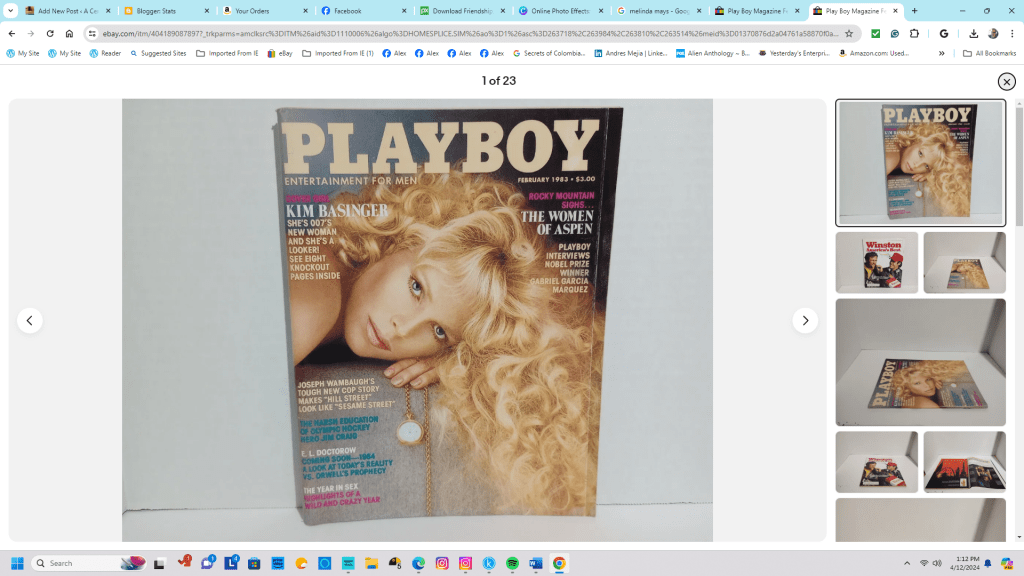
Function in the Story: Jim’s best friend and (dramatically) he serves various roles, including The Voice of Reason and Comic Relief, throughout both books of the Reunion Duology. Although he’s younger than Jim by six months, Mark sometimes steps into the role of the big brother Jim never had. It is from Mark, for instance, that Jim learns about sex (perhaps sometime between sixth and eighth grade), especially various practices and positions, by way of Playboy magazines that he somehow manages to acquire. (In fact, Mark gave Jim the February 1983 issue which featured Melinda Mays as Miss February, much to his best friend’s surprise.)
I looked around the cafeteria, searching for my best friend, Mark Prieto. He was supposed to meet me here for lunch, but he was nowhere to be seen. I took another bite of my pizza and started to worry. Maybe he had forgotten about our plans. Maybe he was sick. Maybe he had gotten into a fight.
Just as I was losing hope, I spotted Mark making his way towards me from the far end of the cafeteria where the lunch line and the cashiers were found. He had his usual jeans and button-down shirt on, and he carried a tray in his hands and a bright smile on his face. He gestured at me and approached the table.
“Hey,” he said. “Sorry I’m late. I had to go to the bathroom.”
“No problem,” I said. “I was just starting to worry about you.”
Mark sat down across from me, his lunch tray in front of him. We chatted about our classes, our plans for the week, and the latest gossip. I laughed and relaxed, forgetting all about my worries.
After a while, Mark took one last bite of his pizza and made a face. “This pizza is terrible,” he said. “It’s so greasy and the crust is hard.”
I laughed. “I know,” I said. “That’s why I always get the oatmeal cookie.”
Mark reached over and took a bite of my cookie. “This is good,” he said. “Can I have another bite?”
I laughed again and told him he could have the rest of my cookie.

“So, how are your classes?” I asked.
“They’re okay. I’m really digging Business Ed, though. Especially Business Math.”
“Really? Why’s that?”
“Well, for one thing, I like math. It’s fun and useful. And for another thing, Ms. Garcia is hot.”
I rolled my eyes. Mark had a crush on every attractive female teacher in the school.
“Come on, man. She’s old enough to be your mom.”
“So? She’s still cute. And she’s nice. And she knows her stuff.”
I shook my head. Mark was hopeless.
Mark and Jim met in Ms. Ellen Nabutovsky’s sixth-grade class at Kinloch Park Elementary at the beginning of the 1976-1977 school year. Here’s the timeline:
If Mark and Jim have known each other for seven school years by the time they graduate high school in the 1982-83 academic year, they would have met in the sixth grade during the 1976-77 school year. Here’s the breakdown:
– 12th Grade (Senior Year): 1982-83
– 11th Grade (Junior Year): 1981-82
– 10th Grade (Sophomore Year): 1980-81
– 9th Grade (Freshman Year, but still in junior high): 1979-80[2]
– 8th Grade: 1978-79
– 7th Grade: 1977-78
– 6th Grade: 1976-77
So, logically, Mark and Jim would have met at the beginning of the sixth grade in the fall of 1976, which would mark the start of their seven school years of friendship leading up to their high school graduation.
[1] Received Pronunciation. (2024, April 10). In Wikipedia. https://en.wikipedia.org/wiki/Received_Pronunciation
[2] In the 1970s and 1980s, junior high consisted of grades 7, 8, and 9, even though 9th grade was, by tradition, the first year of high school (or senior high school, as it was called when I was a student in the Dade County Public Schools system). When I started attending South Miami High at the start of the 1980-81 school year, I was a sophomore. In 2024, junior high is called “middle school” and consists of grades 6 through 8; first-year students at South Miami High now enter the campus as 9th graders. This change occurred, I believe, in the 1990s, several years after I graduated with the Class of 1983.
 A Certain Point of View, Too
You must be logged in to post a comment.