It was cold, gray, and wet on Monday, May 27, 2024. (Photo by the author)
Midday/Early Afternoon, Tuesday, July 30, 2024, Madison, New Hampshire
Hi, all. As I begin this, my 1,616th post in A Certain Point of View, Too, it’s a gray-shrouded and humid day in the mountains of eastern New Hampshire. The light filtering through the office window is weak and dim, and we’ll likely get some light showers throughout the afternoon. I saw the forecast for today last night after I posted ‘We Have Scene Three!’ A Writer’s Update, so I knew it was going to be a cloudy, wet Tuesday.
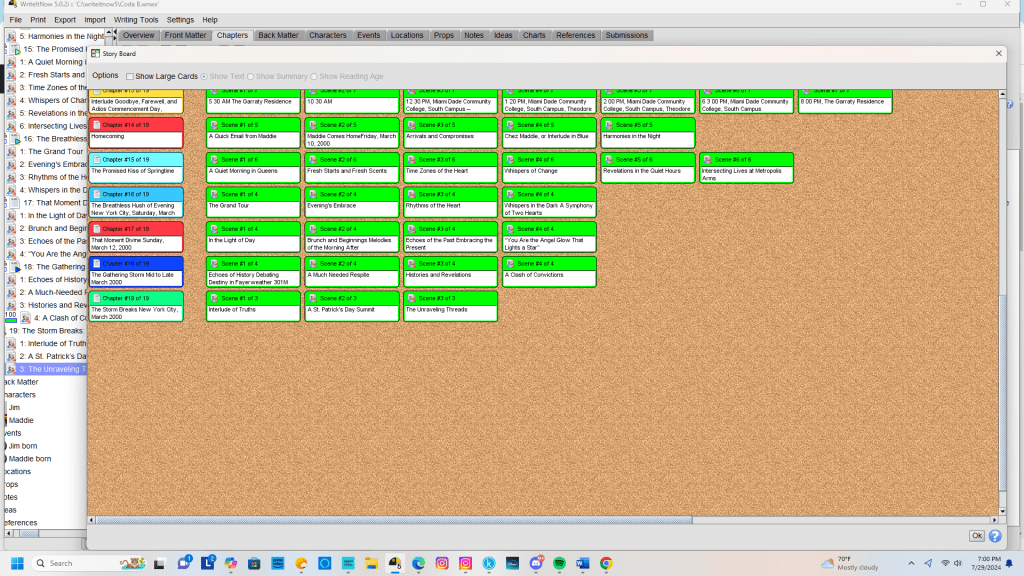
I woke up before 5 AM to use the bathroom, and then I had trouble falling asleep again. As a result, I got up at 9:20 AM feeling tired and low on energy. I made breakfast slowly and now I will have to postpone my midday break to 1 PM and get back to work on Reunion: Coda at 3.
Since I’m short on time and don’t have anything positive to report, I’m going to share some YouTube music videos featuring the music I listen to when I work on my novel. Enjoy!
This is one of the few songs that I could quote lyrics from in Reunion: Coda since it’s a “traditional” song in the public domain.
I wanted to get the rights to use lyrics from this song for Reunion: Coda, and I went through most of the process to do so. Unfortunately, getting permission to use lyrics from the copyright holders is not easy, and it’s not geared for indie authors.
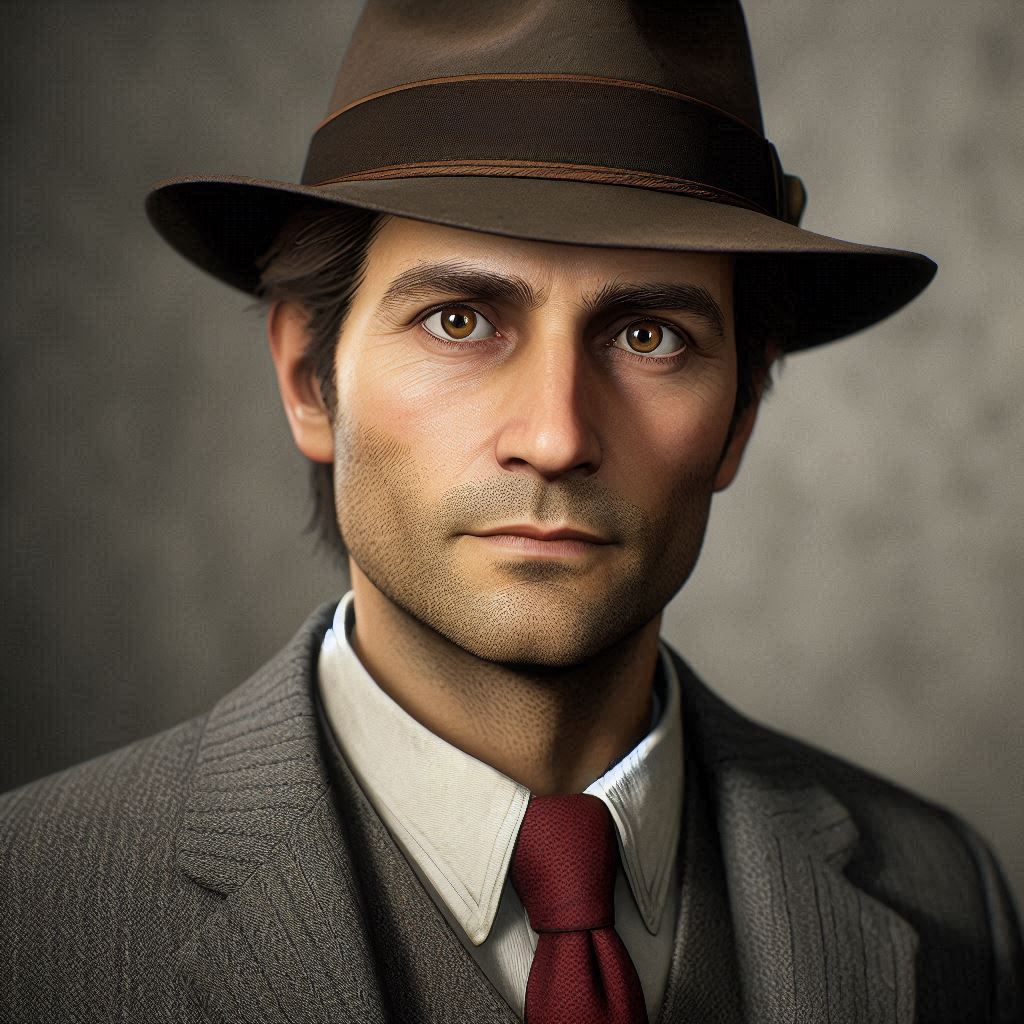
Like me, Reunion: Coda’s Jim Garraty came of age in the early 1980s and is a fan of both John Williams and Indiana Jones. Jim Garraty in 2000.
I wrote a brief parody of this Welsh military marching song for the novel. I wish that a better lyricist would add more verses to “Boy of Harvard” (my version), or that a talented singer would record my short one, but they’d need to read Reunion: A Story to do the former, and want to sing the existing song to do the latter.
Lastly, this song by Jerome Kern and Oscar Hammerstein II is a major influence in my novel.
Sorry you didn’t have a good nights sleep, insomnia sucks so much. I had a particularly bad night last night too. Barely got any sleep.
I thought I was the only one who enjoyed listening to music while writing, it helps me concentrate better. I had mentioned on my blog that I listen to music while writing and everyone thought it was weird lol. Will definitely check out your recommendations.
Because the story of “Reunion: Coda” features many scenes that mention songs and classical compositions, I often listen to either the specific works mentioned or alluded to, or I’ll play a random song to get inspired.
When I wrote Reunion: A Story, which is a smaller story in scale (it mostly takes place during one day of Jim’s life in between the 1998 bookend scenes), I listened to:
“No Absolution” by James Horner (Titanic) “This Night” by Billy Joel “Scenes from an Italian Restaurant” by Billy Joel (which inspired the story’s structure) “Omaha Beach” by John Williams (Saving Private Ryan) for the foreboding mood Jim feels as he walks through South Miami High “Hymn to the Fallen” by John Williams (Saving Private Ryan) for the bookends. That’s why Jim Garraty ended up being a “young Stephen Ambrose” history prof.
I tend to think of my stories in cinematic terms. A hangover, I suppose, of my love for movies and film scores.
For instance, when I wrote scenes starring Marty in the new novel, I listened to Leroy Anderson’s Forgotten Dreams. I thought of that piece as “Marty’s Theme.”
Re everyone thought it was weird that you listen to music while you write: I suppose many folks need to have a quiet writing environment so they can write with no distractions. Hence all of the “That’s so weird!” reactions.
I need solitude and a “stress-free” attitude so I can write, especially on a major project like Reunion: Coda. That said, a totally silent environment is far more distracting (to me, anyway). I need to hear at least some music (usually, but not necessarily, classical music) playing in the background. I’ve written all of my fiction (including assignments for my Creative Writing class back in 1987) this way.
Usually, I try not to play songs with lyrics when I write so I don’t start paying more attention to Billy Joel, Frank Sinatra, Kiri Te Kanawa, or Carly Simon than to the manuscript. I do make exceptions if the story I’m working has musical references or is a period piece. Most of the time, I prefer classical compositions or film scores; if they happen to happily fit the mood of the scene I’m writing, or serve as a wellspring of inspiration, so much the better.
(I call this “The John Williams Effect,” since his music has been a dominant presence in the soundtrack of my life since I was 14 years old.)
Yeah I think music is distracting for many. For me, it somehow helps me focus more. I don’t like distractions either and need an stress-free, peaceful area to write but music isn’t a problem for me either.
Billy Joel is wayyy too distracting. I would just start singing along lol. I generally prefer music with no lyrics when writing too. These days I love listening to piano pieces.
I try to match the music to the scene I’m writing, especially if the setting is a high school auditorium, a nightclub, or a piano bar, and even more so when I mention specific songs or compositions. This puts me right into the world of the story and helps me visualize the characters and situations better.
There are also times when I have no idea how to put my vague ideas down on Word, but if I know the mood I want to convey, I’ll listen to something that evokes that feeling. For instance, for a quiet romantic scene between Jim and Maddie I’ll put on Debussy’s “Claire de Lune.” In the same vein, if I’m conjuring up a scene from Jim’s high school era, I’ll listen to Anderson’s “Forgotten Dreams.” Very rarely will I put on a song with lyrics unless it’s part of the story itself.
I also pick scene-specific songs. For instance, when Jim and Maddie share their first dance early in Reunion: Coda, they do so to Jerome Kern and Otto Harbach’s “Smoke Gets in Your Eyes.”
Sure. for Book 1, at least. I do like redeeming Jim in Book 2 without straying from who he is as a person. He’s happier in the novel, but even there, he’s still faced with the ghost of Marty, if you will.
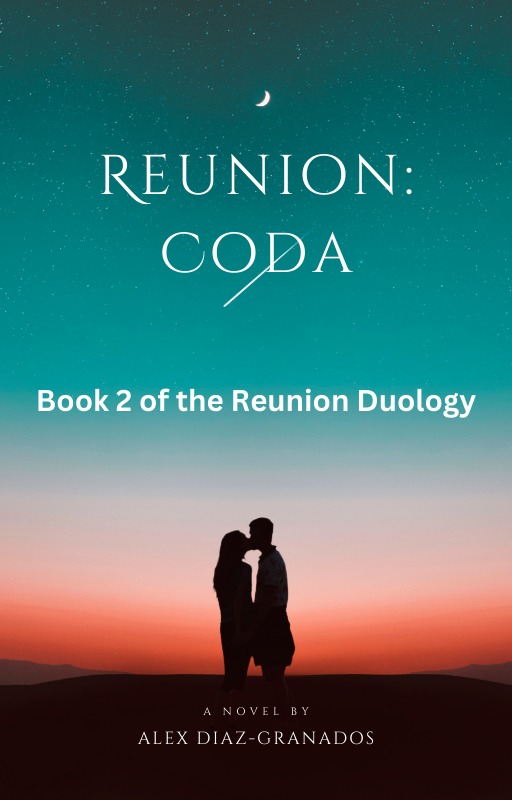
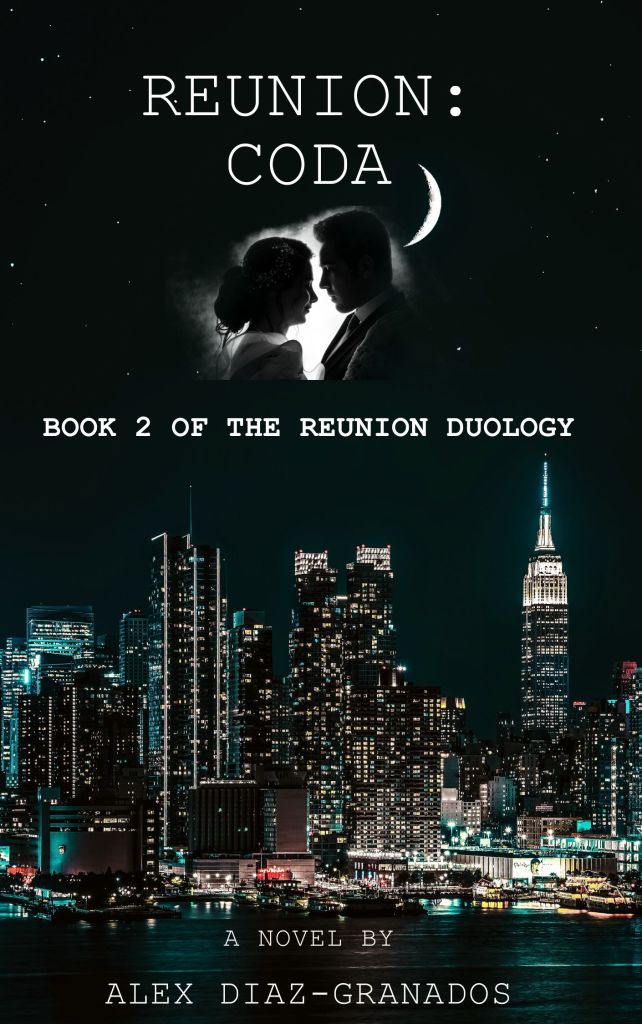
It will. It not only takes up the story two years after the Present-Day setting of Reunion (Book 1), but it also looks backward at Jim’s high school days, from 10th grade to commencement.
At one point, I thought I’d keep things simple (for myself, mostly) and just focus on Jim post-1998. But at least one Amazon review (from the UK) expressed a wish to get the story from Marty’s POV. I couldn’t do that; I’m still new to writing fiction, and telling a story exclusively from a woman’s perspective is not something I can do…yet.
So, after trying to produce a way to tell Jim’s story in 2000 and give readers more of Marty’s story, I chose a dual timeline approach that is a fair compromise. In Book 2, you’ll see how Jim first met Marty in more detail, and even though I don’t contradict the events of Book 1 (much), you’ll see more Jim-Marty interactions that add a richer backstory than the one in the novella.
I understand. Part of my story that I’m working on is from a young man’s perspective and it’s been hard. I keep asking my cousin brothers for help because as someone who was born and raised a woman, it’s really out of the norm for me.
I would love to get more of Marty so I’m glad you found a way to do that without telling it from her POV.
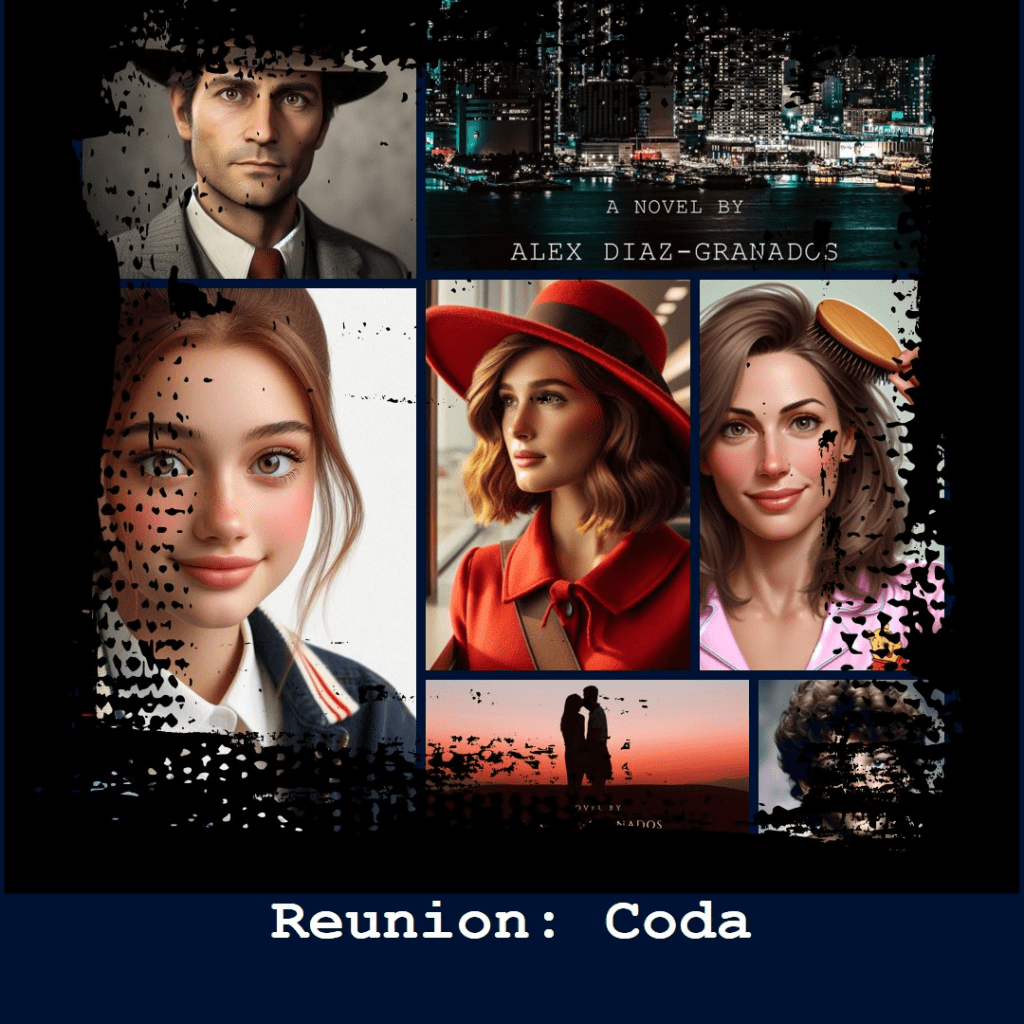
My actor-director friend, Juan Carlos Hernandez, says Marty (as depicted in the novel) is a great character. The story arc must stay true to what is established in Reunion: A Story, but she is a more “present” character in Reunion: Coda, as well as Jim’s “the one that got away.”
True to form, she appears in a few dream sequences throughout the novel, including one in which Jim hears a parody of Men of Harlech (“Boy of Harvard“).
Re writing female characters: Luckily, I lived in an environment in which women were my primary role models, so I can write them well. I sometimes feel a bit less confident about how authentically female they are on the page, but when I read scenes with either Marty or Maddie (as if I had not written them), I am happy with how they come across.
I agree, you did a great job with the female characters. But I think writing from the opposite genders POV is a little more complicated. We may know them well but their innermost thoughts are difficult to get through properly in writing. At least that was my struggle.
Exactly! As well as I know Marty, Maddie, and the various other female characters, I’m not able to “get into their hearts and minds,” so to speak, from a woman’s perspective. Someday, if I ever decide to tell a story from a woman’s POV, I’ll have to conduct interviews with my female friends, like you’re doing with your male cousins for your WIP.




 A Certain Point of View, Too
Comments
28 responses to “More Music to Write Novels By (And Soothe a Writer’s Anxious Brow)”
Sorry you didn’t have a good nights sleep, insomnia sucks so much. I had a particularly bad night last night too. Barely got any sleep.
I thought I was the only one who enjoyed listening to music while writing, it helps me concentrate better. I had mentioned on my blog that I listen to music while writing and everyone thought it was weird lol. Will definitely check out your recommendations.
LikeLiked by 1 person
Because the story of “Reunion: Coda” features many scenes that mention songs and classical compositions, I often listen to either the specific works mentioned or alluded to, or I’ll play a random song to get inspired.
When I wrote Reunion: A Story, which is a smaller story in scale (it mostly takes place during one day of Jim’s life in between the 1998 bookend scenes), I listened to:
“No Absolution” by James Horner (Titanic)
“This Night” by Billy Joel
“Scenes from an Italian Restaurant” by Billy Joel (which inspired the story’s structure)
“Omaha Beach” by John Williams (Saving Private Ryan) for the foreboding mood Jim feels as he walks through South Miami High
“Hymn to the Fallen” by John Williams (Saving Private Ryan) for the bookends. That’s why Jim Garraty ended up being a “young Stephen Ambrose” history prof.
May you have a better night’s rest, P.J.!
LikeLiked by 1 person
Thanks and you as well!
Ooh interesting, I love that the music inspired your writing.
LikeLiked by 1 person
I tend to think of my stories in cinematic terms. A hangover, I suppose, of my love for movies and film scores.
For instance, when I wrote scenes starring Marty in the new novel, I listened to Leroy Anderson’s Forgotten Dreams. I thought of that piece as “Marty’s Theme.”
LikeLiked by 1 person
I think of my stories like that too, like I can see the story playing in my head as I write it.
LikeLiked by 1 person
Re everyone thought it was weird that you listen to music while you write: I suppose many folks need to have a quiet writing environment so they can write with no distractions. Hence all of the “That’s so weird!” reactions.
I need solitude and a “stress-free” attitude so I can write, especially on a major project like Reunion: Coda. That said, a totally silent environment is far more distracting (to me, anyway). I need to hear at least some music (usually, but not necessarily, classical music) playing in the background. I’ve written all of my fiction (including assignments for my Creative Writing class back in 1987) this way.
Usually, I try not to play songs with lyrics when I write so I don’t start paying more attention to Billy Joel, Frank Sinatra, Kiri Te Kanawa, or Carly Simon than to the manuscript. I do make exceptions if the story I’m working has musical references or is a period piece. Most of the time, I prefer classical compositions or film scores; if they happen to happily fit the mood of the scene I’m writing, or serve as a wellspring of inspiration, so much the better.
(I call this “The John Williams Effect,” since his music has been a dominant presence in the soundtrack of my life since I was 14 years old.)
LikeLiked by 1 person
Yeah I think music is distracting for many. For me, it somehow helps me focus more. I don’t like distractions either and need an stress-free, peaceful area to write but music isn’t a problem for me either.
Billy Joel is wayyy too distracting. I would just start singing along lol. I generally prefer music with no lyrics when writing too. These days I love listening to piano pieces.
LikeLiked by 1 person
I try to match the music to the scene I’m writing, especially if the setting is a high school auditorium, a nightclub, or a piano bar, and even more so when I mention specific songs or compositions. This puts me right into the world of the story and helps me visualize the characters and situations better.
There are also times when I have no idea how to put my vague ideas down on Word, but if I know the mood I want to convey, I’ll listen to something that evokes that feeling. For instance, for a quiet romantic scene between Jim and Maddie I’ll put on Debussy’s “Claire de Lune.” In the same vein, if I’m conjuring up a scene from Jim’s high school era, I’ll listen to Anderson’s “Forgotten Dreams.” Very rarely will I put on a song with lyrics unless it’s part of the story itself.
LikeLiked by 1 person
Claire de Lune is so fantastic, perfect for romance scenes.
LikeLiked by 1 person
I also pick scene-specific songs. For instance, when Jim and Maddie share their first dance early in Reunion: Coda, they do so to Jerome Kern and Otto Harbach’s “Smoke Gets in Your Eyes.”
LikeLiked by 1 person
That’s a really beautiful one.
LikeLiked by 1 person
One trait that I share with Jim Garraty is a deep-rooted romantic streak, which is reflected by our love of “standards.”
“Smoke Gets in Your Eyes” is one of my favorite songs. It has been since the first time I heard it…the night before I started 10th grade.
LikeLiked by 1 person
That’s really nice, I don’t think I’m a romantic and I think that shows in my writing. But I admire those that are.
LikeLiked by 1 person
I’m not sure if being a romantic is a blessing…or a curse. It’s a little bit of both. Jim Garraty just carries it better than I do.
LikeLiked by 1 person
Characters are always better at love than us.
LikeLiked by 1 person
I can’t disagree with you there, even though Jim Garraty’s love life has not always run smoothly.
LikeLiked by 1 person
Still, it’s better to have loved and lost. As they say.
LikeLiked by 1 person
Sure. for Book 1, at least. I do like redeeming Jim in Book 2 without straying from who he is as a person. He’s happier in the novel, but even there, he’s still faced with the ghost of Marty, if you will.
LikeLiked by 1 person
I’m very excited for the second book, I think it’ll give us more insight into the characters.
LikeLiked by 1 person
It will. It not only takes up the story two years after the Present-Day setting of Reunion (Book 1), but it also looks backward at Jim’s high school days, from 10th grade to commencement.
LikeLiked by 1 person
That’s really great, a bit of both keeps the story interesting.
LikeLiked by 1 person
At one point, I thought I’d keep things simple (for myself, mostly) and just focus on Jim post-1998. But at least one Amazon review (from the UK) expressed a wish to get the story from Marty’s POV. I couldn’t do that; I’m still new to writing fiction, and telling a story exclusively from a woman’s perspective is not something I can do…yet.
So, after trying to produce a way to tell Jim’s story in 2000 and give readers more of Marty’s story, I chose a dual timeline approach that is a fair compromise. In Book 2, you’ll see how Jim first met Marty in more detail, and even though I don’t contradict the events of Book 1 (much), you’ll see more Jim-Marty interactions that add a richer backstory than the one in the novella.
LikeLiked by 1 person
I understand. Part of my story that I’m working on is from a young man’s perspective and it’s been hard. I keep asking my cousin brothers for help because as someone who was born and raised a woman, it’s really out of the norm for me.
I would love to get more of Marty so I’m glad you found a way to do that without telling it from her POV.
LikeLiked by 1 person
My actor-director friend, Juan Carlos Hernandez, says Marty (as depicted in the novel) is a great character. The story arc must stay true to what is established in Reunion: A Story, but she is a more “present” character in Reunion: Coda, as well as Jim’s “the one that got away.”
True to form, she appears in a few dream sequences throughout the novel, including one in which Jim hears a parody of Men of Harlech (“Boy of Harvard“).
Re writing female characters: Luckily, I lived in an environment in which women were my primary role models, so I can write them well. I sometimes feel a bit less confident about how authentically female they are on the page, but when I read scenes with either Marty or Maddie (as if I had not written them), I am happy with how they come across.
LikeLiked by 1 person
I agree, you did a great job with the female characters. But I think writing from the opposite genders POV is a little more complicated. We may know them well but their innermost thoughts are difficult to get through properly in writing. At least that was my struggle.
LikeLiked by 1 person
Exactly! As well as I know Marty, Maddie, and the various other female characters, I’m not able to “get into their hearts and minds,” so to speak, from a woman’s perspective. Someday, if I ever decide to tell a story from a woman’s POV, I’ll have to conduct interviews with my female friends, like you’re doing with your male cousins for your WIP.
Good luck with your writing projects, by the way!
LikeLiked by 1 person
Yes, it’s best to speak with them and get to know them better. Understand their thoughts and feelings. And thanks so much!
LikeLiked by 1 person
You’re quite welcome!
LikeLiked by 1 person