Did your approach to writing change between the first book and the sequel? If so, how?
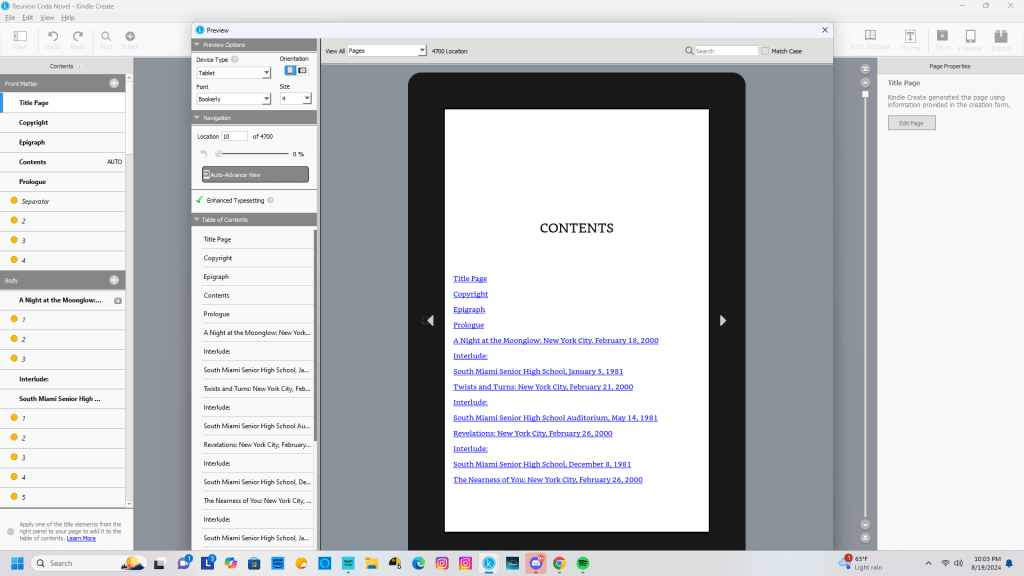
Absolutely, it did. When I penned Reunion: A Story as “Love Unspoken, Love Unbroken” (a title I snagged from a song in Lehar’s The Merry Widow) 26 years ago, I just had the original CRW-2001 assignment “Write a Story with a Dream or Fantasy Sequence” and a goal to see if I could write a short piece of fiction. Publishing it or sharing it beyond my mom and a few friends didn’t even cross my mind. I didn’t have any “how-to” guides on writing fiction either. I had this juicy Jim Garraty tale on my mind and wanted to see if I picked up any skills from that creative writing class a decade ago.
Like I mentioned earlier, I scrapped the original dream sequence since it was too steamy for a broad audience. Even though I wasn’t planning to publish “Love Unspoken, Love Unbroken”, I switched the narrative from present to past tense. I kept the same setting—the library at South Miami High School—but toned down Jim’s fantasy to make it less suggestive.

Forgotten Dreams: June 15, 1983
11 AM: South Miami Senior High/ The Library
I had been sitting in the library for nearly an hour when fatigue and emotional exhaustion finally caught up with me. I’d been leafing listlessly through the final issue of the school newspaper and had nearly finished the lead article (Assistant principal announces retirement) when my eyelids suddenly dropped like shutters on a window, and I drifted off into a deep slumber. I vaguely thought about classes, but – nothing ever happens on the last day – I suddenly didn’t care. Without hesitation, I put my head down on the table and allowed my mind to drop off into a misty netherworld of dreams.
This is what I dreamed:
I am sitting alone in my old English classroom at my old desk, reading from Shakespeare’s Macbeth. The only sounds in the room are the ticking of the clock and the occasional rustling of the pages of the book. Then, Martina Reynaud, the most beautiful girl in the Class of ’83, walks in. She’s tall, graceful, and absolutely breathtaking. She’s wearing a black dress, one that shows off her long dancer’s legs. Her peaches-and-cream complexion is flawless; there is no sign of a pimple anywhere. Her long chestnut hair cascades down over her shoulders. In short, she is the personification of feminine elegance from the top of her head to her high-heeled shoes.
I try to get back to my reading assignment, but the scent of her perfume, a mixture of jasmine and orange blossoms, is beguiling. I look to my right; she is sitting at the desk right next to mine. She gives me a smile. My heart skips a beat. I know guys who would kill for one of Marty’s smiles. She has that effect on most men. Her smile is full of genuine warmth and affection; I can tell by the look in her hazel eyes.
“Hi, Jimmy,” she says. Her voice is soft and melodious; she speaks with a lilting British accent. From what I’ve heard, her family is from England. London, actually.
“Hi,” I reply, feeling about as articulate as your average mango. Then, mustering my last reserves of willpower, I focus my attention on Shakespeare’s play.
“Tomorrow, and tomorrow, and tomorrow,” I recite slowly, like a child learning to read for the first time, “creeps in this petty pace from day to day….”
I falter. I try to read further, but the urge to sneak a peek at Marty is irresistible. It is easier to stop an avalanche than to resist temptation. I put the book down again and I steal a furtive glance at her, hoping fervently she won’t catch me.
Suddenly, her hazel eyes meet mine.
I freeze, thinking that soon I will be flying across the classroom.
I close my eyes, expecting – what? A rebuke? A sarcastic laugh? A stiletto to the heart?
Nothing happens.
I open my eyes. Blink once. Blink twice. Look around.
The classroom is, well, gone. Instead of being in a room with thirty-five desks, a blackboard, a lectern, a teacher’s desk and a bookshelf, I am standing in the middle of what looks like the ballroom in a fashionable hotel. Confused, I look to my right to see if Marty is still there. Yes, she is still there. She gives me another one of those dazzling smiles.
“Come on, Jimmy, let’s dance,” she says. She extends her right hand invitingly and gives me a come-hither stare. In the background, a 1940s-style band like those led by Tommy Dorsey, Artie Shaw, or Glenn Miller, its members dressed in white tuxes, is warming up for its next performance.
I hesitate. I take her outstretched hand, but my feet feel as though they are stuck in industrial-strength concrete. “I’m not a good dancer,” I gasp.
“Come on,” she repeats softly, almost imploringly, “it’s a slow dance.” She tugs insistently at my hand. I don’t dare resist.
The band starts to play, and Martina pulls me closer to her. She places my left hand on her waist and holds my other hand gently but firmly to her side as we sway to the beat of the music. She is right; it is a slow dance. I feel as though I am Fred Astaire. The music picks up momentum. As we dance, my ears prick up as the bandleader segues from instruments to the vocalist.
Where time’s winds blow
That’s where you are;
Your bright eyes glow
Like distant stars.
My heart aches with pent-up yearning as I hold the girl of my dreams in my arms. I look into those wonderful eyes and a million questions rush into my fevered mind at that instant. I try to speak, but Marty places her index finger on my lips and gently shushes me with a Mona Lisa smile. “Don’t say a word,” she whispers. “Let’s just dance, okay?”
I nod meekly, and she gently lays her head on my shoulder. We dance as smoothly and flawlessly as if we have been dancing partners forever. As I close my eyes and follow the rhythm of the song, I feel Marty’s heartbeat and the slow rise and fall of her breathing – we’re that close.
Where time’s winds blow
Things cannot last.
We come and we go
Like ships that pass.
Love’s not always sweet, nor is it just “tomorrows”
It has sharp edges, barbs, and is full of sorrows
Yet we must love, and face the storm
When time’s winds blow…..
The music stops after a while, and we stand in the center of the ballroom, still in each other’s arms. I try again to collect my thoughts, to formulate a question, but all I can think about is her presence. Finally, I manage to whisper: “Marty, I….”
Just then, the school bell – irrelevant now because there were no real classes in session – rang loudly, shattering my dream like a bomb blast breaking a mirror.
I awoke with a start, hating the damned school bell with every fiber of my soul.
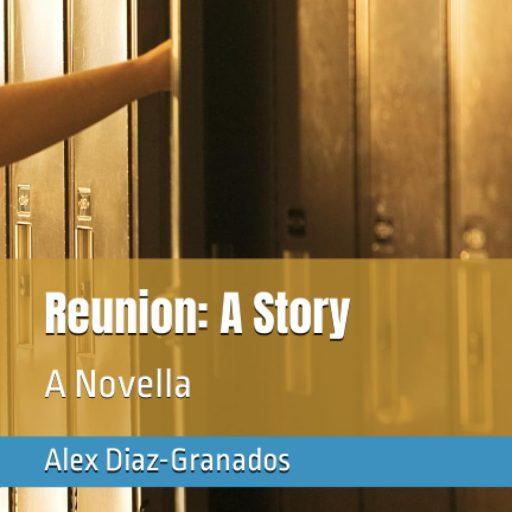
I found that the “frame story” from 11 years ago was still good enough to use for the dream sequence. After tweaking it a bit, it turned into the chapter “Journey’s End”. By adding some parts from 1998 to show Jim as a historian and professor in New York, then having him go back to Miami unexpectedly, it became the core of the current novella.

Did I have a plan? Nope.
Did I know what I wanted “Love Unspoken, Love Unbroken” to be from the start? Not at all. It wasn’t until I wrote the opening line of the Present Day part, showing Jim at a cemetery in Miami, that I figured out how to wrap up what I originally thought was just a standalone story with no sequel in mind.
When working on what is now Reunion: A Story, I often listened to classical music or film scores to create new scenes that matched the mood. Sometimes a piece of music would stick with me, and I’d write something that suited its tone. For example, John Williams’ “Omaha Beach” from Saving Private Ryan totally influenced the somber and tense vibe of the scene where Jim Garraty jogs from the school library to the music wing, looking for his beloved Marty, with a last-minute love confession hidden in his jacket pocket. I don’t think I could’ve written that part without Williams’ sad music playing in the background as I typed away.
When it comes to Reunion: Coda, I’m taking a more systematic approach, even though I haven’t sketched out the whole novel or the individual chapters. For the first 15 chapters, I didn’t use any outlines at all. Each day, I’d read what I wrote the previous day – in Tampa before December 12, 2023, or in Madison, New Hampshire after December 15 – and then just figured out, “What happens next?”
As I near the end of my novel, it’s becoming harder to wing it and just see where the story goes. Now, I have to plan out each scene in detail before writing, even if I already know exactly what my characters need to do to advance the plot and wrap up Jim Garraty’s storyline well.
And this time, I’ve got some new tools in my arsenal, like books that teach me how to write different kinds of scenes—romantic ones, steamy ones, and even fight scenes. Plus, I use Word’s text-to-speech feature to hear how my writing flows, and I have a Beta Reader to catch mistakes that slip past both spellcheck and my own eyes.
 A Certain Point of View, Too
You must be logged in to post a comment.