+🎵 “You Were Here”: Source Music, Intimacy, and the Mixtape Mind of Comings and Goings
Some stories unfold over weeks, with characters shaped by seasons and seismic shifts. Others happen in a night. A moment. A mixtape.
Comings and Goings – The Art of Being Seen takes place over one Boston evening in 1984—a quiet collision of two people, stitched together by cassette tapes, silences that speak, and music that does more than play. It listens back.
For me, writing this story meant living inside that night—breathing with it, soundtracking each heartbeat. Music wasn’t background. It was architecture. Source music, specifically: the kind playing inside the scene, on stereos and radios, heard by characters in real time. Because sometimes, the most honest dialogue between strangers is a shared song.
🎚️ From Static to Stillness: How Source Music Sets the Tone
The night begins in noise. Twisted Sister’s “We’re Not Gonna Take It” blares from someone’s stereo, all bravado and volume. It doesn’t just set the scene—it reflects Jim Garraty’s inner hum of discomfort. He’s not chasing romance. He’s trying not to flinch.
Then “Never Gonna Fall in Love Again” enters the soundscape—bittersweet, crooned, almost deceptively simple. But underneath? Rachmaninoff. The Adagio from Symphony No. 2, quietly repurposed. It’s the kind of melodic ache you might miss, unless you know what it’s quoting.
And Kelly Moore knows.
She doesn’t explain. Doesn’t lecture. But in a moment tethered to that song’s borrowed sadness, she drops the name Rachmaninoff—not to impress, but to offer. It isn’t analysis. It’s fluency in grief, recognition wrapped in restraint.
That’s how she meets Jim. Not with declarations. With resonance.
🛋️ Scenes in Stereo: “This Night” in Kelly’s Apartment
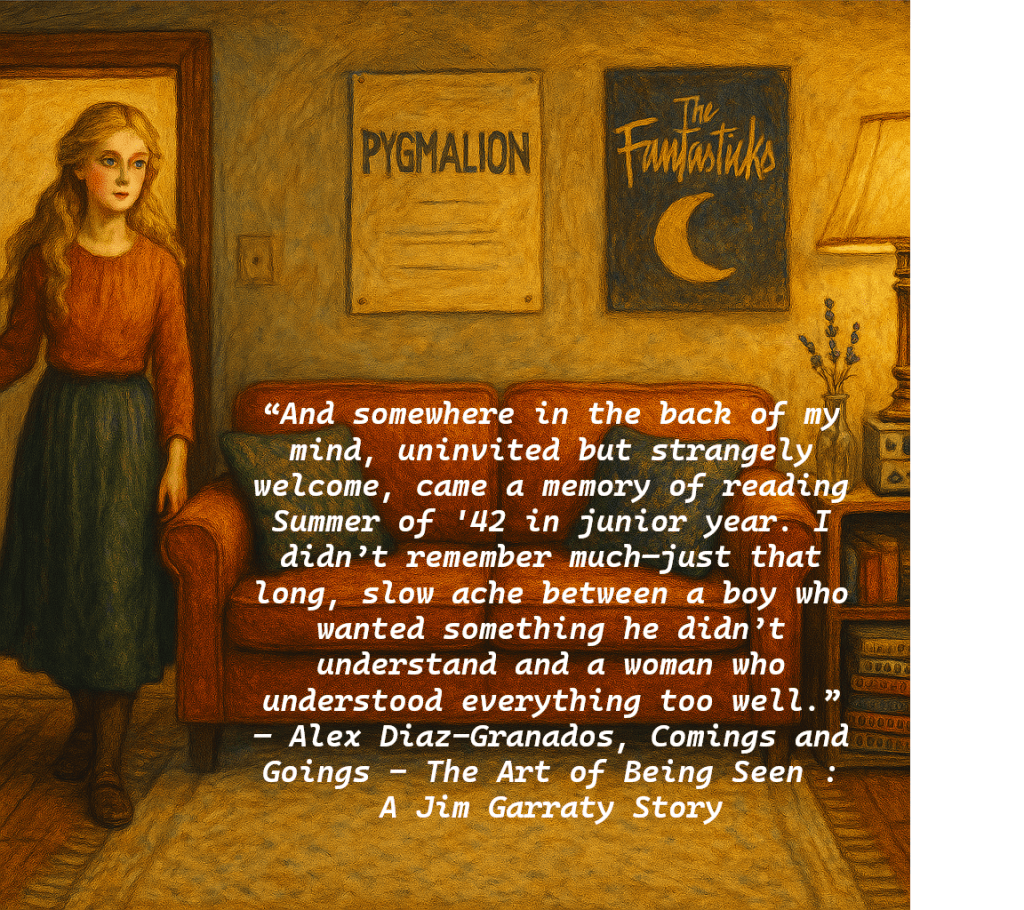
Later, in her walk-up apartment—books half-shelved, lavender by the stereo, mismatched pillows softening the room—Kelly slots in An Innocent Man. Not the first track. She fast-forwards. Stops. Presses play.
“This Night.”
Romantic. Longing. Lifted from Beethoven’s Pathétique Sonata, second movement. Joel’s version is dressed in doo-wop, but its spine is classical heartbreak. It’s a song trying not to say too much, and in that way, it mirrors Jim himself.
As they move through the vulnerable, tentative choreography of intimacy, the music keeps playing. But Jim doesn’t register the tracks that follow. Because what lingers isn’t sound—it’s her. Her calm. Her courage. The way she says “Let me” with no pressure, just presence.
The mixtape fades. She doesn’t.

🛻 Last Tracks, First Truths
There’s a kiss. A drive through quiet streets. And that’s where the echoes begin.
Back in Somerville, alone again, Jim hears Adagio cantabile playing on the radio—not Joel’s borrowed version, but Beethoven’s original. And with it comes a memory of Marty. Another girl. Another goodbye. A fragrance, a hallway, a line of music he thought he’d left behind.
It’s not jealousy. It’s not regret. It’s the recognition that memory doesn’t ask permission. That one song can hold two truths.
Unable to sit with it, Jim ejects the present and chooses familiarity: West Side Story on cassette. Marty’s graduation gift. Ritual, not relief. But it’s enough.
Just enough to carry the ache without drowning.
🎼 The Comings and Goings Soundtrack
A playlist curated by the characters themselves—songs playing in real time, not behind the scene but within it:
| 🎶 Track | 💬 Emotional Undercurrent |
| We’re Not Gonna Take It – Twisted Sister | Rebellion turned white noise; discomfort as volume |
| The Winner Takes It All – ABBA | Artful devastation disguised as disco |
| Never Gonna Fall in Love Again – Eric Carmen | Rachmaninoff’s heartbreak, filtered through soft rock |
| Symphony No. 2 (Adagio) – Rachmaninoff | Ghosted into the story—felt more than heard |
| This Night – Billy Joel | Hesitation made harmonic; borrowed notes, borrowed courage |
| The Longest Time – Billy Joel | The tremble of connection still finding its voice |
| Beethoven Sonata No. 8 (Adagio cantabile) | Emotional muscle memory; the past pressing gently forward |
| Somewhere – Bernstein/Sondheim | The ache of belief in something not yet real—but still hoped for |
🧠 Soundtrack as Soulprint
These songs aren’t backdrops—they’re fingerprints. You can trace them across Jim’s breath, Kelly’s gaze, the spaces between their hands. When I write, I build playlists not as mood boards, but as emotional blueprints. They’re how I find the heartbeat of a scene.
Comings and Goings might only span a few hours, but its emotional timeline is symphonic. Each track serves as a movement, each silence a rest. And when the final scene closes with a stranger humming “This Night” somewhere in the Cambridge dusk, you realize—some songs aren’t meant to be replayed. They echo forward, quietly altering the key of your next step.
If you’ve ever heard a song and flinched with recognition—or paused to remember the way someone looked at you once—then you already understand.
And if you’ve ever built a playlist to hold the things you couldn’t say…
You’re already composing a story of your own.

🎧 This Night: The C&G Soundtrack – Liner Notes
1. “We’re Not Gonna Take It” – Twisted Sister
💥 Defiance wrapped in volume. The party’s first pulse, all bombast and bravado. It doesn’t belong to Jim—it overwhelms him. This isn’t rebellion. It’s refuge in noise.
2. “The Winner Takes It All” – ABBA
💔 Disco’s most elegant heartbreak. A voice breaking inside a major key. It echoes quietly from the corner—grief dressed in glitter, emotion edited down to something people can dance to.
3. “Never Gonna Fall in Love Again” – Eric Carmen
🎼 Soft rock with a hidden ache. Borrowed from Rachmaninoff’s Adagio and steeped in surrender. Kelly hears what others miss—the classical ghost inside the radio croon. That’s her language.
4. “This Night” – Billy Joel
🌓 Beethoven in a doo-wop tuxedo. Romantic, nostalgic, and too sincere to be ironic. Kelly fast-forwards to this one in her apartment—a choice, a risk, a hope. It’s not seduction. It’s offering.
5. “The Longest Time” – Billy Joel
☁️ Uncertainty finding its voice. The joy of connection still untested, unsure. Played in the background as boundaries blur, as nervous laughter edges toward belonging.
6. Beethoven: Sonata No. 8 “Pathétique” – Adagio cantabile (Keduk/Radunski)
🌘 The melody beneath memory. Played later on WCRB, unbidden, unavoidable. It summons not Kelly, but Marty—a ghost of a goodbye Jim never quite shed. One piece, two lives.
7. “Somewhere” – West Side Story (Bernstein/Sondheim)
🌈 Not just hope—impossible hope. A song that asks for a world where people can meet without armor. It’s not played that night, but it lives in the subtext. In Kelly’s gaze. In Jim’s breath.
8. Rachmaninoff: Symphony No. 2 – III. Adagio
🖋️ The unspoken voice beneath Never Gonna Fall in Love Again. Optional addition. Adds weight to Kelly’s recognition and honors the melodic lineage. Grief made orchestral.
9. West Side Story – Overture
🎭 Marty’s gift. The cassette Jim turns to when the ache sharpens. Not because it replaces feeling—but because it lets him survive it with music. Ritual as comfort.
 A Certain Point of View, Too
You must be logged in to post a comment.