Themes, Subtext, and the Uninvited Guests of Fiction
Thursday, December 11, 2025 — Orlando, Florida
I don’t believe every novelist consciously aims to send a message for readers to ponder about themes or social issues. Sure, on some level, we authors create stories reflecting human needs and desires, exploring our religious, philosophical, and political beliefs, or looking at life stages from birth to death. – Alex Diaz-Granados, in a 2024 interview with Thomas Wikman
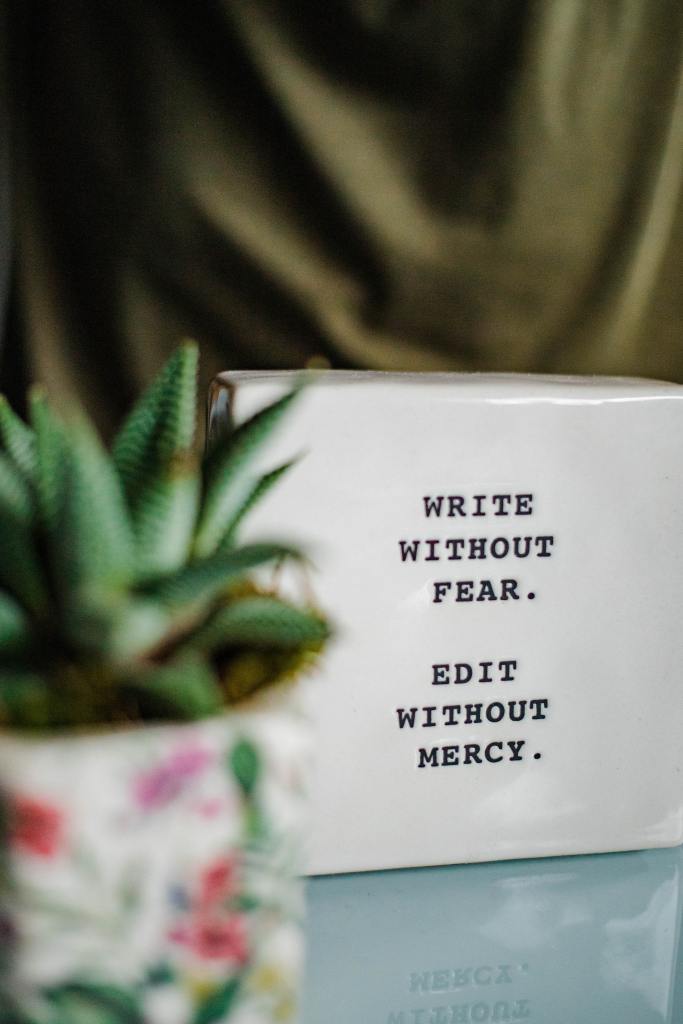
When I sit down to write, I’m not thinking about “themes” or “Big Ideas.” I’m thinking about the nuts and bolts: point of view, tone, character quirks, and whether the story is sprawling or intimate. Drafting fiction is already a juggling act—why add “Insert Theme Here” to the to-do list?
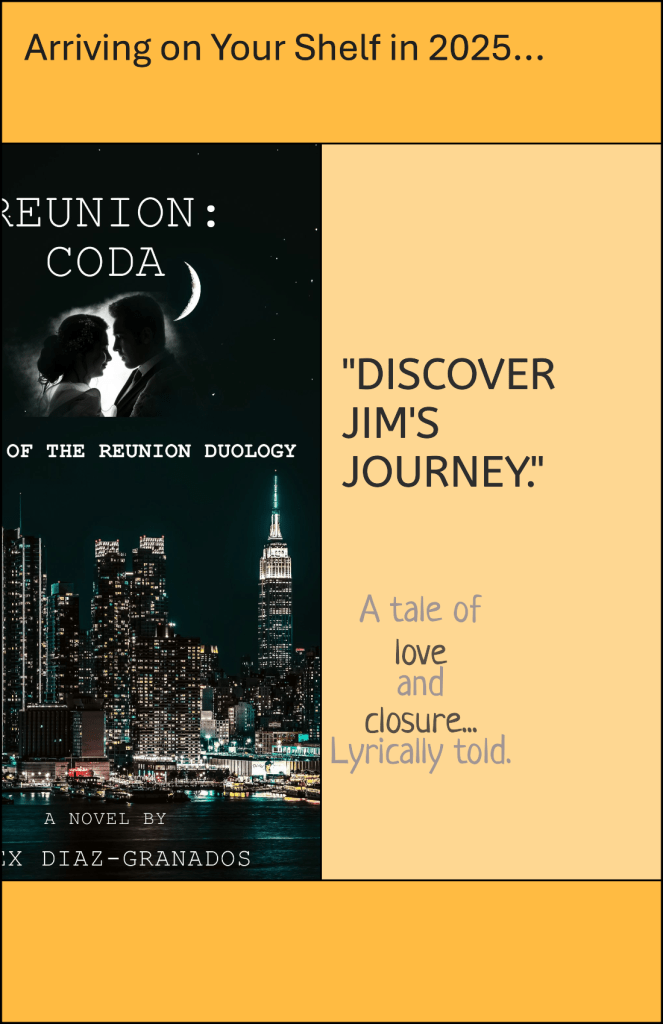
Take Maddie, for instance, one of Reunion: Coda’s leading ladies. When I introduced her, my focus wasn’t on what she symbolized. It was on her voice, her scent, her intelligence, her quirks—the details that make her real. Themes? They weren’t on my conscious checklist. But here’s the trick: if you do the craft well enough, themes sneak in anyway.

Maddie’s Entrance into Jim’s Life
I glance at the bottle of Heineken in my hand, feeling the chill of the condensation on my fingers. It’s a new nightclub, and I’m curious to see what it’s like. I’m not here to hook up, but I wouldn’t mind some company. Maybe someone who shares my passion for history. Someone who appreciates the stories behind the facts. Someone who can make me laugh and think at the same time.
That’s when I hear her voice. “Excuse me,” she says, “Is this seat taken?”
Her accent is refined and elegant, like a mix of Roosevelt’s Mid-Atlantic drawl and a British aristocrat’s clipped tone. I swivel around, and there she is, clutching a bag stuffed with books from Book Culture—that quaint little bookstore on Broadway.
Her hair, the color of caramel, cascades in loose waves that brush her shoulders with effortless grace. Her hazel eyes, framed by arched brows, are luminous and expressive, catching the club’s dim lights like facets of amber and green. Her heart-shaped face, softened by the delicate contours of her cheeks, holds an inviting warmth. Her lips, poised in a polite smile, seem to carry the promise of lighting up even the darkest corner of the room. The sky-blue dress she’s wearing hugs her frame perfectly, a splash of softness against the nightclub’s gritty backdrop. She’s breathtaking.
And she’s a complete stranger.
But something about her reminds me of someone I used to know.
As she steps closer, a faint but unmistakable scent reaches me—jasmine and orange blossom. It’s subtle, almost teasing in its familiarity. For a moment, it pulls me back to humid South Miami nights, and I catch myself on the edge of an old memory.
I shake my head, snapping back to the moment. Take it easy, Jim, I think, that’s just the beer talking.
A jolt of attraction and curiosity rushes through me, unbidden and undeniable. Who is she? What brings her here? And why do I feel like I already know her?
“Is this seat taken?” she asks again, her voice cutting through the din as she shifts the heavy bag of books in her arms. “I hate to bother you, but I really need to put this down before I drop it. It’s heavier than it looks, and if I hold it any longer, someone’s liable to trip.”
Her smile is polite but insistent, and I can tell she’s not used to being ignored. I finally snap out of my daze and gesture at the chair across from me. “Sorry—no, it’s not. Please, sit down.”
She nods her thanks and slides into the chair with natural elegance. She checks the floor quickly before placing her bag under the table, tucking it neatly out of the way. She casts a quick glance around the room, her curiosity evident in the way her eyes dart over the wartime decor and lingering crowds.
“So,” she says, returning her attention to me, her smile lighting up again. “What brings you here?”
“I’m here for the music,” I say, shrugging. “I love the Big Band era. Glenn Miller, Tommy Dorsey, Duke Ellington, Artie Shaw, Benny Goodman… They don’t make them like that anymore.” I point at the stage where the Swinging Millers are about to resume their performance. “And this place has a great vibe. It’s called Moonglow, after all.”
She meets my gaze and smiles. “It does,” she says.
“You’re a swing fan, too?” I ask.
“Sometimes,” she says. “I prefer classical music, but I’m not picky about genres. It depends on my mood, really.”
“I enjoy classical music as well. Beethoven is my favorite, but I also like Bizet, Albeniz, Rodrigo, and Brahms.”
“Those are some of my favorite composers. Who else do you like?”
I hum a few bars of a familiar melody, tapping my fingers on the table. The Moonglow is buzzing with chatter and laughter, but I don’t mind. I like the atmosphere. I look at her and see a spark in her eyes. She knows the tune.
“Mozart, right?” she says, leaning in. “The flute and harp concerto?”
I nod, impressed by her musical knowledge. “You have a good ear,” I say, grinning. “It’s one of my favorites.”
She grins back and tilts her head slightly. “Mine too,” she says softly. “It’s so beautiful and romantic.”

And here’s where the uninvited guests arrive. Themes and subtexts don’t need an engraved invitation; they slip in through the cracks of character and memory. I can fuss endlessly over whether Maddie’s perfume is jasmine or orange blossom, but somewhere in the background, my subconscious is weaving threads of longing, regret, and recognition. Readers will find echoes of their own lives in Jim’s hesitation, Marty’s resilience, or Maddie’s unexpected grace—even if I never sat down with a chalkboard labeled “Lesson Plan.”

When I first drafted Reunion: A Story nearly 28 years ago, I wasn’t pondering big themes like teenagers making bad choices. I was grieving the loss of a classmate who had died in a car crash. That grief seeped into the story whether I wanted it to or not. Subtext doesn’t ask permission; it simply shows up.
Across the Reunion Duology, readers may notice:
- Jim’s hidden affection for Marty is a reminder that hesitation can cost us dearly.
- His bond with Mark is proof of the power of honesty and trust in friendship.
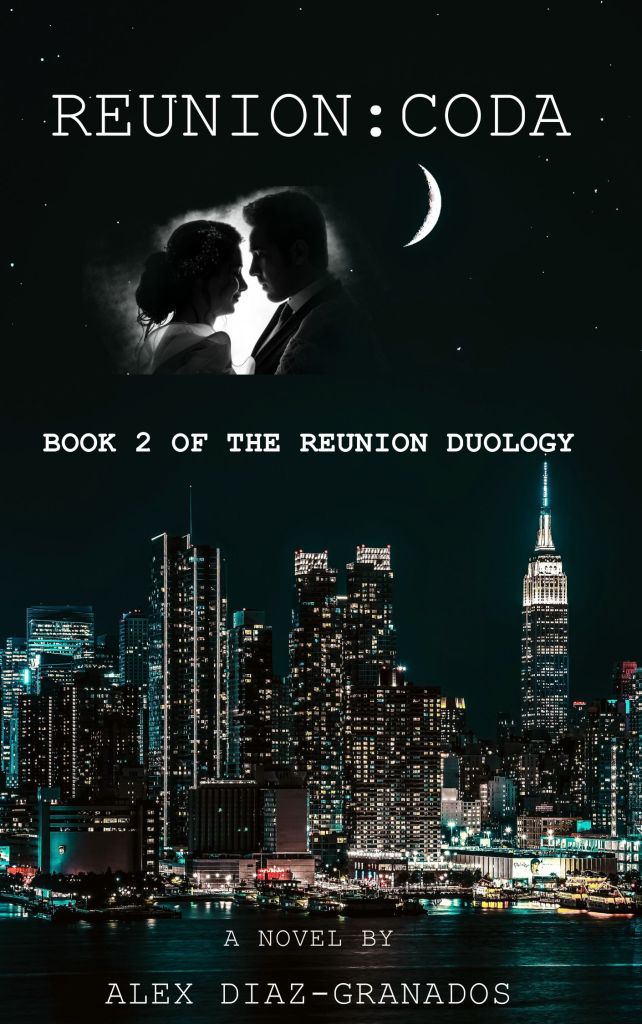
- His journey in Reunion: Coda is a call to embrace mistakes and seize new chances at love.
But above all, I hope readers enjoy the books as stories—alive, engaging, and fun. If themes and subtexts appear, it’s because the characters demanded them, not because I forced them.
Closing thought: Fiction is a mirror we polish with craft. If we polish it well enough, readers will see more than just the reflection we intended—they’ll see themselves.
 A Certain Point of View, Too
Comments
2 responses to “On Writing and Storytelling: Themes, Subtext, and the Uninvited Guests of Fiction”
Thank you Alex for mentioning my interview with you
https://leonbergerlife.com/2024/09/02/an-interview-with-author-alex-diaz-granados/
LikeLiked by 1 person
You’re welcome, Thomas!
And thank you for interviewing me….and allowing me to include our chat in my novel’s Back Matter pages.
LikeLiked by 1 person