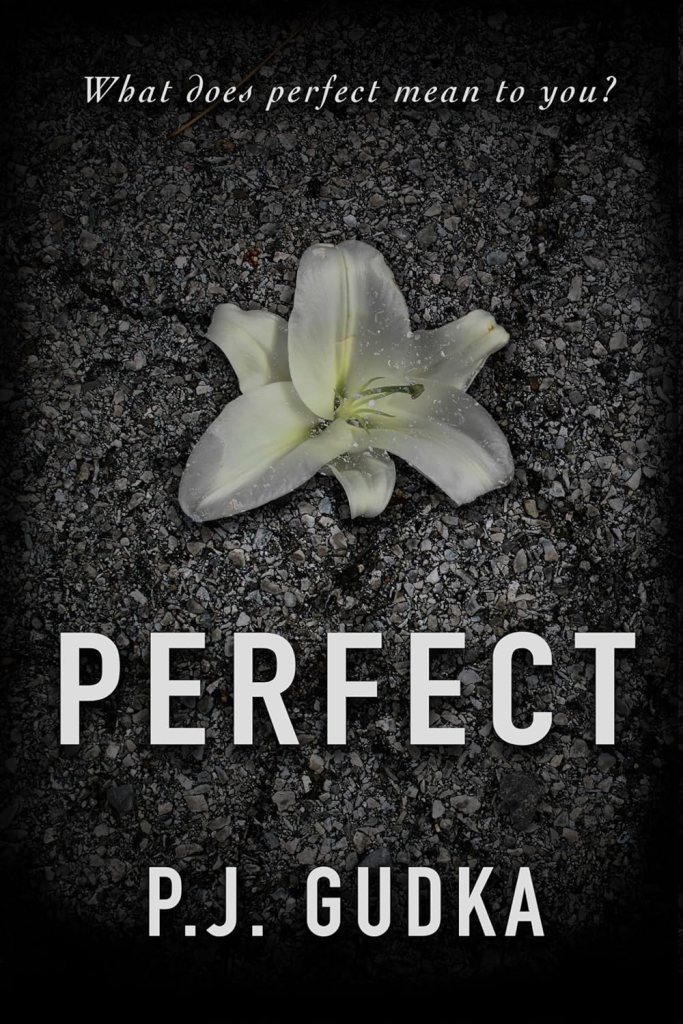
Perfect
By: P.J. Gudka
Publisher: Wild Ink Publishing
Year of Publication: 2026
Genre(s): Murder Thriller, Psychological Fiction, Psychological Thriller
From the Publisher
A mother protecting her son.
A boy spiraling into darkness.
A girl who never stood a chance.
Sally thinks she’s succeeded in breaking generational curses until she finds out her eldest son, James, is the prime suspect in Lily Johnson’s murder. After years of bliss, she’s forced to revisit dark family secrets she believed she had left behind. Even more unsettling is that the deeper she digs, the more she realizes she may not know James as well as she thought.
James is certainly not the perfect son his mother believes he is. He has always felt painfully different from everyone around him—until he meets Lily Johnson. At first, their relationship seems flawless, but soon the cracks begin to show, leaving James questioning everything, including his own sanity and just how far he’ll go to protect the girl he loves.
After her father’s death, Lily’s mother marries Paul—a man Lily despises. And if that wasn’t devastating enough, Paul moves their family to the small town he grew up in. They thought Lily would be safer there, but little did they know the town holds secrets none of them could have imagined. Secrets some would kill to protect. And Lily finds herself in the middle of it all.
Perfect is an emotionally gripping psychological domestic thriller that explores the impact of dark family secrets and the generational trauma they create. It will have readers questioning how well we know those we love—and how far we’re willing to go to protect them.
My Take
After publishing All the Words I Kept Inside, a collection of serious, often dark poems, in the summer of 2024, P.J. Gudka—creator of the Lifesfinewhine blog on WordPress—set out on a more ambitious literary adventure: writing her first novel, Perfect.
If you, like me, are a regular reader of P.J.’s blog, you probably suspected that her first foray into long‑form fiction would reflect her fondness for wry, shadow‑tinged themes—the kind fans of Alfred Hitchcock, Robert Bloch, or Brian De Palma will recognize.
Perfect is a straightforward psychological thriller that takes its cues from High School Confidential, Peyton Place, and some of Hitchcock’s darker films, including Rear Window and Frenzy. Told from multiple points of view, the narrative gives readers insight into the complex dynamics of high school life in small‑town America, as well as the lingering effects of childhood trauma and the pressures of pursuing perfection.
Because this is a murder mystery set in a small town, I won’t delve too deeply into the plot. I will say, though, that Gudka handles plotting and pacing well, and she kept me guessing about the killer’s identity until the end.
I also appreciated her decision to tell the story through three first‑person narrators—Sally, her teenage son James, and Lily, James’s girlfriend. In the hands of a less skilled writer, this could have gone wrong quickly, but Gudka makes it work.
That said, I struggled with some of the storytelling choices. I’m not sure whether Gudka was aiming for a Mary Higgins Clark–style “anytown” atmosphere, but I never quite felt that the characters lived in a real, grounded place in 21st‑century America. Aside from a few pop‑culture references—It’s Always Sunny in Philadelphia, for instance—the setting feels more like Anytown, U.S.A. Even the high school James and Lily attend is oddly anonymous.
I also had issues with some of the dialogue attribution. Not the dialogue itself, but the tags attached to it. For example:
“How could you do that to me, John?” I questioned further…
“James interjected.”
“I instructed harshly.”

These tags often do more work than necessary. Simpler tags—I asked, James said, I said—would keep the scene moving. The emotions are already clear from the dialogue and context, so the heavier tags slow the rhythm without adding much. In tense scenes, cleaner attribution would let the emotion land more naturally.
Still, despite its imperfections, Perfect is a compelling story, and Gudka’s strengths as a storyteller shine through. The novel has enough suspense, emotional weight, and narrative momentum to keep readers engaged, even when some stylistic choices don’t quite land. For a first novel, it shows real promise, and I look forward to seeing how Gudka develops her craft in future books.


Share your thoughts with the world!