
I wish to have no connection with any ship that does not sail fast; for I intend to go in harm’s way. – John Paul Jones
Back in 1989, while I was studying journalism at Miami-Dade Community College, I proudly owned an Apple IIe computer. Besides writing, my limited social life meant I spent countless hours gaming. My fascination with military strategy drew me to captivating titles like MicroProse’s F-15 Strike Eagle and Lucasfilm Games’ thrilling Strike Fleet.
Strike Fleet, a classic naval simulation published by Electronic Arts in 1988, featured scenarios inspired by real military operations such as the Falklands War, the USS Stark incident, and intense Cold War campaigns. Although its graphics might seem primitive today, the game struck a perfect balance between realistic events and enjoyable gameplay, securing its place as one of my all-time favorites.

It may be easy for some, after a near-record 54-month economic recovery, to forget just how critical the Persian Gulf is to our national security. But I think everyone in this room and everyone hearing my voice now can remember the woeful impact of the Middle East oil crisis of a few years ago: the endless, demoralizing gas lines; the shortages; the rationing; the escalating energy prices; the double-digit inflation; and the enormous dislocation that shook our economy to its foundations. – President Ronald Reagan (at a press conference on May 29, 1987)

I bring up Strike Fleet because it connects to Triassic Games’ Sea Power: Naval Combat in the Missile Age, also published by MicroProse. Two scenarios from Strike Fleet – The Road to Kuwait and Dire Straits – foreshadowed the thrilling Hormuz NATO mission in Sea Power, rekindling fond memories and showcasing the evolution of naval combat simulations.

Last night, when I completed the Hormuz mission for the first time since Sea Power was released in Early Access on Steam in November, I thought of my old 1980s favorite. Partly because Hormuz combines elements of The Road to Kuwait and Dire Straits, but mostly because I applied many of the tactics I learned while playing Strike Fleet to shepherd two U.S.-flagged tankers (one less than in The Road to Kuwait) from the Gulf of Aden into the Persian Gulf via the narrow and dangerous Strait of Hormuz.

Tactically, the situation in Hormuz resembles that in Dire Straits: you command three U.S. Navy warships – the Belknap-class cruiser USS Fox, the Oliver Hazard Perry-class frigate USS Crommelin, and the Kidd-class destroyer USS Kidd – and two reflagged tankers through an Iranian blockade that includes missile-armed frigates, U.S.-made aircraft like the F-4 Phantom II and Northrop F-5 Freedom Fighter, SH-3 Sea King helicopters, and speedboats armed with heavy automatic weapons.
Oh, yes. And the occasional volley of land-based anti-ship SS-N-2 Styx cruise missiles will come your way.

Since November, I’ve been working on completing the two-star Hormuz mission. The objective is straightforward: protect the tankers until your convoy reaches a certain area in the Persian Gulf. This mission doesn’t involve Iranian submarines but requires careful management of time compression since saving and loading aren’t available yet. This adds to the challenge due to the mission’s length and the convoy’s slow speed of 15 knots. Until last night, I had only been able to sink three Iranian frigates and shoot down a few enemy planes before exiting the game.

I won’t bore you with a detailed account of how I beat Hormuz. I might do one of those after-action “news articles” the next time I play through the scenario. I will say, though, that I’m impressed with how the developers designed the mission: the enemy AI was clever enough to position Iranian aircraft in such a way that USS Fox depleted her 32 SM-2 surface-to-air missiles (SAMs) in an attempt to shoot them down. Fox did manage to knock out quite a few Iranian F-4s and F-5s trying to approach my convoy, but many of the enemy planes used chaff and evasive maneuvers to avoid being hit. Luckily, Crommelin and Kidd had enough SAMs of their own to defend the convoy in case the Iranians pressed their air and missile attacks. If Fox had been the tankers’ sole guardian, the mission would have ended in disaster.
I earned a Decisive Victory at the end of Hormuz, but it wasn’t a perfect mission. I don’t know whether I gave a wrong order or there’s a bug in Sea Power – remember, the game is still in Early Access – but somewhere along the line, USS Kidd stopped conforming to formation orders and did its own thing. At one point, the destroyer – one of four in what sailors puckishly nicknamed the “Dead Admirals Class” – stopped dead in the water, then failed to rejoin the formation when ordered. Instead, she meandered amidst the convoy until, finally, she collided with a tanker and sank in the Persian Gulf.
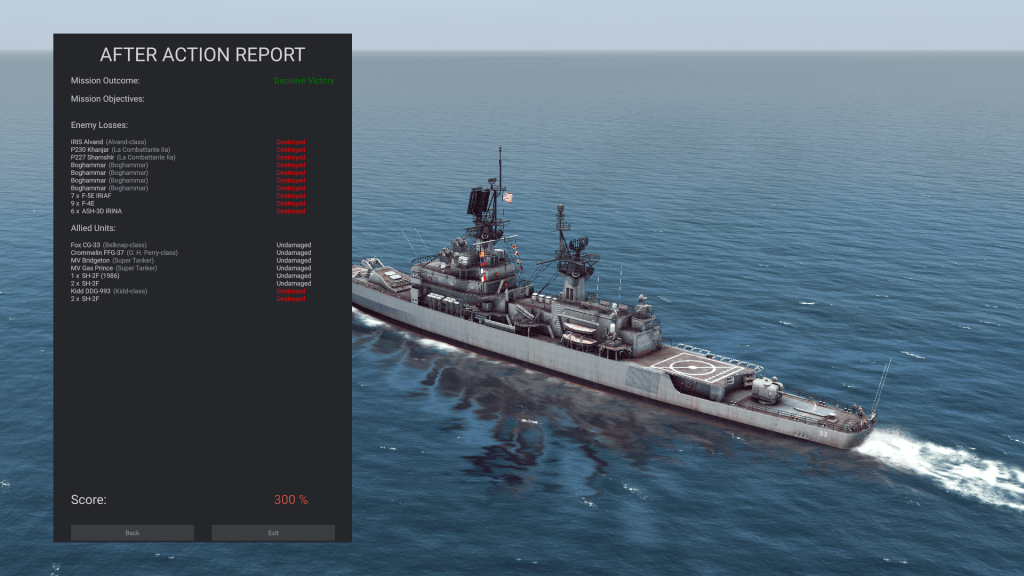
 A Certain Point of View, Too
You must be logged in to post a comment.