On Being Quoted (Unexpectedly) by an Editorial Board
Every once in a while, the universe tosses a small, pleasant surprise your way — the kind that makes you blink twice, lean back in your chair, and mutter, “Well, how about that?”
This week, mine came in the form of a quote.
Not just any quote, and not from a reader comment or a social media share.
No — this one came from the Republican-American Editorial Board, which decided to cite a paragraph from a review I wrote back in 2021 about Ken Burns and Lynn Novick’s Prohibition documentary.
To say I wasn’t expecting that would be an understatement.
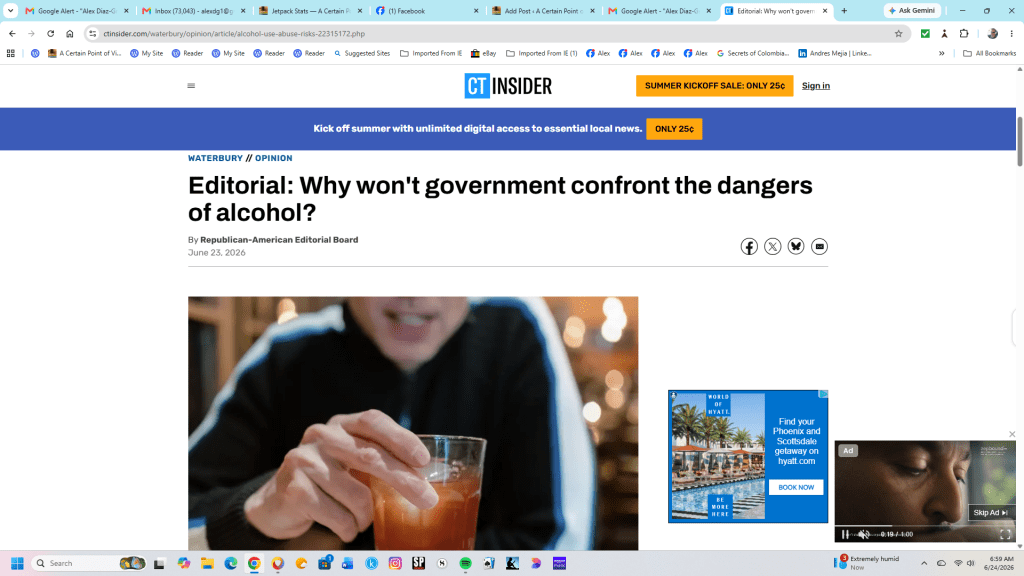
The editorial — titled “Why won’t government confront the dangers of alcohol?” — opens with the familiar lament that any attempt to regulate harmful behavior inevitably summons the ghost of Prohibition. Then, right after setting the stage, the board drops in a passage from my review:
“(M)ost Americans knew that alcohol abuse was a social problem that needed to be addressed,” Alex Diaz-Granados wrote in a 2021 review of the miniseries. “Many individuals, even those who were drinkers, tried to obey the law as a matter of good citizenship. As a result, alcohol-related car accidents were reduced, and public drunkenness arrests went down sharply within the first 12 months after Prohibition became the law of the land.”
Seeing my own words — written for a modest WordPress review that doesn’t exactly set traffic records — suddenly living inside a newspaper editorial was… surreal. In a good way.
What struck me most was why they used it. The editorial’s argument hinges on the idea that Americans have a selective memory about Prohibition. We remember the speakeasies, the gangsters, the flappers, the jazz. We don’t remember the social crisis that led to the 18th Amendment, or the fact that, for a brief moment, the law actually did what it set out to do.
Republican-American Editorial Board (Waterbury, CT)
“(M)ost Americans knew that alcohol abuse was a social problem that needed to be addressed,” Alex Diaz-Granados wrote in a 2021 review of the miniseries. “Many individuals, even those who were drinkers, tried to obey the law as a matter of good citizenship. As a result, alcohol-related car accidents were reduced, and public drunkenness arrests went down sharply within the first 12 months after Prohibition became the law of the land.” If anyone remembers that chapter of the Prohibition story – including, notably, the terrible effects of the alcohol habit in the decades before Prohibition – he most likely keeps quiet about it.
That’s the part of the story I tried to capture in my review — not as a political statement, but as a historical reality. Apparently, that was exactly the nuance the editorial board needed.
I’ll admit: it’s flattering. Not in a “frame it and hang it on the wall” way, but in the quiet, satisfying sense that something I wrote — something I researched, shaped, and tried to phrase clearly — found its way into a larger conversation. Writers don’t always get to see where their words travel. Most of the time, they vanish into the digital ether without so much as a ripple.
This time, one of them made a ripple.
And that’s enough to make a writer’s day.


Share your thoughts with the world!