On Writing and Storytelling: Why An Innocent Man Had to Score “This Night”
Some choices in storytelling are deliberate. Others are instinctive—felt before they’re understood. When I wrote Comings and Goings, I knew Jim and Kelly needed music playing in the background of their brief, luminous night together. I also knew it had to be something from 1983 or early ’84, something they could plausibly have on cassette, something that wouldn’t dominate the scene but would quietly shape it.
What I didn’t realize at first was that the album I chose—Billy Joel’s An Innocent Man—wasn’t just a good fit. It was the only fit.
1. Starting in the Middle: Why Kelly Skips “Easy Money”
Technically, the album opens with “Easy Money,” a punchy, slightly goofy track written for a Rodney Dangerfield movie. It’s fun, but it’s also the one song on the album that feels like it wandered in from somewhere else.
Kelly knows that.
She doesn’t want brassy comedy. She doesn’t want swagger. She doesn’t want a song that winks at the audience.
She wants tone. She wants mood. She wants something that matches the quiet, unexpected intimacy unfolding between her and Jim.
So she skips it.
She goes straight to “This Night,” the emotional center of gravity for the entire album—and for the scene. And later, during a pause, she rewinds to track 2, “An Innocent Man,” because that’s the song that speaks to who Jim is in that moment.
This isn’t just a musical choice. It’s a character choice. Kelly is shaping the emotional space they’re sharing.
2. “An Innocent Man”: A Man Learning to Feel Again
The title track is about someone who’s been hurt, who’s wary, who isn’t sure he has anything left to offer… until someone unexpected comes along and makes him feel seen again.
That’s Jim in 1984.
He isn’t looking for romance. He isn’t trying to impress anyone. He’s simply trying to survive a night he didn’t want to attend. And then Kelly appears—wry, warm, perceptive—and suddenly he’s feeling things he didn’t expect to feel again.
When Jim sleeps with Kelly, he really is an innocent man. Not just sexually inexperienced—but also emotionally inexperienced. He’s rediscovering tenderness after a long emotional drought.
The song doesn’t play during the love scene, but its spirit is everywhere.
3. “This Night”: The Emotional Architecture of the Scene

“This Night” is the track that most directly mirrors the emotional truth of what happens between them. It’s a song built on longing, restraint, and the ache of wanting something you’re not sure you’re allowed to want.
It’s romantic without irony. Vulnerable without apology. Yearning without melodrama.
That’s the atmosphere in Kelly’s apartment.
Jim isn’t suave. Kelly isn’t performing seduction. They’re two people suspended in a moment that feels separate from the rest of their lives. “This Night” captures that sense of fragile possibility—the feeling that something fleeting can still be meaningful.
It’s no accident that this is the song Kelly chooses first. It’s the emotional truth of the scene distilled into melody.
4. “The Longest Time”: A Moment That Doesn’t Have to Last to Matter
“The Longest Time” is a song about rediscovering hope after giving up on it. It’s about being surprised by connection, about letting yourself believe in something gentle even if you know it might not last.
That’s Jim and Kelly.
Their night together isn’t a grand romance. It isn’t destiny. It’s a constellation that appears once and never again—but it leaves a permanent mark on Jim’s emotional sky.
The irony is beautiful: the song is about something lasting, but the moment it scores is fleeting. Yet the feeling of that night stays with Jim for decades.
5. And Maybe… “Keeping the Faith”
If there’s a fourth track that resonates, it’s “Keeping the Faith,” a song about looking backward, holding onto the past, and trying to make sense of who you used to be.
Jim is a college freshman caught between the boy he was and the man he’s becoming. Kelly is a reminder that the past doesn’t have to define him. Their night is a hinge—quiet, small, but pivotal.
6. A Lifelong Habit: Scoring Stories with Music
If this all sounds intentional, it is—but not in the way people might think.
I’ve been “scoring” my stories since junior high. Back then, it was John Williams soundtracks on cassette, or classical pieces I heard on the radio, or standards I’d learned in Ms. Owen’s chorus classes at South Miami High. Later, it became pop songs—like “The Winner Takes It All” or “Never Gonna Fall in Love Again,” both of which appear in the chapter where Kelly decides to take Jim home.
Music has always been my creative ignition switch.
A melody can unlock a scene. A lyric can suggest a character’s emotional truth. A chord progression can whisper, “Here’s the story you’re trying to tell.”
I was doing this at sixteen and seventeen. I’m still doing it in my sixties. And Comings and Goings is one of the clearest examples of how deeply music shapes my writing.
Why This Album, and No Other
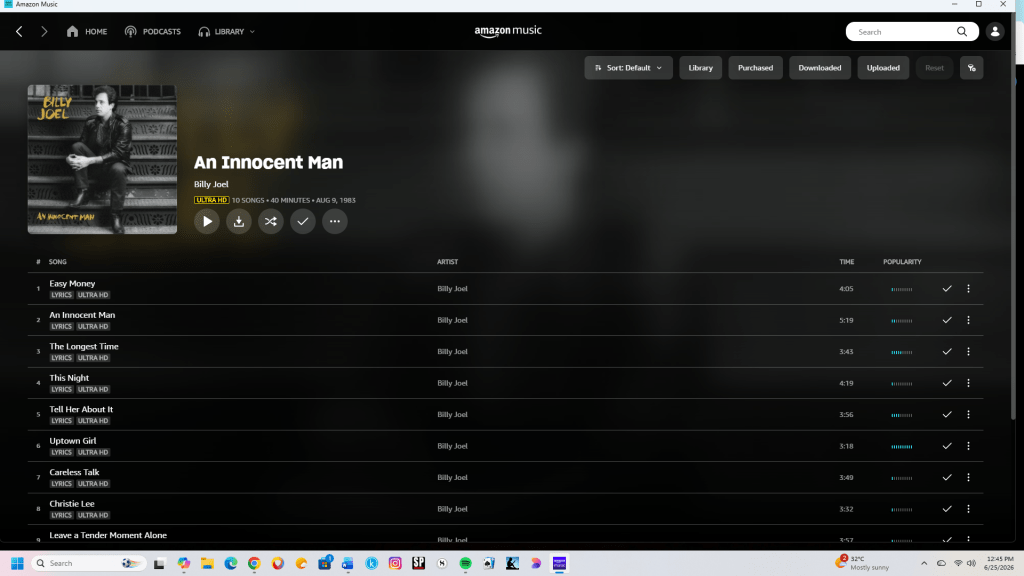
An Innocent Man is an album about emotional rebirth. About vulnerability without guarantees. About moments that don’t have to last to matter. About men who aren’t performing masculinity, but simply trying to be honest.
That’s why it had to be the soundtrack to Jim and Kelly’s night.
Not because it was popular in 1983. Not because I happen to love it. But because it speaks the same emotional language as the story.
It’s the album of a man learning to feel again. And that’s exactly what Jim does in Kelly’s apartment—quietly, unexpectedly, and for the first time in a long while.


Share your thoughts with the world!