
Friday, June 26, 2026 — Orlando, Florida
“The mediocre teacher tells. The good teacher explains. The superior teacher demonstrates. The great teacher inspires.” — William Arthur Ward
Ms. Owen was my mentor. She was special — an amazing chorus director and someone I always wondered about long after graduation. I am saddened to hear of her passing, but grateful that she lived a long life and left this world peacefully. She will always hold a very special place in my heart. — Lily Gonzales Ham, South Miami Senior High School alumnus and chorus member, Class of 1983
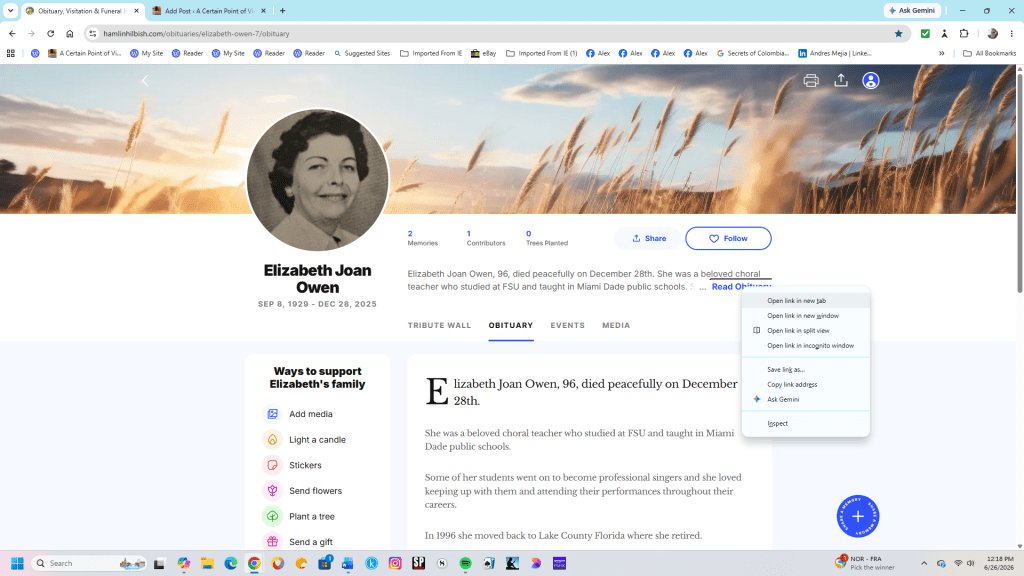
Elizabeth Joan Owen: September 8, 1929 – December 28, 2025
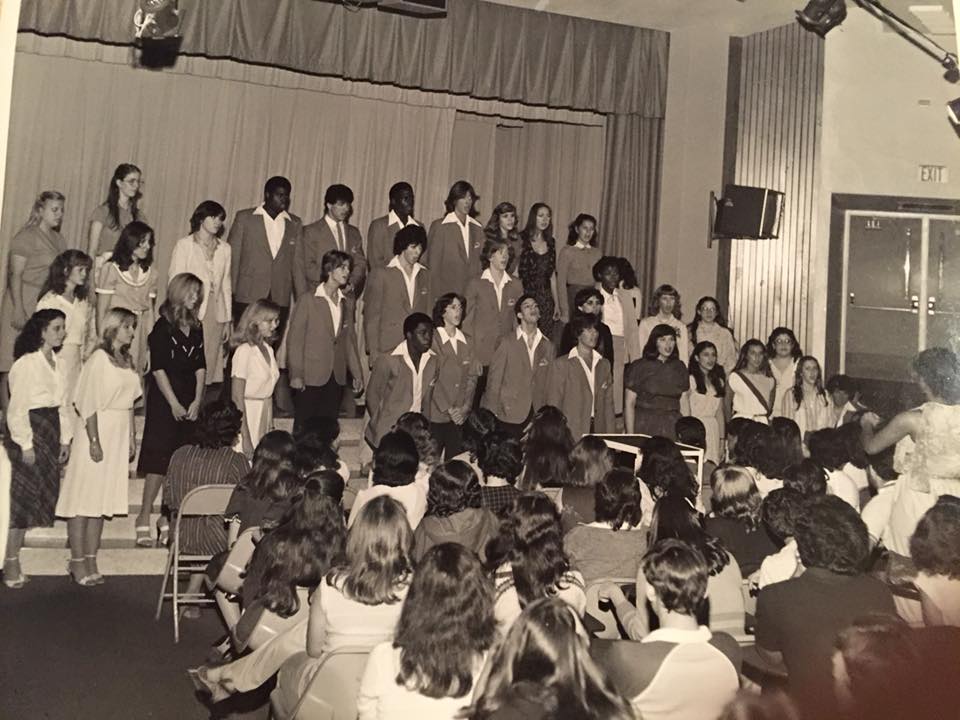
It has been more than 43 years since I last saw Ms. Elizabeth Joan Owen in Room 136, the practice room in the music annex at South Miami Senior High. It was sometime after St. Patrick’s Day in 1983 — I remember that much — and the occasion was a somber one. She had just announced that it would be her last day in Cobra Country. She had been offered an opportunity elsewhere, and although she was saddened that she would not lead us in one final concert that May, she could not pass it up. She had to leave immediately. (I believe it may have been with the Miami Boys’ Choir, though I’m not entirely certain.)
I don’t remember her farewell address word for word; like most of my fellow singers in Mixed Chorus II, I was in shock. But I do remember that she understood our surprise and sadness. She hoped we would learn to seize opportunities whenever life offered them, because they might lead to greater and better things.
After her remarks, she used the rest of our 50‑minute period for an impromptu awards ceremony. She handed out medallions — bronze, I think — with stylized lyres on the front and Mixed Chorus 1983 carved on the back. She told us she had wanted to give one to everyone, but the funding simply wasn’t there, so she asked us not to feel hurt if our names weren’t called.
At the time, I didn’t expect to be among those chosen. Yes, I had joined the choral department in January 1981. Yes, I had earned A’s every grading period and even sung a solo — “White Christmas” — at the 1981 Winter Concert. I knew Ms. Owen liked my singing and believed I had potential. Even so, I didn’t think I merited an award. I was a student journalist first and foremost, not someone pursuing a future in music.
How wrong I was.
The following excerpt from Reunion: Coda transforms that real farewell into fiction, recasting Ms. Owen as Mrs. Quincy, Jim Garraty’s chorus teacher. In this scene, memory and imagination converge as Jim relives the unexpected moment when a teacher’s parting gesture reveals just how deeply she had seen — and valued — one quiet student.

Digging once more inside the shopping bag from Burdine’s, Mrs. Quincy pulled out a sheet of paper that I presumed was a list of the students who would receive one of those medallions. Of course, I couldn’t see the names, but I was convinced that my name was not among the lucky ones; I wasn’t a music major, after all, and I genuinely thought that most of the other class members were far better singers than I.
“All right,” Mrs. Quincy said. “I’m going to call out names in alphabetical order. When you hear your name, please walk up to me in an orderly manner, quietly, and accept your award, then quietly take your seat. Any questions?” She surveyed the room with her blue-gray eyes, trying to convey a business-like demeanor, but even though – as I said earlier – I was not great at reading body language, I could tell she wished that the timing of her departure had come later in the school year and not before our last concert together.
When no one spoke – her instructions had been explicit and clear, and we were all still trying to come to terms with the fact that she was leaving that same day – she simply nodded and started reading names from her list. “Alicia Aleman,” she called out, and one of the girls over in the soprano section – at the far end of the room opposite from where we guys sat – rose from her chair with as much dignity as she could muster, walked down to where our teacher stood, and – fighting back the occasional sniffle – quietly accepted her medallion.
“Alicia,” I heard Mrs. Quincy say sweetly, “whoever teaches you here next year – Mr. Abner is only here for the rest of this semester – will be blessed to have you in class. You are a marvelous singer, and it was an honor to be your teacher.”
“Thank you, Mrs. Quincy,” Alicia said. She gripped her award…or token of appreciation…or whatever it was in her hands, turned around, and quietly walked back to her seat.
For the next 10 minutes or so, I watched and listened as Mrs. Quincy went through her list. She went through the A’s, B’s, C’s, D’s E’s, and F’s at a steady pace, and because – it seemed to me, anyway – that the medallions were all going to be given to the “real” singers who were planning to make music a profession, I had more or less stopped paying close attention after she’d called the various students with the last name “Diaz” or variations thereof.
I was thus lost in my thoughts (mostly about hoping that the Spring Concert would go on as scheduled and that Marty and I could still practice “Somewhere” together) and not paying attention to what was going on in class when suddenly my fellow baritone Bruce Holtzman tapped me on my shoulder and whispered, “Hey, Jim. Mrs. Quincy just called your name….”
And if that weren’t embarrassing enough, I heard our chorus teacher say, in that tone that I recognized from the rare instances when she was annoyed, “Mister Garraty? Are you still with us?”
“Yes, yes, ma’am,” I managed to utter in my most apologetic tone. “I’m still in a bit of shock, though.”
For a moment, Mrs. Quincy stared at me stonily, as if she wanted to send me to the principal’s office or to SCSI – School Center for Special Instruction, which is where students who had flouted the rules in class served an in-school suspension. But as I rose from my metal folding chair and walked down to where she stood, I could see her expression softening, and the sternness on her face vanished, replaced by a gentle if bittersweet smile.
I stepped up to her, standing as close to attention as someone who has not served in the military can. Eyes forward. Shoulders back. Chest out. Arms at your side. Spine ramrod straight, Jim, I thought. She held out a medallion – it was made from a bronze-like metal, round, and three inches in diameter. It depicted a musical instrument (It’s a lyre, you dolt, I heard my inner voice scolding me) and it bore a lamp – like Aladdin’s – in the center.
“I bet,” Mrs. Quincy said in a soft voice so low that I had to strain to hear her, “you thought I had forgotten you, right?”
I didn’t say anything, but a fiercely hot blush that burned my cheeks and my lowered gaze told Mrs. Quincy my true feelings. As she pressed my award…or farewell gift…or whatever the medallion was supposed to represent into my hand, she said, still speaking so I alone could hear her, “How could I ever forget that shy 10th grader who sang ‘Ben’ in my office before homeroom two years ago? I’m proud of you, Jim. You’re a good student. You’re a great singer. And you’re a fine young man.” She smiled gently, then, patting me once on my left cheek, said in a louder voice, “Thank you, Mr. Garraty. Now, take your seat. I still have a few more of these to hand out.”
That fictionalized moment is close enough to memory that writing it still brings me back to Room 136. The names have changed, and Jim Garraty is not quite me, but the feeling at the center of the scene — the surprise of being recognized by a teacher I admired — belongs entirely to that day.
“There are two kinds of teachers: the kind that fill you with so much quail shot that you can’t move, and the kind that just gives you a little prod behind and you jump to the skies.” — Robert Frost
I never saw Ms. Owen again after that melancholy day in mid‑March 1983, but I never forgot her. The medallion she gave me is one reason. Like Jim Garraty, I had not expected anything beyond perhaps a quick hug or a quiet, “Goodbye, Mr. Diaz‑Granados. Thank you for your time as a Singing Cobra.” And yet she saw — and heard — me well enough to make sure I knew I mattered to her, too.
And even though I moved on with my life after high school — yes, boys and girls, that does happen — I often thought about my chorus teacher, especially during my long stint at Miami‑Dade Community College. Whether I was accepting a new editorial position on the student newspaper or signing up for the Semester in Spain program in 1988, I would find myself wondering, What would Ms. Owen think if she heard I was doing this?
When I wrote my novella Reunion: A Story in 1998, I based Jim Garraty’s chorus teacher, Mrs. Quincy, on my vivid memories of Elizabeth Joan Owen, one of my three favorite teachers at South Miami. In that story, I chronicled her departure as one of the defining moments of Jim’s senior year. Later, in Reunion: Coda, her role as a mentor becomes a key element in Jim’s 1981–83 arc — my way of honoring the real Ms. Owen.
She was living in Lake City when I wrote my first novel between Spring 2023 and Spring 2025. She passed away at the age of 96 six months ago — a fact I discovered only last night.
And here’s the truth: I’m still processing it.
But if there’s one thing I know — one thing she taught me without ever saying it outright — it’s that music, memory, and gratitude are meant to be shared, not hoarded. She wouldn’t want a dirge. She’d want a story. She’d want a smile. She’d want a former student to stand a little straighter, breathe a little deeper, and keep singing.
So this isn’t a eulogy. It’s a thank you.
Rest in peace, Ms. Owen. And wherever you are, I hope the choir sounds amazing.


Share your thoughts with the world!