Seven Albums for a Penny: Remembering Columbia House
Wednesday, August 19, 2026 – Orlando, Florida
Hi, everyone.
Well, another iconic brand from my misspent youth is about to disappear into the mists of history, taking with it a particular kind of mail-order anticipation that younger readers may know only from old magazine ads and family stories.
Columbia House, which began in 1955 as a Columbia Records mail-order venture aimed at music fans with little access to record stores—eight years before I was born—and later became famous for its splashy ads in magazines and on television, is closing its doors.
The idea made sense in the mid-1950s, especially for rural consumers and small-town music fans who did not have a well-stocked record shop nearby. Columbia House was, in that sense, a pre-Internet workaround: a way to browse a catalog at home, fill out a form, drop it in the mail, and wait for music to arrive at the door. Long before streaming services promised instant access to almost everything, the club offered a slower but still exciting version of abundance.
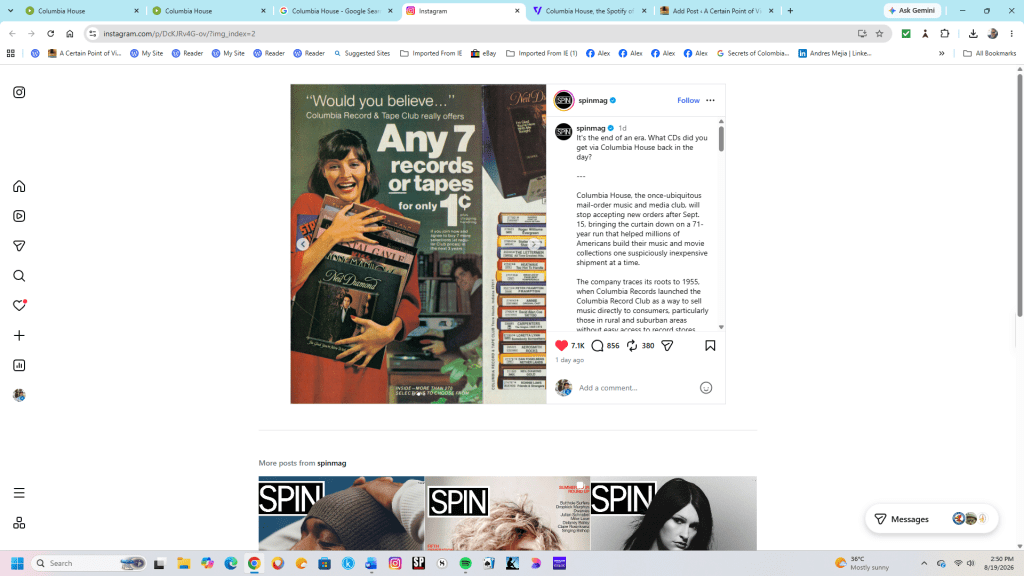
In its heyday, Columbia House Record Club, which was later rebranded as Columbia House Record and Tape Club and expanded into the home video market during the VHS and DVD era, enticed prospective members with such offers as “seven records or tapes for one penny – plus shipping and handling” when they signed up.
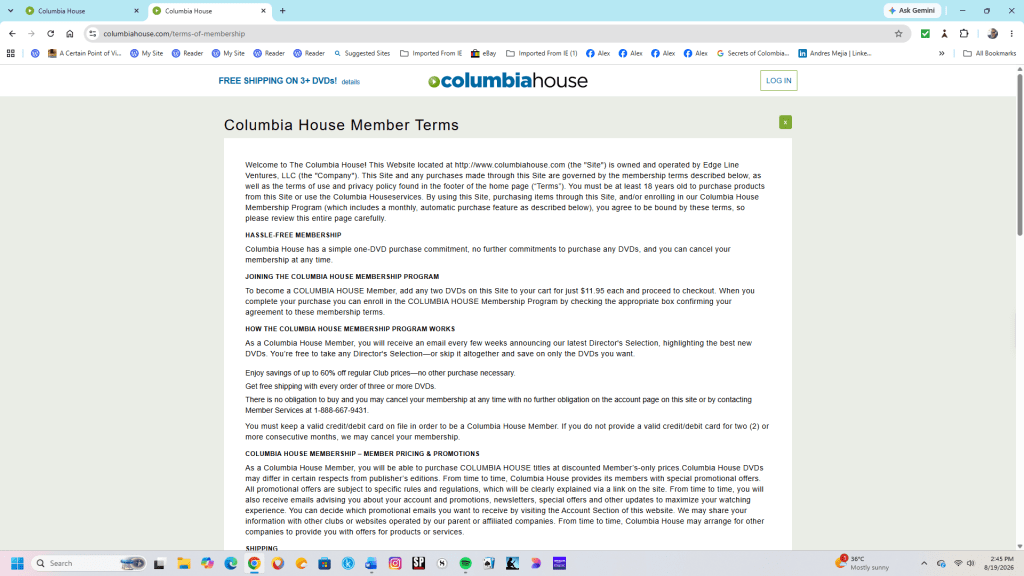
The catch, of course, was that membership came with obligations. You had to buy a certain number of albums—seven, if I recall correctly—within a fixed three-year period. Every month, Columbia House sent either an order form with the Club’s featured recommendation or a catalog of available titles. You could accept the monthly pick, choose something else, or decline that month’s selection altogether. But the burden was on you: if you forgot to mail the form back by the deadline, Columbia House treated your silence as consent and shipped the Album of the Month anyway. That was the famous—and infamous—negative option system in action.
I was a Columbia House customer twice – once as a junior high school student in the late 1970s during my vinyl and eight-track tape phase, and then again when the company branched out into the home media market and sold VHS tapes. I remember getting eight-track editions of Inside Star Trek, the soundtracks to Star Wars, 2001: A Space Odyssey, and Superman as part of my obligations to the Club; later, in the early 1990s, I shared a membership in Columbia House’s Video Club with my childhood friend Richard de la Pena. (He was the actual member of the club, but I would have him order a few titles a year until we had fulfilled the contract’s conditions and agreed to not continue the subscription.) I don’t recall now what my last order was, but I do remember my first – 1990’s The Hunt for Red October.
Columbia House changed ownership several times after I last ordered a VHS tape through Richard. Columbia Records sold the brand to competitor BMG in 2005. A few years later, BMG sold it to Najafi Companies, a private investment group, which rebranded the business as Direct Brands and eventually stopped selling music albums entirely, focusing instead on DVDs and Blu-rays.
I’m not surprised to see Columbia House vanish; in an era where streaming is remorselessly reshaping the way we consume audiovisual media and eclipsing older, physical media (even though streaming is no panacea), the company was obviously struggling to remain both relevant and profitable.
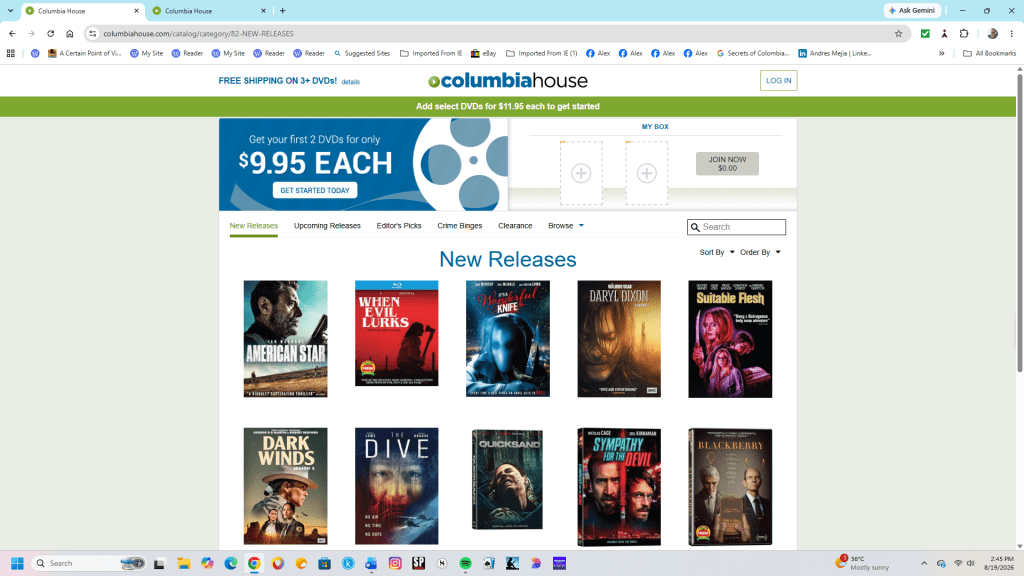
And judging from the few products still in stock on the Columbia House website, the once-mighty club was clearly on its last legs. The DVD category includes such titles as It’s a Wonderful Knife, The Angry Black Girl and Her Monster, American Star, and Suitable Flesh—not exactly the sort of deep, irresistible catalog that once made Columbia House feel like a gateway to abundance.
I am, though, a bit melancholic. Not because I loved Columbia House’s negative-option billing practices—my mom and teenaged me certainly did not—or because I miss the joys of mailing away for things. Nowadays, Amazon Prime is faster, and purchases are not made under pressure from a contract that punishes forgetfulness. But for me and many others who came of age in the 1970s, ’80s, and ’90s, the Columbia House Record and Tape Club was part of our cultural landscape for more than half our lives.
Maybe that is why Columbia House’s disappearance feels less like the loss of a company than the closing of a small, oddly complicated ritual. It was not always consumer-friendly, and it certainly belonged to a slower, more cumbersome world. But it also belonged to a time when discovering music or movies required catalogs, patience, memory, and a little bit of risk. For better or worse, Columbia House taught us that anticipation was part of the experience. And like so many things from that analog age, it now survives mostly as a story we tell, a punchline we remember, and a penny offer that seemed, for one brief shining moment, too good to pass up.
And now, like eight-tracks, Columbia House catalogs, and the little order forms we once had to mail back before a deadline, it is fading off into the Land of Ago.


Share your thoughts with the world!