

The Jock vs. Nerd Rivalry I Refuse to Write — And How Reunion: Coda Subverts It
Some high‑school tropes never die. They show up in movies, TV shows, YA novels, and even adult fiction: the artsy, awkward kid pining for the girl; the confident quarterback who already has her; the rivalry that becomes the story’s emotional engine. It’s familiar, it’s easy, and it’s usually false.

I’ve never liked that trope. Not when I was a teenager living through the real thing, and not now as a writer. It flattens people into archetypes. It turns the girl into a prize. It turns the boys into combatants. And it pretends that adolescence is a battlefield instead of what it really is: a fog of insecurity, longing, misinterpretation, and emotional guesswork.
In Reunion: Coda, I decided to confront that trope head‑on — first by setting it up exactly the way readers expect, and then by quietly dismantling it.
Setting Up the Trope: Jim Garraty vs. Kenny Garcia
Early in the story, Jim and Marty, who are singers in South Miami High’s choral groups, are talking after their first concert when the moment is broken by “the sound of heavy footsteps pounding on the carpeted floor.” Three JV football players approach, forming a triangle around their leader — Kenny Garcia.
Jim recognizes him instantly. Kenny isn’t hostile, but he’s territorial. He puts a hand on Marty’s shoulder and greets her with a casual, possessive “Hi, babe.” He kisses her forehead. He kisses her on the lips. He squeezes her shoulder while talking to Jim, a gesture meant to be affectionate toward Marty but dominant toward the boy standing beside her.

Jim tries to stay cool, leaning back against the wall, clutching his travel bag. He asks if Kenny watched the show. Kenny replies that he wouldn’t have missed Marty’s first concert “for anything in the world.” Then he turns to Jim and says he liked the number with the sailor hat — the one Jim identifies as “‘There Is Nothing Like a Dame,’ from South Pacific.”
It’s a small exchange, but emotionally loaded. Jim feels jealousy, intimidation, and disappointment. Marty looks embarrassed. Kenny leads her away by the hand, flanked by his two teammates, leaving Jim alone with his thoughts.
It’s the perfect setup for the cliché: The jock has the girl. The nerd wants her. The rivalry is born.
Except it isn’t.
Jim doesn’t vow revenge. He doesn’t imagine himself “winning” Marty. He doesn’t even resent Kenny in any operatic way. He just hurts — quietly, realistically, the way teenagers actually hurt.
That’s the first crack in the trope.
The Subversion: The Rivalry Was Never Real

Later in Coda, the school newspaper runs a short article about Kenny Garcia’s transfer to Southridge Senior High. It’s written by the Sports Editor — Alejandro de Grande — and it’s wonderfully mundane. No drama. No mythology. Just facts.

The article notes that Kenny was the backup quarterback, not a star. He completed 12 of 18 passes for 145 yards and two touchdowns — respectable numbers, but hardly the stuff of legend. It mentions that he transferred because he was dissatisfied with his limited playing time. It hints at possible disciplinary issues. It quotes the Athletic Department head wishing him well and the coach expressing confidence in the remaining roster.
In other words, Kenny wasn’t the unstoppable force Jim imagined. He wasn’t the golden boy. He wasn’t the rival Jim built up in his head. He was just another teenager trying to find a place where he felt valued.
The rivalry existed only in Jim’s imagination.
That’s the heart of the subversion.
The trope depends on the jock being a symbol — the embodiment of everything the nerd isn’t. But Kenny Garcia is a human being, not a symbol. He’s not the villain of Jim’s story. He’s not the obstacle to Jim’s happiness. He’s not even thinking about Jim.
The “rivalry” collapses under the weight of adulthood and perspective.
Why I Chose This Approach
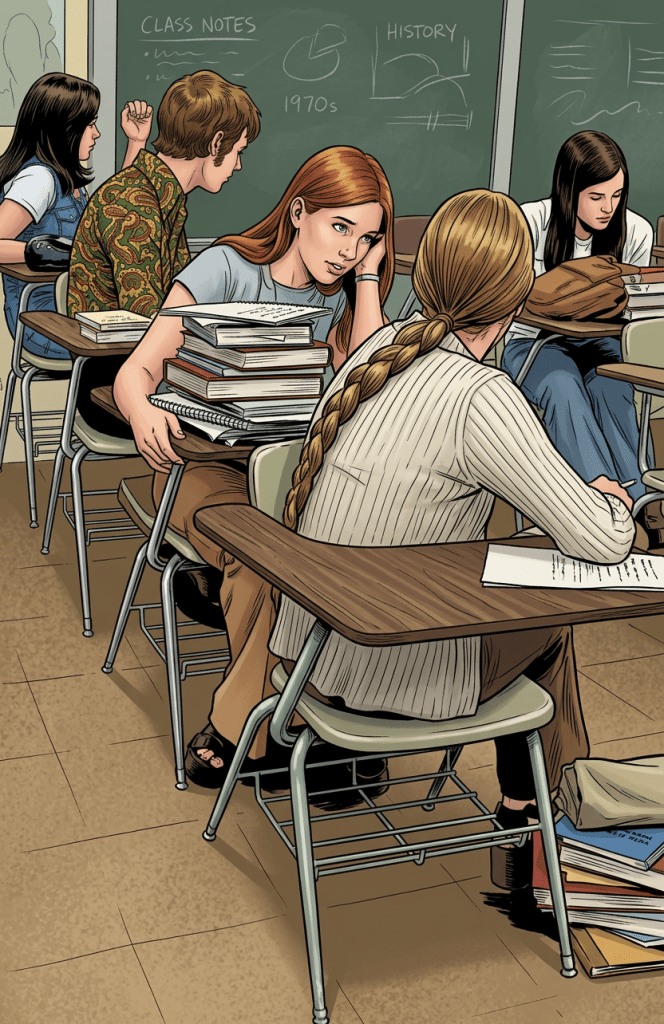
High school feels mythic when you’re living it. Every crush feels epic. Every humiliation feels permanent. Every perceived rival feels larger than life. But adulthood shrinks those distortions back to human scale.
I wanted Reunion: Coda to honor that truth.
By presenting Kenny first through Jim’s teenage eyes — and then through the neutral lens of a school newspaper — I let readers experience the collapse of the trope in real time. The “jock vs. nerd” dynamic dissolves under the weight of perspective. What felt like a defining conflict becomes, in hindsight, a misunderstanding shaped by insecurity and youth.
This is the kind of subversion I enjoy writing: not clever for its own sake, but honest. It respects the characters. It respects the readers. And it reflects the way memory actually works.
Closing Thoughts
I don’t write stories where the girl is a trophy and the boys are combatants. I write stories where teenagers misread each other, misread situations, and misread themselves — and where adulthood finally reveals what was really happening.
In Reunion: Coda, the jock vs. nerd rivalry isn’t defeated. It simply evaporates when exposed to the truth.
If you want to see how that plays out on the page, you can read Reunion: Coda and revisit the moments that once felt mythic — and now feel human.



Share your thoughts with the world!