
Monday, October 5, 2026 – Orlando, Florida

Hi, everyone.
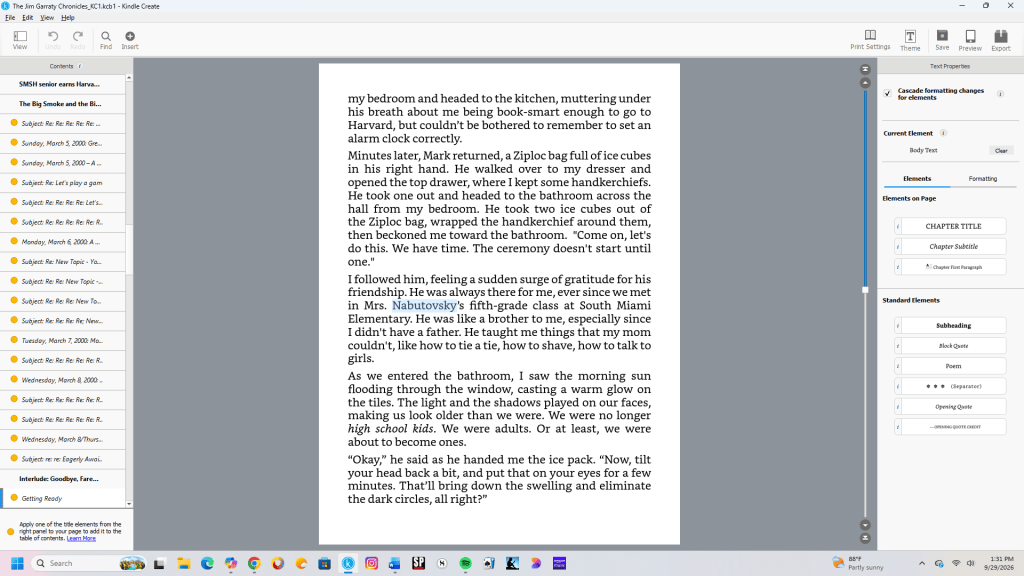
It’s Monday—again. The day that arrives with the punctuality of a tax bill and the enthusiasm of a damp dishrag. For most people, it’s the start of the work or school week. For me, it’s the day I march back into the first few pages of And the Horse You Rode in On, armed with a wireless keyboard, a can of Coke, and the faint hope that maybe—just maybe—this time the manuscript will behave.
Today’s mission: evaluate the opening chapter, decide what still works, and figure out which parts need to be escorted off the premises with a polite but firm “thank you for your service.”
Sounds simple, right? Basic CRW‑2001 stuff, as my younger self would have said back in 1987—the year I first wrote about Jim Garraty for a class assignment and accidentally launched a literary universe that would follow me around for decades like a loyal but occasionally mischievous pup.
In theory, this should be a straightforward exercise: identify the “wrong” information about how Jim—age ten, wide‑eyed, and blissfully unaware of future continuity headaches—meets his best friend, Mark Prieto, years before either boy sets foot inside South Miami Senior High.
In the current draft, Jim’s mom, Sarah, sends him down the block to deliver recipe cards to Dale Prieto. It’s the summer break before the 1975–76 school year, the neighborhood kids are home, and voilà—Mark is there. A perfectly plausible setup. Charming, even. I liked it enough to write it with gusto.
And honestly? It is well‑written. The character beats land. The dialogue feels right. The setting hums with mid‑’70s South Florida atmosphere. It’s the kind of scene you finish writing and think, “Hey, that’s not bad. Maybe I can do this writing thing.”
But then—because the universe enjoys irony—I remembered that in Reunion: Coda I casually, almost flippantly, mentioned that Jim and Mark first meet in Miss Nabutovsky’s fifth‑grade class at South Miami Elementary. Not in the summer. Not over recipe cards. In school. During the 1975–76 academic year.
Stephen King once wrote, “Kill your darlings, even if it breaks your scribbler’s heart.” And oh, does it break mine. Because this isn’t a matter of replacing bad writing with better writing. It’s replacing good writing with correct writing. It’s swapping out a scene that sings for one that simply aligns with the facts.
A blink‑and‑you‑miss‑it detail. A single line. But it’s canon. And canon, once established, is like gravity: ignore it at your peril.
Stephen King once wrote, “Kill your darlings, even if it breaks your scribbler’s heart.” And oh, does it break mine. Because this isn’t a matter of replacing bad writing with better writing. It’s replacing good writing with correct writing. It’s swapping out a scene that sings for one that simply aligns with the facts.
So why bother? Why sweat the timeline when most readers won’t notice—or care?
Because continuity is a promise. Because the world of Jim Garraty is built on memories, history, and emotional truth. Because even tiny cracks in the foundation eventually widen. Because you will know. And because I will know—and once a writer sees a flaw, it’s impossible to unsee it.
Fixing the timeline matters for the same reason historical novelists obsess over the color of a 1943 ration book or whether a certain Miami street existed in 1975: the story deserves the respect of accuracy. Even if only five readers ever catch the discrepancy, those five matter. And so does the integrity of the world I’ve spent decades building.
So yes—this part of the story must be rewritten. Completely. Thoroughly. With a sigh, a wince, and a muttered “why did Past Me do this to Present Me?”
I can do it. I will do it. I just won’t enjoy it.
But that’s writing. And on this Monday—again—that’s the job.


Share your thoughts with the world!