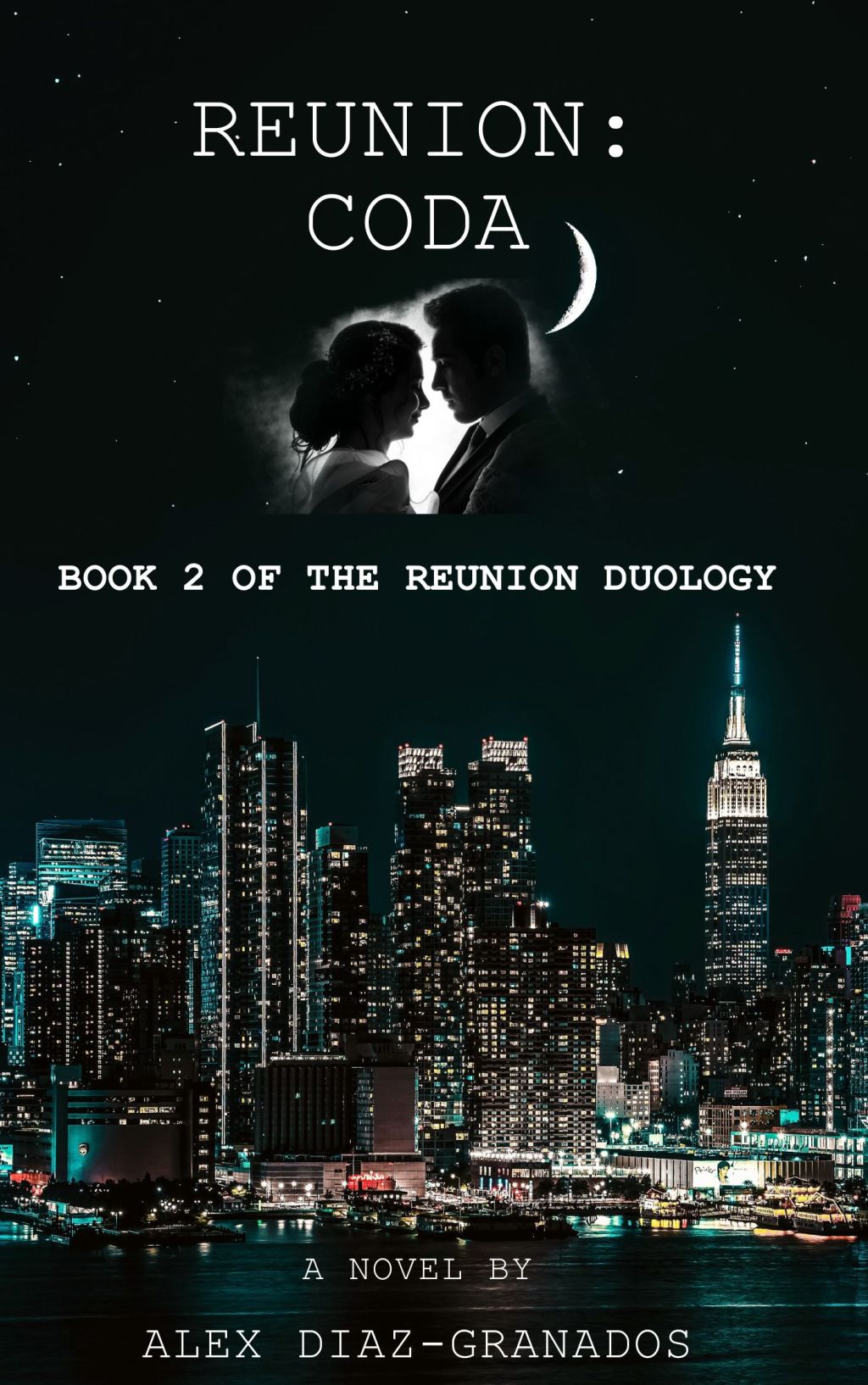

(C) 2025 Alex Diaz-Granados
By the time I began writing Reunion: Coda in the spring of 2023, I was facing an uncomfortable truth: this was my third attempt to write a novel since 2015 and my fourth attempt overall. Each previous project had stalled out somewhere between ambition and exhaustion. I knew I couldn’t afford to abandon another one. And yet the only way forward, the only way I could keep myself from walking away again—was to do the very thing I had resisted for twenty‑five years: return to the world of Reunion: A Story.
I had written that novella in 1998, self‑published it in 2018, and revised it again in March 2023, mere weeks before Coda began. But the more I tried to write something new, the more I realized I wasn’t done with Jim Garraty. Not really. Not emotionally. Not narratively. His pilgrimage to Martina Reynaud’s grave in 1998 had closed one chapter, but it had not closed him. If anything, it left a deeper question echoing in the silence: Why did Marty matter so much?
To answer that, I had to go back—back to Jim’s high school years, back to the origin of the wound, back to the girl whose absence shaped the man he became. The novel needed to move in two directions at once: forward, into Jim’s life after Miami, and backward, into the years when everything between Jim and Marty was still fragile, hopeful, and painfully unfinished.
Because a quarter of a century had passed since I first wrote Reunion: A Story, I knew I needed a Prologue that could bridge the gap between the two books—something that would orient returning readers, welcome new ones, and gently guide everyone into the emotional architecture of this expanded narrative. The four vignettes in the Prologue serve as that bridge, each one illuminating a different facet of Jim’s past.

This fourth and final vignette is the emotional keystone. It takes place on the last day of Jim’s senior year in 1983, half an hour after he said goodbye to Marty for what he believed would be the last time. It’s the moment when the weight of that goodbye finally breaks through his defenses—not in front of friends or teachers, but in the quiet, familiar safety of home, where his mother becomes the first witness to a heartbreak he will carry for decades.
Before you read it, I want to share something a reader once wrote about Reunion: A Story—a line that stayed with me as I wrote Coda, and one that captures the emotional truth at the heart of Jim and Marty’s story:
In this bittersweet story of the innocence and naivety of youth, the reader is transported back to his or her own high school days. We’ve all been Jim. We’ve all had our Marty.
That sentiment—raw, honest, and deeply felt—is the heartbeat of this vignette.
What follows is the moment Jim finally lets himself feel the loss.
“Did You Have a Good Last Day of School?”
I had just closed the front door and was shrugging off my heavy backpack, stuffed with my 1983 De Capello yearbook and a copy of A Bridge Too Far—my library companion after the last exam—when I heard Mom’s voice calling from the kitchen.
“Jim, is that you?”
I thought about quipping, “No ma’am, it’s President Reagan here to invite you to a White House dinner with Nancy and me!” But I was too drained for jokes, so I settled for, “Yeah, Mom, c’est moi.”
Mom stepped into the living room, wiping her hands on a towel. Her striking red hair, gray-green eyes, and freckled pale skin gave her the timeless presence of someone equally at home in a Norman Rockwell painting or a Van Morrison ballad. From the mouthwatering aroma wafting through the air, it was obvious she was making lasagna. It was her special occasion dish—a tradition for birthdays or, once, the candlelit dinner I shared with Kathy at the tender age of fifteen.
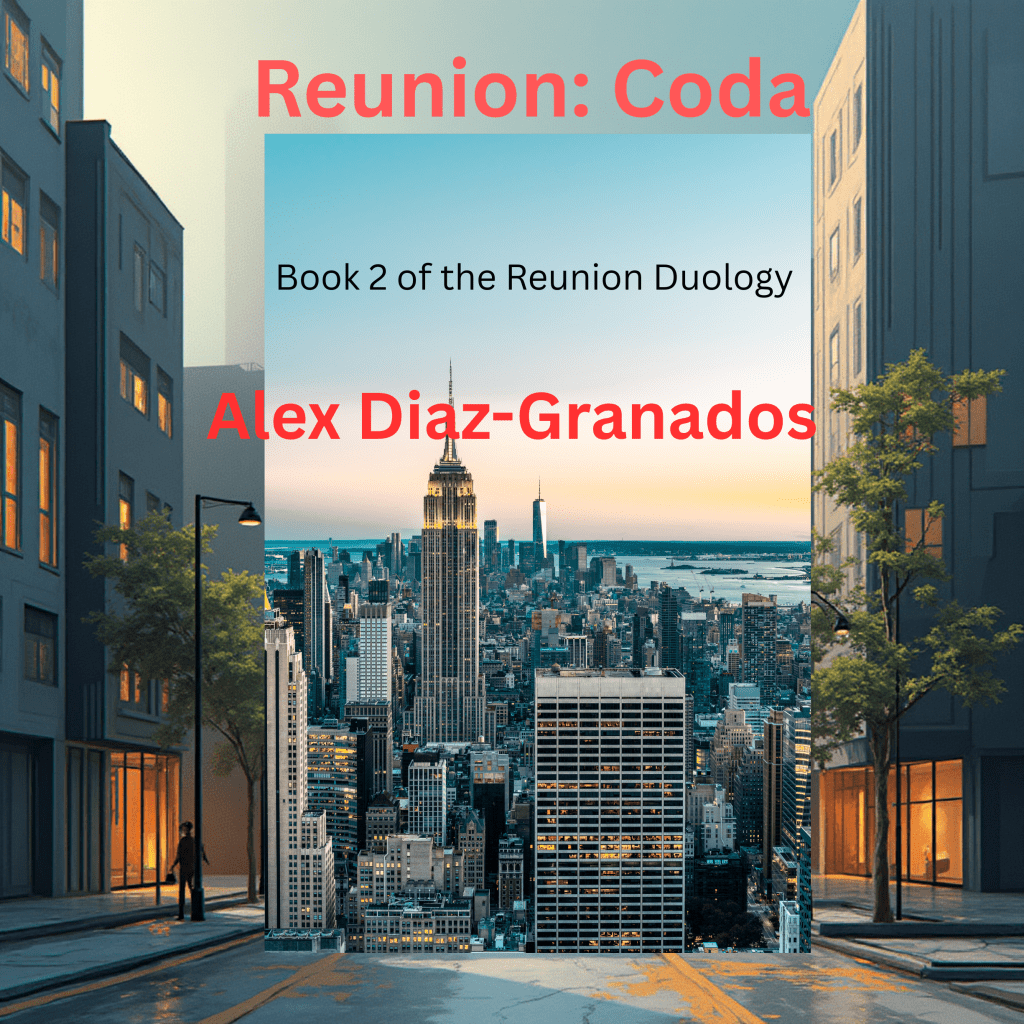
Audible edition cover created by Alex Diaz-Granados
The thought of Kathy—or Cherry, as her name demanded—brought an unwelcome flood of memories. Her betrayal had stung worse than lemon juice in a papercut, an emotional disaster on par with Operation Market-Garden. I shook my head and pushed the thought aside, focusing instead on plans for Saturday: seeing Return of the Jedi with Mark and the crew. A last hurrah before the unknown waters of adulthood.
“Did you have a good last day of school?” Mom asked, her voice warm with curiosity.
“It was okay,” I replied, dropping my backpack onto the couch. “I only had one final, remember?”
“In Economics, right?”
“Yep. I think I passed.”
Mom chuckled. “That’s because you studied. You study hard, you pass your tests. That’s how it’s supposed to work. Besides,” she added, “you’re a smart cookie. I knew you would ace it.”
“Aw, Mom,” I said. “I wouldn’t say I ‘aced’ it. But thanks for the vote of confidence.”
She gave me a quick hug and a peck on the cheek. “I think you aced it, Jim.” A pause. Then, with cautious curiosity, she added, “And the rest of your day? I know you didn’t ditch school.”
I shrugged. “It was okay. I took a nap in the library after the test, had lunch with Mark, and said goodbye to some of my teachers. I’ll say goodbye to most of my friends at commencement on Friday.” My voice wavered at the thought.

“Did you say goodbye to that girl you like?” Mom’s question was gentle, but it landed like a sucker punch.
Tears welled up, spilling over before I could blink them away. “Yes,” I said, my voice barely above a whisper.
In an instant, Mom closed the distance between us, wrapping me in her arms. She held me as I sobbed, her hand gently patting my back in the comforting rhythm of my childhood. “Oh Jim,” she murmured, her voice full of love. “Maybe you’ll see her again someday. Life has a funny way of bringing people back together.”
I shook my head stubbornly. “No, Mom. I might see Marty at graduation, but after that…”
A fresh wave of tears silenced me.
Mom brushed my tears away. “Oh, kiddo, I know it hurts like hell right now. I was young and in love when I was your age, too, you know. And I know that you don’t want to hear this—or believe it, for that matter—but you might see Marty again someday. And if you don’t, there will be other women. You’ll see.”
I don’t want any other women, I thought petulantly. I didn’t say it; I knew it was a childish and churlish thing to say, especially when Mom was only trying to assuage my feelings of anger and despair at the unfairness of it all. I kept the thought to myself, but I didn’t shake it out of my mind either.
“Look, James Garraty,” Mom said, half-sweetly, half-stern. “Life isn’t always fair. And all right, I don’t have all the answers, and maybe I shouldn’t have said you’ll see Marty again after Friday’s ceremony. I know you feel like this is the end of the world for you, just like you did when you broke up with Cherry a couple of years ago. But believe me when I tell you that you’ll get over it. Maybe not completely, but you’ll see. Time heals all wounds, Jim. Try to believe that.”
Yeah, right, I thought sourly even as I finally stopped blubbering like a little kid. Still, I knew Mom really believed that, even if I did not. Mustering all my willpower, I managed to give my mother a wan smile. “Thanks, Mom,” I said quietly. “I love you.”
“I love you, too, Jim,” she said as she let me go and patted the wrinkles from her floral print dress. “Now, go wash up—take a shower if you like. It might make you feel a bit better. Dinner won’t be ready for an hour anyway.” And with that, she walked with quick steps back to the kitchen, where the tasks of making lasagna were easier to manage than the topsy-turvy emotions of a heartbroken 18-year-old boy.
What Readers Say
Pooja
5.0 out of 5 stars Loved it!
Reviewed in Canada on June 7, 2025
Format: Kindle
Verified Purchase
Firstly, the writing was excellent. I felt drawn in from the moment I began reading and I think it helped that I was already familiar with the characters. I appreciate that his writing is incredibly intelligent and well done without crossing the line into being pretentious.
I thought the themes that Alex Diaz-Granados chose to explore were very meaningful. Lost love, loss in general, being stuck in the past/memories of the past are things we can all relate to.
I really enjoy the way Alex creates characters because they very much feel like real people. They have flaws and they have redeeming qualities just as most of us do.
I won’t go into the details of the plot because with books like this one giving away too much can ruin the experience for other readers. But I will say there are some beautiful moments, some heavy moments, some thoughtful moments, and most importantly the plot deals with the complex nature of relationships that humans have with one another. We crave love, social interactions and connections, yet when we achieve them, things are often more complicated than we realise.
Overall, I very much enjoyed Reunion: Coda by Alex Diaz-Granados. I had high hopes for this book and he delivered. If you enjoy a poignant, thoughtful and well written book- this one is for you. I highly recommend it. And if you haven’t read the first book in the series, please do as it will help you understand the plot of this one much better.


Share your thoughts with the world!