All the Things She Taught Me
Tuesday, July 7, 2026, Orlando, Florida
On this exquisitely hot July afternoon in Central Florida, I find myself thinking about the lasting impact truly great teachers have on our lives—and how even the smallest things can bring their memories back. That feels especially true as we grow older, and more poignant still when we learn of their passing.
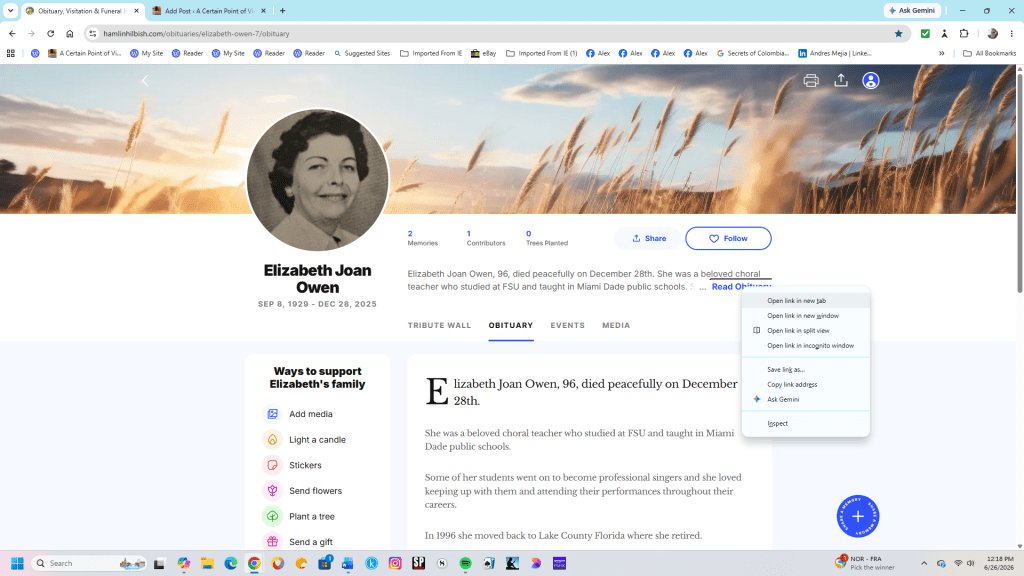
If you’re a regular visitor to this space, you may recall that not long ago I learned Ms. Elizabeth Joan Owen—my chorus teacher from January 1981 to March 1983—had died on December 28, 2025, at the age of 96. I suppose the news was not entirely unexpected. When I searched the Web for her in late June, I guessed she was likely in her eighties or nineties, so finding an obituary seemed a real possibility.
Still, there is a vast difference between intellectually understanding that a teacher I last saw more than 43 years ago might no longer be alive and seeing the fact confirmed in black and white. The obituary, accompanied by an old 1960s-era faculty photograph, said that Ms. Owen had died peacefully at 96. Even so, the news hit me like a punch to the solar plexus. More than a week later, I’m still not quite over it.
But I don’t want this to become another post about Ms. Owen’s passing. Her death, of course, has colored everything I have written about her lately; it would be dishonest to pretend otherwise. Once you learn that someone who helped shape you is gone, memory changes its pitch. The past does not become less real, but it does become more fragile, more precious, and sometimes more insistent.
What I find myself wanting to write about instead is the strange and lasting afterlife of a teacher’s influence. I am, after all, a man who grew up in the 1960s, 1970s, and 1980s, which means I came of age surrounded by the popular music of those decades. Rock, disco, New Wave, synth-pop, MTV, Top 40 radio—all of it was part of the atmosphere. And yet, somewhere along the way, I became the sort of person who is far more likely to listen to classical music, choral ensembles, movie scores, Broadway cast recordings, and standards than to whatever happens to be passing for popular music in 2026.
That is not meant as a scolding judgment on the present. Every generation has its own noise, its own rhythms, its own private language. The music of 2026 is simply not, for the most part, the music I reach for when I want company. More often than not, I find myself drawn to older melodies, to carefully shaped lyrics, to harmonies that invite rather than assault, to songs that seem to have been built to last beyond the mood of the moment.
And sometimes, without warning, a song will surface that reminds me just how long Ms. Owen’s influence has been echoing in my life. I fell in love with “All the Things You Are” and “It Was a Very Good Year” well into my fifties—thirty or more years after my stint in chorus. Yet even now, when I sing them quietly at home, I can hear the faint residue of her instruction: the insistence on phrasing, the attention to breath, the belief that a song’s emotional truth lives in how you carry the line. She once thought I might be able to sing “It Was a Very Good Year” in a Spring Concert. I never did, but the idea stayed with me, tucked away like a small vote of confidence I didn’t fully appreciate at the time.
Would Ms. Owen be pleased by that? I cannot know, obviously. I can only imagine the possibility. I like to think she might smile at the thought of one of her former senior high students—now much older than she was when she taught him—still finding pleasure in melody, still trying to respect the shape of a song, still choosing standards when there are easier and flashier things to sing.
I also wonder what she would have made of Mrs. Quincy, the chorus teacher who appears in two of my stories and who is, in many ways, modeled closely on her. Fiction gives us permission to rearrange the furniture of memory, but it does not erase the source. Mrs. Quincy is not Ms. Owen, not exactly. She belongs to the stories. Still, the cadence of her authority, the seriousness with which she treats music, and the sense that she sees more in her students than they see in themselves all owe a debt to the real woman who once stood in front of a chorus class and expected us to do better than merely get through the song.
Maybe that is why her death has stayed with me so stubbornly. It is not only grief, though grief is part of it. It is recognition. Some teachers do more than teach a subject; they leave behind a way of hearing, a way of noticing, a standard by which certain things are measured. In my case, Ms. Owen helped attach music to memory, discipline to feeling, and beauty to the act of paying attention.
So no, this is not simply about the fact that Ms. Owen died. It is about the curious fact that, decades later, she remains present—in the songs I still choose, in the stories I have written, and in the part of me that still believes a well-sung line can carry more feeling than ordinary speech. If that is part of her legacy, then it is a quiet one. But quiet legacies are often the ones that last.


Share your thoughts with the world!