
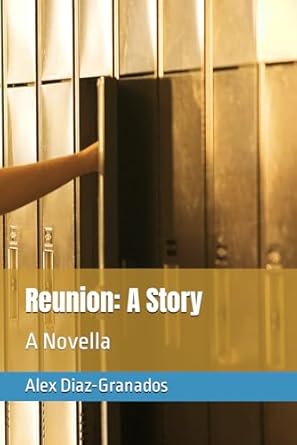
When I finally sat down to write my first serious work of non-genre fiction since my college creative-writing class, the plan—if I’m being generous enough to call it one—was simple: tell the story of a high school romance that never quite got off the ground.
As I’ve explained elsewhere—including in a behind-the-scenes interview two years ago—the idea arrived in the fall of 1998, a few weeks after South Miami High School’s Class of 1983 held its 15-year reunion. I couldn’t afford to go, which left me with time for an uncomfortable realization: for all my talk about wanting to be a writer, I hadn’t drafted a story worth reading since dropping out of Miami-Dade Community College in December 1989. I had written plenty during those nine years, but most of it was business-related work for paying clients. Useful work, certainly—but not work I had written for myself.

Twenty-eight years later, I don’t recall why I decided to expand a short writing exercise from my CRW-2001 class—“Write a fantasy or dream sequence. Use concrete details!”—into what ended up becoming the novella Reunion: A Story. I seem to recall wanting to submit it to a contest sponsored by the Miami Herald’s now-defunct Sunday supplement, Tropic Magazine, but I’m not sure.
I do, however, remember feeling a sudden—if much-delayed—impulse to write a story. Any story, really—whether for a contest (and possible publication in Tropic) or simply for myself—as long as I wrote something.
As I explained in the foreword to The Jim Garraty Chronicles:
[In] 1987, I was twenty‑four, taking CRW‑2001 at Miami‑Dade Community College…. I didn’t want to write sci‑fi or high fantasy. At twenty‑four, my mind was on women and sex, not dragons or spaceships. So I wrote something…well, let’s call it NC‑17 and leave it at that.
Years later, when I revisited the assignment, I kept the frame story — Jim Garraty, high school, the idea of a dream — but I changed the dream itself. I toned it down to PG‑13, and in the process, I created Marty. She wasn’t in the original version. She wasn’t planned. She appeared because the story needed someone real, someone human, someone who could carry emotional weight without turning the dream sequence into a fantasy romp.

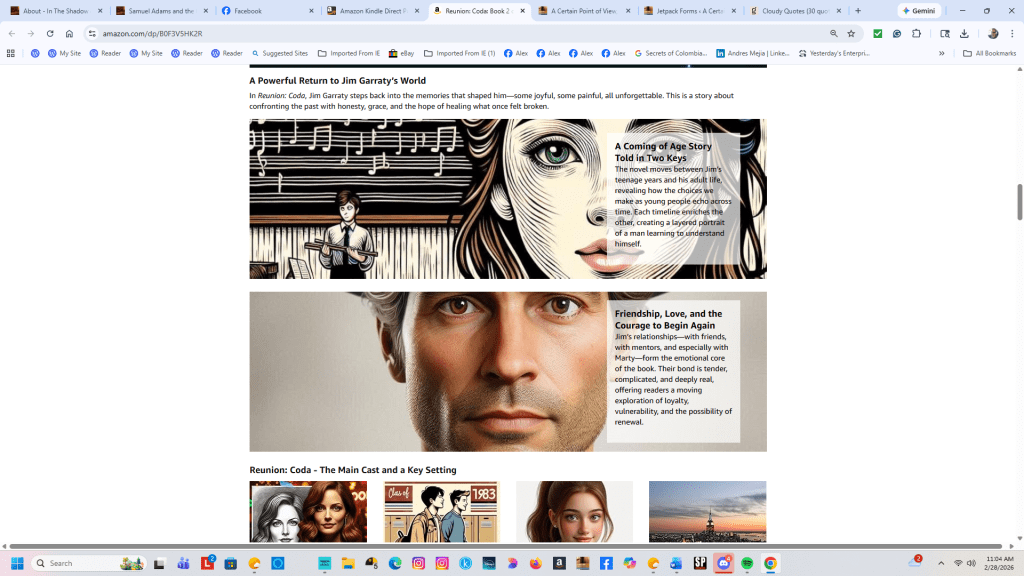
Marty’s arrival changed the trajectory of the story, but she wasn’t the only unexpected character who insisted on being heard. Once I began shaping Reunion into something more than a reworked classroom exercise, I realized that a story about a romance-that-almost-was couldn’t survive on longing alone. Jim needed someone to talk to—someone who was neither a love interest, a rival, nor a plot device. He needed a witness. He needed a counterweight. He needed a friend.

The school cafeteria was nearly as deserted as a ghost town. I sat alone at one of the outermost tables, picking at my lunch with little enthusiasm. It wasn’t that the food was awful – for cafeteria fare, the Salisbury steak wasn’t too bad, really. I wasn’t all that hungry. My headache was receding somewhat, but the emptiness of the school, the sense that this was going to a day full of finality (The final moments of the Class of ’83, crowed the last issue of The Serpent’s Tale) simply was a bit too much for my already overloaded emotional defenses. I picked up the plastic utensil known colloquially as a “Spork” and ate a few bites of Salisbury steak without enthusiasm, like a condemned man eating a last meal.
I heard a chair being pulled away from the table and felt, rather than saw, Mark Prieto’s presence.
“So, how are you, Jim?” Mark asked as he placed his lunch tray on the cafeteria table and sat down across from me.
“I’ve got a bit of a headache,” I replied without looking up from my half-eaten lunch. I picked at my Salisbury steak listlessly with my plastic Spork.
“How did your finals go?” Mark asked.
“I only had one test this morning – in economics. We didn’t have a test in chorus.” I looked at Mark, then at my Spork. A piece of Salisbury steak was impaled on its tines. Cold gravy dripped onto the tray with little wet splashing sounds. I put the plastic utensil on the tray. Suddenly I wasn’t very hungry anymore.
“Oh, yeah,” Mark said. I could almost see the proverbial light bulb clicking on above his head. “Mrs. Quincy left in March, didn’t she?”Mark was referring to the chorus director’s unexpected departure three months earlier; Mrs. Quincy had been offered the choral director’s position at the Juilliard School of Music. “It’s a once-in-a-lifetime opportunity,” Mrs. Quincy had said when she announced her decision, “and if there is anything I want you to learn from me is that you have to take advantage of these rare opportunities.”
I blinked with surprise when Mrs. Quincy’s words resounded in my mind. A snippet of visual memory flickered before me like an old newsreel: as our teacher was giving us an explanation of why she was leaving before the Spring Concert in May, I was gazing at Martina, who sat with the altos and sopranos across the chorus room from my seat in the bass section. She didn’t notice; she was paying attention to Mrs. Quincy. Our teacher’s announcement had caught us all unaware, and on Marty’s face there was shock and disappointment. I looked around the room; everyone had a stunned, what-are-we-going-to-do mien. Some of the girls wept unabashedly.
A substitute teacher, a semi-famous concert cellist named Mr. Abner, came to class the following day, and tried to keep things going. We dutifully attended class and tried to follow our routine of vocal exercises and practicing the last pieces Mrs. Quincy had selected for the Spring Concert, but our hearts were not in it. Some of the singers – the underclassmen, mostly – were so disheartened by Mrs. Quincy’s departure that they never sang another note and used their class time as an ersatz Study Hall. The seniors, including Marty and me, tried to keep things going as if by sheer willpower we could pull off one last concert before graduation. But with no real leadership from Mr. Abner and one-third of the class abstaining from even basic practice, it all fell apart. In the end, there was no Spring Concert, and we never sang another note on stage.
I sighed and shook my head to clear away this bitter memory. As I did, I realized how empty the cafeteria was. Only five tables were occupied.
“Hey, dude,” Mark said, “did you hear what I said?”
I looked at Mark dazedly. “Huh?”
He shook his head in irritation. “I asked you if Mrs. Quincy retired in March, man.”
“Oh. Yeah, in March.” This conversation was not improving my morale. I decided to change the subject. “Speaking of finals, how did you do?”
He looked at me and shrugged his shoulders. “Me? I think I passed algebra. I did okay in world history, even though you’re the brain in the topic.” He paused. “So, only one final, huh? Lucky dog.”
I looked at Mark blankly and shrugged noncommittally.
“So, are you gonna stay here till 2:30, or are you gonna go to the beach?” Mark asked.
“I don’t know yet,” I lied.
Mark’s eyes narrowed. He knew I was lying, and he didn’t appreciate it. “Don’t bullshit me, pal. You’re going to stay – and you’re hoping you’ll get to see her before the final bell rings.”

That’s where Mark came in.
I didn’t create Mark because I needed comic relief or a sidekick or a foil. I created him because the emotional architecture of the story demanded a second pillar. Jim, by himself, was too inward, too reflective, too prone to drifting into memory and regret. Marty grounded him in the past, but she couldn’t anchor him in the present. She couldn’t challenge him, tease him, call him out, or—when necessary—pull him back from the edge of his own melancholy. She was a memory. Mark had to be the living presence.
And here’s where a Star Trek analogy becomes useful, even if it sounds like a reach at first. Jim Garraty needed what the other Jim—James T. Kirk—had: a Spock and a McCoy rolled into one. Not literally, of course. I wasn’t trying to write a sci‑fi pastiche or a pop‑culture homage. But I did need someone who could serve the same narrative function those two characters perform for Kirk: the voice of reason and the voice of emotion, fused into a single, believable human being.
Spock and McCoy work because they represent two halves of Kirk’s internal struggle. Spock is logic, restraint, the part of Kirk that wants to think before acting. McCoy is intuition, empathy, the part that feels first and rationalizes later. Kirk needs both because he is neither extreme; he’s the synthesis. Without them, he becomes unbalanced—too impulsive or too detached.
Jim Garraty, in his own quiet, grounded, non‑spacefaring way, needed the same thing.
Mark became the character who could say the things Jim wouldn’t say, admit the truths Jim avoided, and offer the perspective Jim didn’t have. He could be blunt without being cruel, funny without being flippant, supportive without being saintly. He could challenge Jim’s assumptions about Marty, about high school, about adulthood, about the stories we tell ourselves to survive the years between who we were and who we became.
Most importantly, Mark made Jim believable.
A story about missed chances and unresolved feelings can easily collapse under its own sentimentality. It can become wistful to the point of weightlessness. But male friendship—real male friendship, not the sitcom version or the YA-novel version—adds gravity. It adds friction. It adds the kind of emotional honesty that doesn’t come from romantic longing or nostalgic reflection. Mark’s presence meant Jim couldn’t hide inside his memories. He had someone who remembered the same events differently, who interpreted the same signals differently, who wasn’t afraid to say, “You’re seeing what you want to see, not what happened.”
That’s why the story grew beyond the romance-that-almost-was. Jim and Marty gave the tale its heart, but Mark gave it its spine.
And once I understood that, the story stopped being about a boy and a girl who almost dated. It became a story about how people carry their pasts, how friendships evolve, how memory distorts, how regret lingers, and how the people who know us best often understand our stories better than we do.
It became, in other words, a story worth writing.
A Reader’s Insight

In this sweet novella about teenage love, the reader is transported back to their high school days and all the feelings of awkwardness, self-doubt, and confusion. The author does an exceptional job of portraying the high school environment, teenage hopes and dreams, pubescent challenges and fears, and the complexities of interpersonal relationships. We all have memories of our first crush, that first tender kiss, and the innocence and purity of youth.
I found the story sad but endearing. Jim Garraty is a man filled with regret over his first love. When he discovers later in life that she has died in a car accident, he takes a walk down memory lane to relive the events. Written in the first person, the reader experiences firsthand all of Jim’s thoughts and inner conflict.
I enjoyed reading this heart-touching story and rate it five stars. – Dawn Pisturino


Share your thoughts with the world!