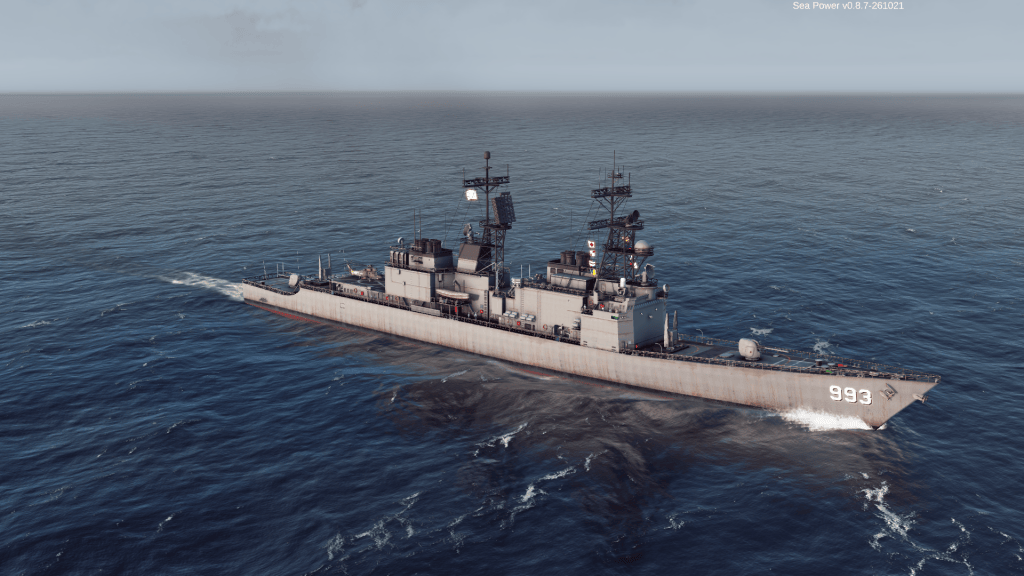
How I Finally Stopped Getting Torpedoed in Sea Power
Sometimes the best way to solve a tactical problem is not to shoot faster.
Sometimes it’s to stop steaming directly toward the submarine that would very much like to ruin your day.
I’ve been playing the Crossing the Line ’86 campaign in Sea Power: Naval Combat in the Missile Age, and after several attempts at its opening scenario, “Quarantine Line,” I finally figured out something that, in retrospect, seems embarrassingly obvious.
The trick isn’t to start the war.
The trick is to know where the dangerous stuff is before somebody else starts it.
Welcome to October 1986, Except Not Quite
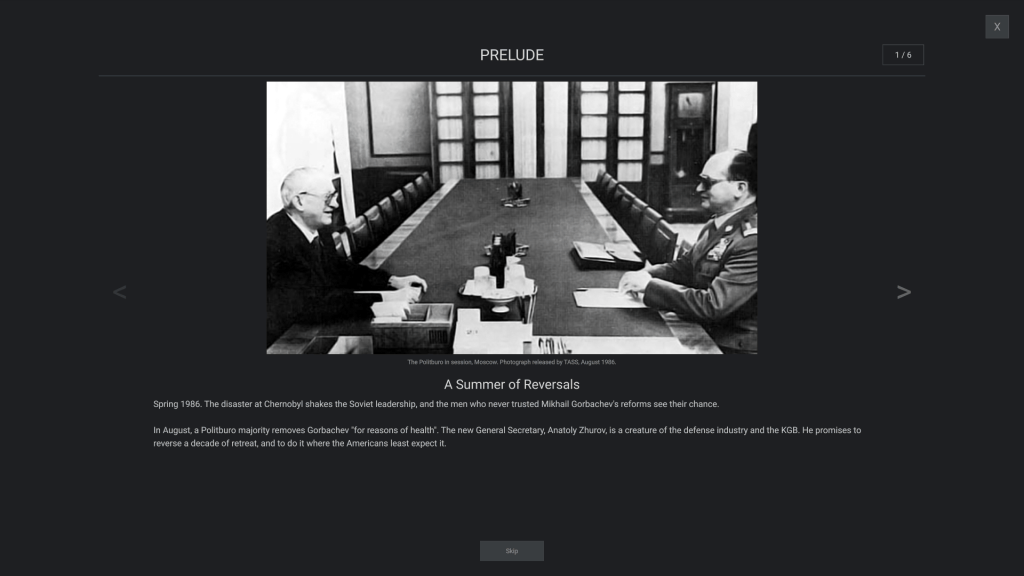
Crossing the Line ’86 takes place in an alternate version of 1986.
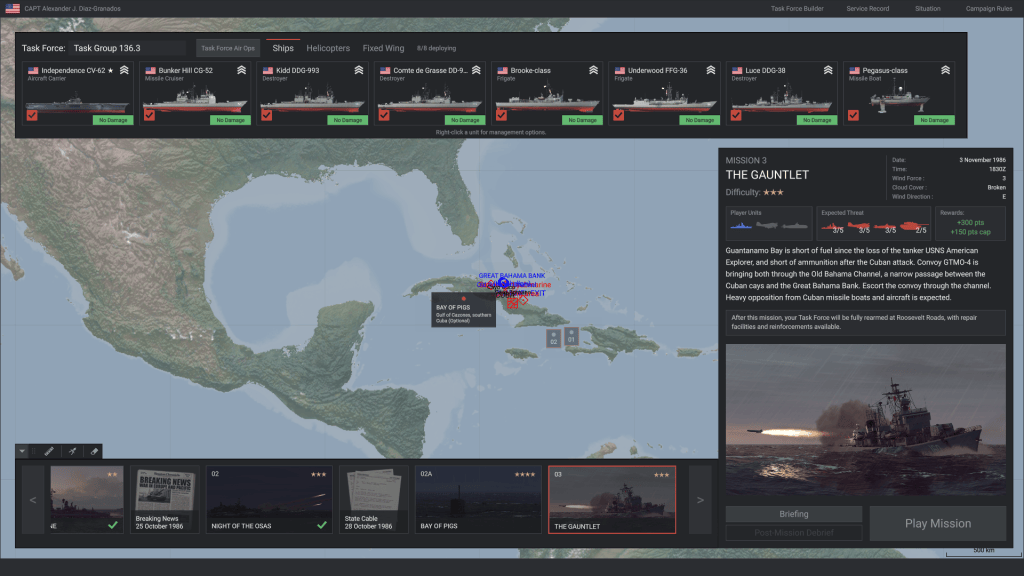
The campaign’s six-part prelude establishes the situation gradually. In the aftermath of Chernobyl, Mikhail Gorbachev is removed from power “for reasons of health,” and a harder-line Soviet leadership takes over. Moscow subsequently signs a treaty with Nicaragua and announces that MiG-23 fighters and SA-6 surface-to-air missile systems will be delivered there.
Washington has already stated that it will not tolerate those weapons in Central America.
The United States responds with a “defensive quarantine” of offensive weapons headed for Nicaragua, deliberately evoking the Cuban Missile Crisis of 1962. Task Force 136 is assembled to enforce it.
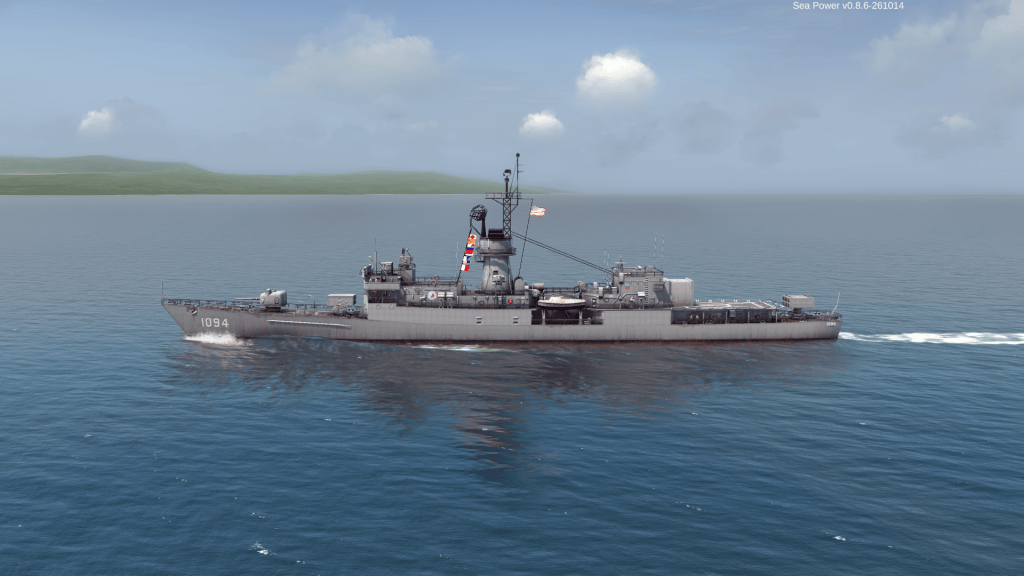
There is another complication. The campaign points out that the North Atlantic Treaty area ends at the Tropic of Cancer. Cuba, the Caribbean, and South Atlantic lie below that line. Meanwhile, major U.S. carrier forces are occupied farther north keeping an eye on a Soviet naval exercise.
That leaves the forces in the Caribbean with a rather unpleasant problem.
And I get command of one of them.
What could possibly go wrong?
Quite a Lot, Actually
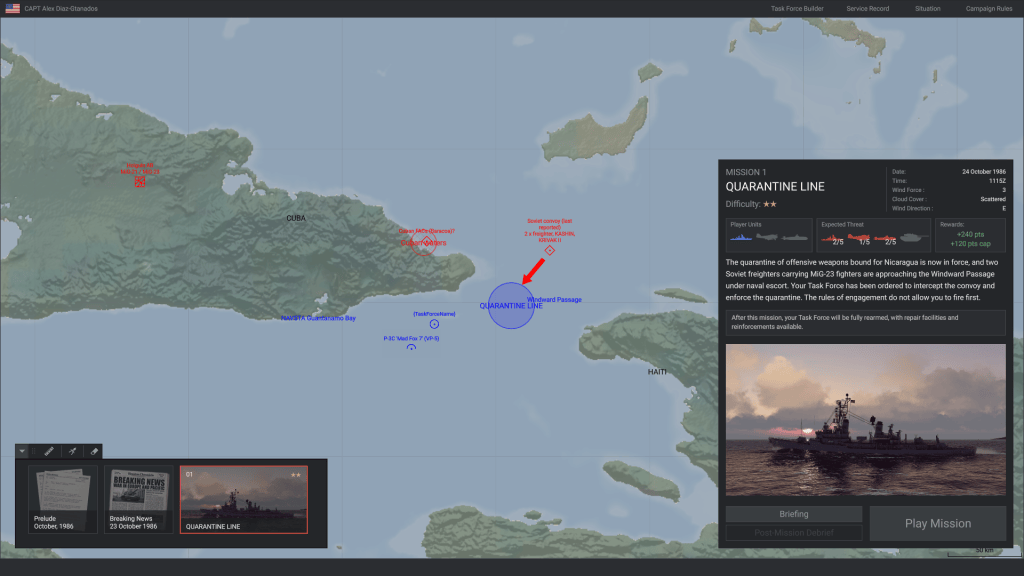
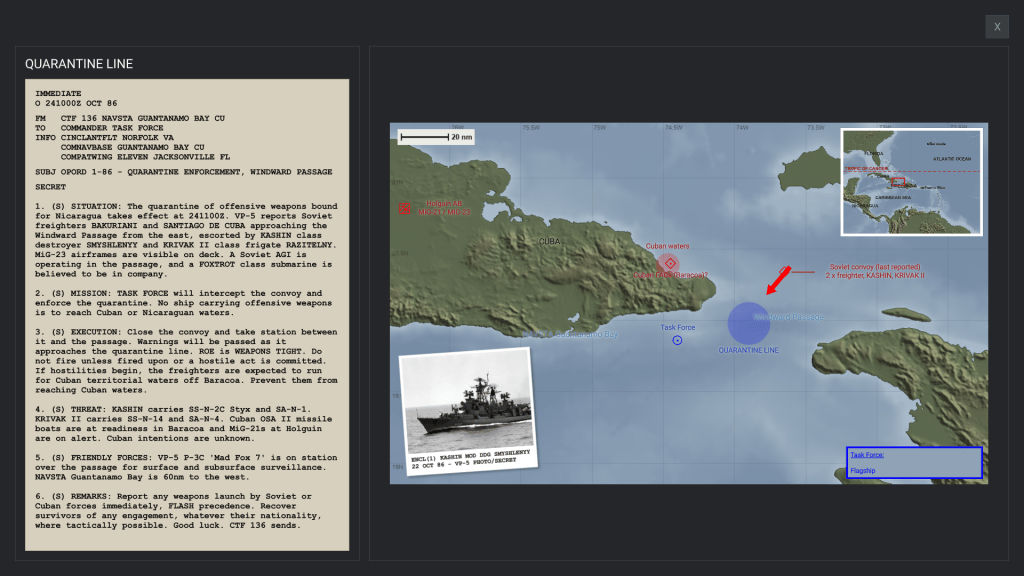
The opening mission puts my task force near Guantanamo Bay with orders to intercept a Soviet convoy approaching the Windward Passage.
According to the briefing, the convoy consists of two Soviet freighters escorted by a Kashin-class destroyer and a Krivak II-class frigate. Soviet MiG-23s are visible on deck aboard the freighters.
Oh, yes.
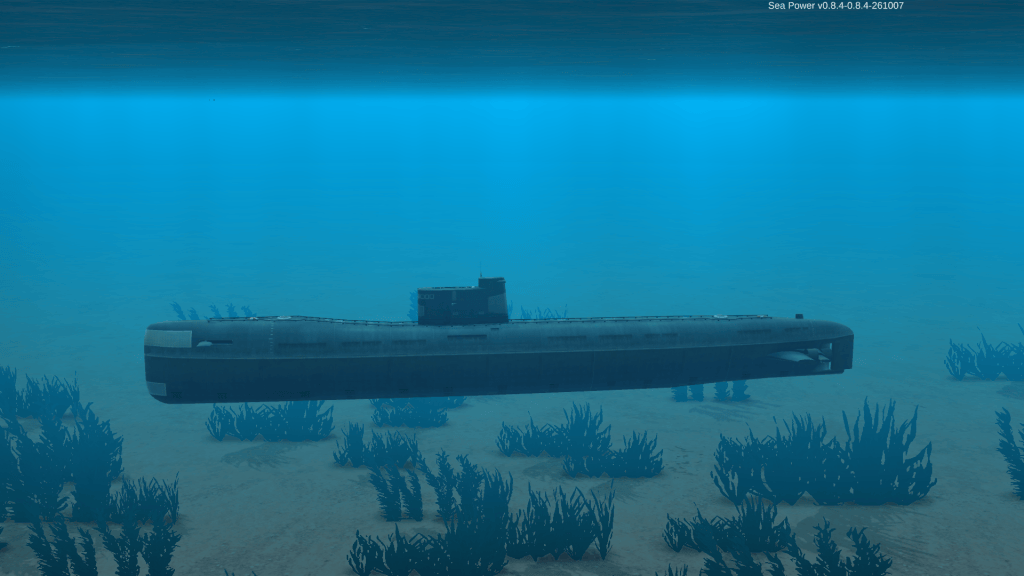
Intelligence also believes that a Foxtrot-class submarine is accompanying the group.
That’s important.
The mission gives me aerial antisubmarine support, including a P-3C Orion from VP-5, and tells me what I’m supposed to accomplish: intercept the convoy, enforce the quarantine, and keep those offensive weapons from reaching Cuban or Nicaraguan waters.
There is, however, a catch.
The Rules of Engagement are WEAPONS TIGHT.
I can’t simply look at the Soviet submarine, announce, “Yep, that’s probably going to be trouble,” and put a torpedo into it.
Until hostilities begin, those Soviet contacts are neutral.
And Sea Power will penalize you for killing wolves in neutral clothing.
My Original Brilliant Plan
In earlier attempts, I took a rather Kirkian approach to the situation.
The Soviet convoy was heading toward the Quarantine Zone.
My ships were there to stop it.
Therefore, I headed toward the Quarantine Zone myself.
This made perfect sense to me.
Unfortunately, somewhere beneath the Caribbean, a Foxtrot-class submarine apparently agreed that my plan was excellent.
For entirely different reasons.
The problem was that the Foxtrot was still neutral while I was moving my task force toward the confrontation. I couldn’t attack it merely because intelligence told me that a Soviet submarine was accompanying the convoy.
Then the shooting started.
And by that point the submarine had maneuvered into a very advantageous position.
On one playthrough, USS Kidd discovered the consequences of this arrangement courtesy of wake-homing torpedoes.
Apparently, my interpretation of Captain Kirk needed work.
Maybe Don’t Cross the Line?
Then I realized something.
I don’t have to enter the Quarantine Zone.
The Soviet convoy does.
That’s the entire point of the scenario.
So on my next attempt, rather than charge toward the line and play chicken with the Soviet surface ships, I altered course and kept my task force away from the zone.
Meanwhile, I had another problem to solve.
I knew there was a Foxtrot out there somewhere.
The scenario doesn’t necessarily hand me its exact position on a silver platter. So I started using the assets I’d been given for precisely that sort of job.
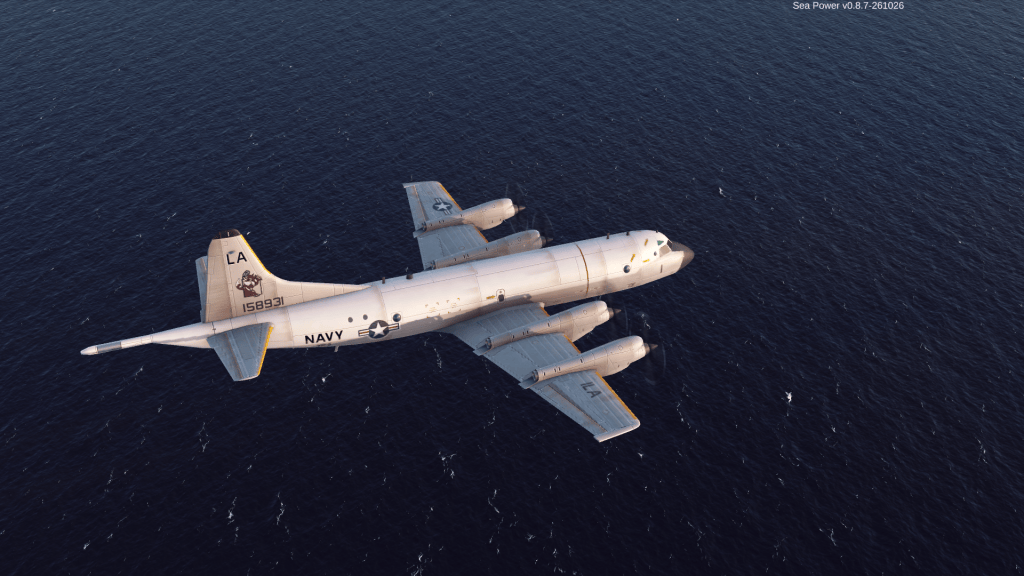
The P-3C went hunting.
So did my ASW helicopters.
And I started laying sonobuoy fields.
Lots of sonobuoys.
Once I detected and identified the supposedly “neutral” submarine, I marked its initial position on the tactical map and watched it as it moved through the sonobuoy network.
I still couldn’t attack it.
That was fine.
I didn’t need to.
I only needed to know where it was.
Patience, Grasshopper
This completely changed the scenario.
Instead of putting my ships in a position where the Foxtrot could stalk them while everybody remained officially neutral, I stayed out of its way and maintained surveillance.
Then I waited.
The Soviet convoy continued toward the Quarantine Zone.
Eventually, the lead Soviet warship entered it.
And that changed everything.
The neutral contacts became hostile. Hostilities had begun.
Except this time, I wasn’t suddenly entering a shooting war wondering:
Where’s that damned submarine?
I’d already done my homework.
I’d found it.
I’d tracked it.
I’d waited.
Now it was hostile.
At which point my priorities became beautifully simple:
Sink the Foxtrot first.
Changing the Conditions of the Test
The funny thing is that my solution wasn’t more aggressive than my earlier attempts.
It was less aggressive.
I hadn’t found a way around the Rules of Engagement. I hadn’t decided to shoot first and accept whatever penalty the game handed me. And I certainly hadn’t decided that every neutral Soviet contact was fair game because I, the player, knew that the scenario was eventually going to turn into a war.
Instead, I finally paid attention to what the scenario was telling me.
Intelligence warned me about the submarine.
I had maritime patrol aircraft and helicopters capable of looking for it.
My task force did not need to blunder into the probable submarine operating area merely because the Soviet convoy was heading toward the quarantine line.
Most importantly, finding a submarine is not the same thing as shooting at one.
So I changed the conditions of the test.
I let the Soviets cross the line.
And when the shooting started, I already knew where at least one particularly dangerous wolf had been hiding.
I don’t know whether Starfleet Academy would give me a commendation for original thinking.
But USS Kidd probably appreciates the revised doctrine.
Meanwhile, in the Shameless Commerce Division…

Before I return to the Caribbean, here’s one quick reminder for the readers who come here for books rather than sonobuoys:
My Kindle omnibus, The Jim Garraty Chronicles: A Life Told in Four Movements, is currently available free, but the promotion ends Friday at 12 AM Pacific Time.
If you’ve been curious about Jim Garraty and his journey through friendship, love, memory, loss, and second chances, this is a good opportunity to add the complete collection to your Kindle library.
And now, if you’ll excuse me, there’s a Foxtrot out there somewhere.


Share your thoughts with the world!