
How Pop Culture and Music Inform the Garratyverse
If you spend enough time inside the Garratyverse, you eventually notice something: Jim Garraty’s world doesn’t just contain pop culture and music—it breathes through them. Songs, films, TV shows, and the cultural noise of their eras aren’t background decoration. They’re emotional weather systems. They shape memory, mood, and meaning. They give the stories their texture, their temperature, and their pulse.
This isn’t nostalgia for nostalgia’s sake. It’s something more deliberate, more structural. Pop culture in the Garratyverse is a language—one Jim speaks fluently, sometimes without realizing it.
The Garratyverse as a Cultural Echo Chamber
Every story in the Garratyverse is set in a very specific cultural moment: 1977, 1981-1983, 1984, 2000. These aren’t arbitrary timestamps. They’re emotional coordinates.
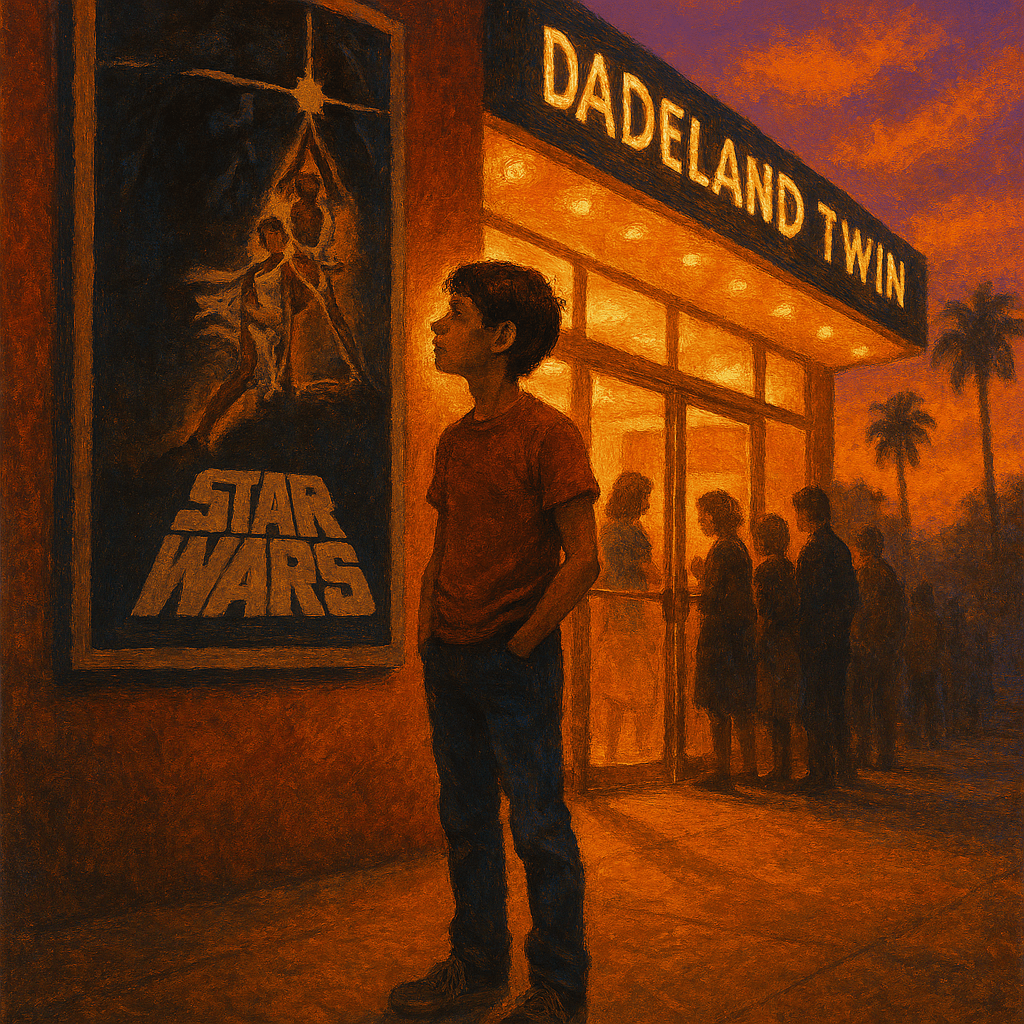
- 1977 is the summer of movies, of a boy discovering the power of stories on a screen.
- 1981–84 is the age of mixtapes, late‑night radio, and the ache of things left unsaid.
- 2000 is the cusp of a new century, where memory becomes both a refuge and a reckoning.
Pop culture becomes a shorthand for who Jim is at each stage of his life. What he watches, what he listens to, what he quotes—these are the breadcrumbs that lead us deeper into his interior world.
Music as Emotional Cartography
Music in the Garratyverse isn’t just soundtrack—it’s subtext.
Jim doesn’t say, “I’m lonely tonight.”
He puts on a record that tells you.
He doesn’t say, “I miss her.”
He hears a song that opens a door he thought he’d locked.
The Garratyverse uses music the way some writers use weather: to signal emotional shifts, to foreshadow, to underline what can’t be spoken aloud.
A few patterns emerge:
1. Songs as Memory Triggers
A melody can yank Jim backward in time faster than any plot device. A jazz standard, a Billy Joel track, a Leroy Anderson piece—they’re portals. They collapse decades into seconds.
2. Music as Characterization
Jim’s taste in music reveals his temperament: introspective, romantic, a little wounded, always listening for something beneath the surface.
3. Music as Narrative Rhythm
Scenes often unfold with the cadence of a song—slow, reflective, or quietly building toward a moment of emotional clarity.
And within this musical landscape, two strands stand out as especially important to the Jim–Maddie arc: the Great American Songbook and the heroic, emotionally transparent film scores of John Williams.
Why Standards and John Williams Cues Elevate the Jim–Maddie Arc
The Jim–Maddie relationship is built on emotional intelligence, shared vulnerability, and a kind of unspoken fluency in the emotional languages they both understand. For Jim, that language is film music and the Great American Songbook. For Maddie, it’s classical training, interpretive nuance, and the ability to hear the emotional architecture inside a melody.
When these two worlds meet, something quietly electric happens.
1. Standards give their relationship emotional lineage
The standards Jim gravitates toward—especially Kern & Hammerstein, whose “All the Things You Are” becomes a leitmotif in Reunion: Coda—are songs with emotional memory baked into them. They’re about longing, possibility, missed chances, and the ache of connection.
When Maddie plays or references these songs, she’s not just performing music. She’s stepping into the emotional tradition Jim has lived in his whole life.
A standard is a bridge:
- between eras
- between emotional vocabularies
- between who Jim was and who he’s becoming
It lets Maddie meet him on ground that feels familiar to him, yet elevated by her artistry.
2. John Williams cues reveal Jim’s inner child — and Maddie sees it
Jim humming the Superman march or lighting up at the Raiders fanfare isn’t nostalgia. It’s autobiography.
Those scores are the emotional DNA of his youth:
- optimism
- courage
- yearning
- the belief that goodness matters
- the sense that adventure is possible
When he unconsciously hums a Williams motif around Maddie, he’s showing her the boy he once was—the boy who stayed through the end credits because the music meant something.
And Maddie doesn’t laugh.
She recognizes it.
She understands that this is Jim’s emotional shorthand, his way of saying:
I feel safe enough with you to be unguarded.
3. Williams’ music gives their scenes a mythic undertone
The marches from Raiders and Superman aren’t just catchy themes. They’re musical embodiments of:
- heroism
- yearning
- moral clarity
- emotional sincerity
When Jim brings those cues into a moment with Maddie—even jokingly—he’s unconsciously framing their connection as something larger than life.
It’s not that he thinks he’s a hero.
It’s that he feels, for the first time in years, like he could be one.
4. Maddie’s musicianship reframes Jim’s pop‑culture heart
Maddie isn’t just a passive recipient of Jim’s references. She’s a classical musician who understands structure, harmony, and emotional subtext.
When she plays the Love Theme from Superman in Reunion: Coda, she’s doing something profound:
- validating Jim’s emotional language
- translating it into her own
- and offering it back to him with tenderness
It’s not just a performance.
It’s a confession.
5. Together, these musical choices make their arc feel inevitable
The standards give their relationship its emotional maturity.
The Williams cues give it its emotional innocence.
Together, they create a dynamic where:
- Jim feels both seen and safe
- Maddie feels both challenged and connected
- the reader feels the gravitational pull between them
The music becomes the invisible architecture of their bond—the thing that tells us, long before either character says a word, that these two people are tuned to the same emotional frequency.
Film as a Moral and Emotional Compass
Movies shape Jim’s worldview as much as any adult in his life.
In The Summer of Two Movies, cinema becomes his first language of longing and possibility. The films he watches don’t just entertain him—they teach him how to feel, how to hope, how to imagine a life larger than the one he knows.
By the time we meet him in Reunion, film references become a kind of emotional shorthand. When Jim compares a moment to something out of Casablanca, he’s not being cute—he’s revealing the lens through which he understands love, sacrifice, and regret.
Movies give him metaphors for the things he can’t articulate. They give him courage when he needs it and comfort when he doesn’t know he does.
Pop Culture as Emotional Atmosphere
The Garratyverse is not a world of big explosions or high‑stakes action. It’s a world of small, meaningful moments—moments that feel bigger because they’re framed by the cultural artifacts that shaped us all.
A song on the radio.
A movie poster in a theater lobby.
A TV show theme drifting from a living room.
A record sleeve worn soft at the edges.
These details don’t just set the scene—they are the scene. They’re the connective tissue between reader and character. They remind us of our own summers, our own heartbreaks, our own quiet epiphanies.
Pop culture becomes the shared vocabulary between author and reader. It’s how the Garratyverse says: You’ve been here too.
Why It Matters
The Garratyverse is ultimately about the interior life—memory, regret, longing, connection, the ache of silence. Pop culture and music give those interior states shape and sound. They make the intangible tangible.
They remind us that our lives, like Jim’s, are scored by the songs we loved, the movies that moved us, and the cultural moments that shaped who we became.
In the end, the Garratyverse isn’t just a fictional universe.
It’s a mixtape of a life.
A playlist of memory.
A cinematic scrapbook of what it means to be human.


 A Certain Point of View, Too
Share your thoughts with the world!